Best Automated Content Creation Tools for Paid Social Ads: 7 Compared
Seven tools that automate paid-social ad creative, grouped by the job they take off your plate (script-to-actor UGC video, link-to-ad, static ad sets, avatar video), each with a price or feature checked on the vendor's own page on September 21, 2026.

Mauricio Valdivia
·12 min

Your Ad Account Needs Ads, Not Blog Drafts
It is Monday, and the Meta account is tired. The five ads that carried last week have been shown to the same people again and again, and the cost per purchase has started to creep up. Nobody on the team needs a blog calendar. The account needs twelve new ads by Thursday.
That is the content this list is about. The phrase "automated content creation tools" covers everything from article writers to post schedulers, but for a paid-social team the content that runs out first is ad creative: short UGC-style videos, avatar videos and ad images. Each of the seven tools below automates part of making that creative. They are grouped by the job they take off your plate, not ranked, and every price or feature quoted here was checked on the vendor's own page on September 21, 2026.
The Short Answer: Seven Tools, Four Kinds of Automation
If you read one section, read this one. Each tool is matched to the job it automates and to the one fact we checked for it.
- Novoads turns a typed script and an AI actor into a UGC-style video ad, and a product photo into an ad image.
- Arcads pairs a library of 1,000+ AI actors with a workflow canvas that a whole team can build on.
- MakeUGC makes AI-creator UGC at volume, with Batch Mode on its Growth tier.
- Creatify turns a product link into a video ad, and its plan comparison lists an AI Performance Agent for Meta, TikTok and AppLovin.
- Higgsfield offers Click-to-Ad, which starts from a product URL and returns a video ad.
- AdCreative.ai makes static ad sets in every size and variation, and scores creatives before you spend on them.
- HeyGen makes avatar and spokesperson video, with integrations to n8n, Make, HubSpot and Zapier on its Business plan.
| Tool | What it automates | Entry price, Sept 21, 2026 |
|---|---|---|
| Novoads | Script to AI-actor video | Starter, $15/month |
| Arcads | AI-actor UGC, team canvas | Not quoted here |
| MakeUGC | AI-creator UGC in batches | Start up, $59/month |
| Creatify | Product link to video ad | Starter, $39/month |
| Higgsfield | Product URL to video ad | Not quoted here |
| AdCreative.ai | Static ad sets, every size | Starter, $39/month |
| HeyGen | Avatar spokesperson video | Creator, $29/month |
The price column is the entry paid plan each vendor's page printed that day, on monthly billing. Two cells are empty on purpose. Higgsfield's pricing page loads its plans in the browser, so a plain fetch of it returned no prices, and we do not quote a number we could not read. Arcads is described here by what its homepage and help centre show, not by a plan price.
What an Ad-Automation Tool Actually Automates
"Automated" is doing a lot of work in most tool lists. Before comparing vendors, it helps to split one ad into the jobs a tool could take over, because the seven here take over different ones.
The four jobs inside one ad
Making a paid-social ad is four jobs, and a tool can take any of them off your plate:
- The script. The hook, the claim, the call to action, and the five versions of the hook you want to test.
- The footage. A person talking to camera, a product scene or an avatar, instead of a shoot.
- The formatting. An aspect ratio for each placement, captions, and the same ad in other languages.
- The launch. Pushing the finished ads into the ad account and reading back which ones to cut.
In our reading, most of the tools here concentrate on the first three, and the fourth is where they differ most. It pays to read the plan page closely on that point. Creatify's plan comparison, for example, has rows for an Ad Launcher and an AI Performance Agent, each for Meta, TikTok and AppLovin. HeyGen's Business plan lists integrations with n8n, Make, HubSpot and Zapier.
Why credits are not a shared currency
Five of the seven tools here print a monthly credit allowance on the plan pages we could read (Novoads, Creatify, MakeUGC, AdCreative.ai and HeyGen), and those five do not spend credits by the same rules. Apps meter credits by clip length, by model, by resolution or by output type, and the mix changes from one app to the next. Our explainer on how AI video credits work goes through the mechanics.
That is why the table above lists prices and not credit counts. Two hundred credits in one app and a hundred in another tell you nothing about which one makes more ads you would actually run.
The comparison that holds: cost per usable ad = what you paid in a month ÷ the number of ads from that month you would put money behind.
To get that number, run the same brief through two or three tools inside one billing month and count the keepers. It is slower than reading pricing pages. It is also the one number in this post that is about your product.
Three questions that pick the tool
Most of the choice comes down to three questions, answered before you open a single pricing page:
- What do you start from? A script, a product photo or a product page URL. The script-to-actor tools start from words and a chosen face; Creatify, Higgsfield and AdCreative.ai can start from a link.
- Who needs to be on screen? A creator-style person holding the product, a presenter explaining it, or nobody at all.
- Where should the tool stop? At a downloaded file that your media buyer uploads, or inside the ad account itself.
Script-to-Actor UGC Video: Novoads, Arcads and MakeUGC
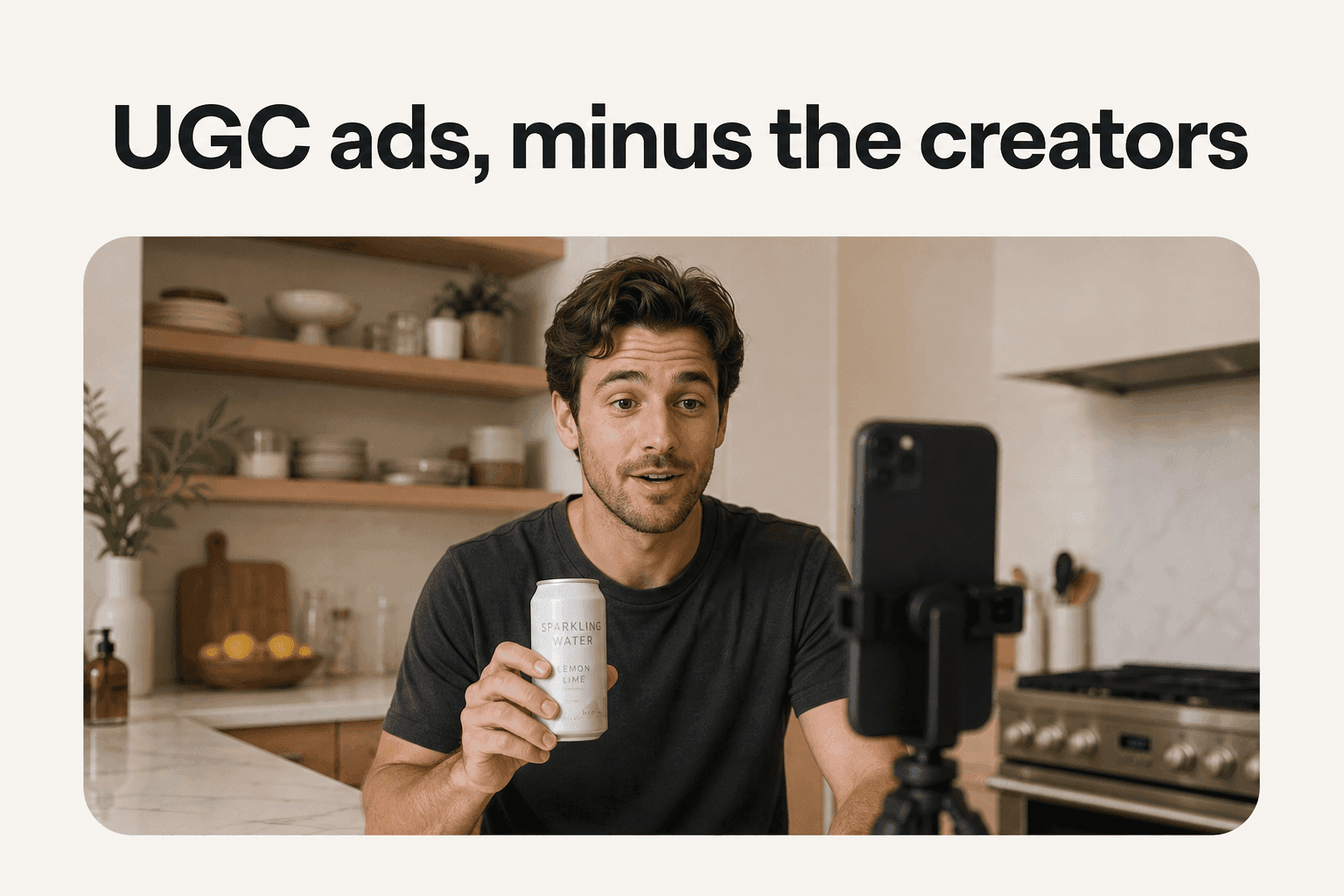
This is the job most performance teams mean when they say they want to automate content: a person talking to camera about the product, the format covered in what makes UGC-style ads work, produced without booking a creator. You supply the words and choose the face. The tool returns the video.
Novoads
Novoads works from a script. Here is what it takes off your plate:
- The script: type one, or paste your website URL during onboarding and it drafts one.
- The footage: pick an AI actor from a library of 100+ and get a UGC-style video ad back in 9:16, 1:1 or 16:9, voiced from a catalogue that covers 31 languages.
- Ad images: Product-to-Ad turns an uploaded product photo into an ad image.
- The plumbing: video runs on frontier engines such as Seedance, Kling and Veo, and a public API lets a team call it from its own code.
One condition matters for ecommerce. A stock actor from the library has empty hands, so to show your product in hand you upload a photo of someone holding it and create a custom actor from that photo.
Price as listed on September 21, 2026: Starter is $15 a month for 200 credits per month, billed monthly only, and Plus is $49 a month for 1,000 credits. Every plan is on the pricing page.
What it does not do: build an ad from a product page URL. If a link is your starting point, Creatify, Higgsfield and AdCreative.ai, further down, can all start from one. Its library of 100+ actors is also smaller than the 1,000+ AI actors Arcads advertises or the 1000+ AI creators MakeUGC lists.
Arcads
Arcads leads with its cast. What its homepage and help centre show:
- a library of 1,000+ AI actors, or your own AI avatar;
- actors that can be made to hold your product, show your app and wear your clothes;
- a core model described plainly in the help centre: Arcads 1.0 generates a video from a text script.
The automation lives in Workflows. The homepage describes Create Workflow as a way to bring your tools and ad workflows "into one infinite canvas to create, test and scale ads faster as a team", and it also carries a section headed "Build your own AI Agent for marketing". The help centre's example workflow takes one script and one product image and generates 20 ready-to-post UGC videos across 10 AI characters in English and Spanish.
That example is a useful picture of what batch automation looks like in practice: one approved script, many faces, two markets, one run. Arcads gets no price in this list; for a head-to-head on the two actor-library tools, see Arcads vs MakeUGC.
MakeUGC
MakeUGC is built around volume. Its pricing page lists, on the entry card:
- 1000+ realistic AI creators;
- unlimited AI scripts;
- parallel generation of up to 10 videos and 10 images at a time.
Price as listed on September 21, 2026: the Start up plan is $59 per month for a fixed 500 credits a month. The Growth tier, pitched at "Testing many creatives a month", is $79 per month for 1,000 credits, and it is the plan where "Batch Mode included" appears.
MakeUGC also runs its own entry offer. Each of its self-serve plans carries a "Start for $1" button, and its pricing page says its Unlimited access only activates after that $1 trial ends and the first full billing cycle begins.
Pick it when you are testing many creatives a month and want batch generation on a fixed monthly credit allowance.

Link-to-Ad, Static Sets and Avatars: Four More Tools
The second family starts from something you already have: a product page, a product photo, or a presenter you want on screen. The script is still there, but the tool writes more of it for you, and two of these four stretch past the video into ad sizes and launch.
Creatify
Creatify's homepage describes URL to Video as a way to "turn any link into a ready-to-post video", and says you can "batch create a dozen variations at once". Its Batch Mode page adds that you can select multiple scripts for each product URL.
Price as listed on September 21, 2026: Starter is $39 / month on monthly billing, with 100 credits / mo and AdFlow (200+ Templates). A banner on the same page reads "Save up to 50% on annual plan"; we have not quoted an annual figure. Creatify also has a Free Plan with 10 monthly credits whose exports carry a watermark.
Pro, at $99 / month, is where the launch side shows up. Its feature list includes:
- "Performance Agent + Automations";
- Ad Clone, described as a way to remake any ad from a URL.
The plan comparison table also has rows for an Ad Launcher and an AI Performance Agent, each for Meta, TikTok and AppLovin.
Read as a whole, this plan page looks as much like a media-buying tool as a video tool. If remaking a proven format is part of your process, our guide to cloning competitor ads covers the workflow, and Novoads vs Creatify compares the two side by side.
Higgsfield
Higgsfield's About page describes Click-to-Ad this way: "Paste a product URL, get a social-first ad. Click-to-Ad generates trend-matched video ads for marketing campaigns at scale." Its ad workspace, Marketing Studio, is described on its own page as the tool that "writes the script, directs the shots, and delivers the final cut". Its help centre sets the maximum clip length at 15 seconds per generation.
Price: not quoted. Higgsfield's pricing page loads its plans in the browser, and a plain fetch of it on September 21, 2026 returned the page without plan prices. Check the live page before you budget, or start from our Higgsfield pricing breakdown.
Our read: a 15-second ceiling per generation fits the short hook-first cuts that feed Reels and TikTok. A longer demo would need several generations stitched together.
AdCreative.ai
AdCreative.ai brings static ad sets into the list, with video alongside. Its homepage pitches the resizing grind directly: "Create every ad size and variation you need in seconds". The same page lists:
- ready-made or custom templates, from which it says you can "generate unlimited on-brand ads for every format and platform";
- Instant Ads, which scans your webpage to produce ready-to-launch ads;
- video from an uploaded product photo;
- a Creative Scoring AI that lets you score your ad creatives before advertising.
Price as listed on September 21, 2026: Starter Plans are $39/month on the monthly tab, for 10 credits a month and 1 brand. The homepage separately advertises a 7 day free trial.
Our read: this fits the team whose bottleneck is the same message in every placement and size, not a new face on camera, the same split we draw in AI ad generator vs Canva. Treat a creative score from a vendor's own model as a prompt for a second look, not as a substitute for the live test.
HeyGen
HeyGen is the avatar entry on this list. A presenter reads your script on camera, which in our view suits explainer and spokesperson ads more than the handheld, filmed-on-a-phone look of UGC.
Price as listed on September 21, 2026: HeyGen's pricing page says "the Creator plan costs $29/month (or $24/month if you pay annually)". The Creator card lists 175+ languages and dialects.
The automation hook sits higher up. HeyGen's Business plan lists integrations with n8n, Make, HubSpot and Zapier. For a team that already runs its marketing operations through one of those, that is the part worth testing. For how it compares with a link-to-ad tool, see HeyGen vs Creatify.
A Worked Example: One Serum, One Week, Twelve Ads
Lists of features are easier to read than to use. Here is how the four kinds of automation split across one realistic week, for a brand with one hero product and a Monday deadline.
The brief
A skincare brand sells one serum and runs it on Meta and TikTok. The creative lead wants to know which of four reasons to buy carries the account: the texture on skin, a two-step morning routine, the ingredient story, and the price set against a salon treatment. Each angle gets three hooks. Four angles times three hooks is 12 ads.
Assigning the jobs
Each part of the brief goes to the job that fits it:
- Hooks and scripts: one writing session produces twelve openings per angle, cut down to the three strongest. Use a tool's script helper or your own team; the point is that the words are approved before anything renders.
- Texture and routine: these need a person on camera with the bottle in hand, which is script-to-actor territory. Check how each tool handles product in hand before you commit: in Novoads it means a custom actor built from a photo of someone holding the product.
- Ingredient story: a presenter explaining what is in the bottle works as an avatar video.
- Price angle: this one can start from the product page (the link-to-ad job), or run as a static ad set resized for every placement, which is where a static tool earns its keep.
Then plan for waste. If one take in two is good enough to run, twelve keepers means about 24 generations. The cost of those 24, not the plan's sticker price, is the number to compare across tools.
How you know it worked
By the end of the week you should be able to say three things: which angle held attention past the first seconds, which one produced purchases at a cost you can live with, and which hooks lost on every angle. Our guide to ad creative testing covers how to read those results without fooling yourself.
If the honest answer is that none of the angles worked, the tool did its job and the angles were wrong. That is a finding, not a failure, and it is exactly what the next section is about.

What Automation Will Not Do for You
Every tool here makes producing an ad faster. None of them decides what the ad should say. Higgsfield's own help centre is direct about the last step: "Voiceover and pacing in UGC Videos can vary by generation: review before publishing." We would extend that advice to every tool on the list.
It will not fix the offer
If the price, the bundle or the guarantee is wrong, twelve new ads are twelve ways of saying something nobody wants. More creative raises the number of tests you can run. It does not raise the odds that the offer underneath is right, and a batch of losing ads is often the first honest signal that it is not.
It will not fix the landing page
A click that lands on a slow page, or on a page that tells a different story from the ad, loses the sale after the creative has done its work. Check the page before you blame the ads. A strong click-through rate paired with weak sales usually points past the creative, which is the case we unpack in what a high CTR does and does not tell you.
It will not design the test for you
A tool that generates fifty variants in an afternoon also makes it easy to launch fifty variants with no hypothesis. Decide what each batch is testing before you generate it:
- one angle per ad set, so the result tells you something about the angle;
- the hook as the only change inside that ad set;
- a stop rule written down before the money goes out.
Automation removes the production limit on testing. It does not remove the need to design the test, and it makes a badly designed one more expensive, faster.
Automate the Making, Keep the Judging
Seven tools, four kinds of automation, one rule. Pick the tool by what you start from and where you want it to stop, then judge it on how many of its ads you would actually put money behind. If your bottleneck is talking-to-camera UGC from a script, with a product photo as the other input, that is the job Novoads is built for.
The tools have made an ad cheap to make. They have not made it cheap to be wrong about what it says.
Frequently Asked Questions
What are automated content creation tools for ads?
They are tools that take over part of making ad creative: writing the script and hook variants, producing the footage with an AI actor, avatar or product scene, formatting for each placement and language, and in some cases pushing the finished ads into the ad account. For paid social, the useful ones make UGC-style video ads, avatar videos and ad images, not blog posts or social schedules.
Which tools turn a product URL into a video ad?
Creatify's homepage describes URL to Video as a way to turn any link into a ready-to-post video, and Higgsfield's About page describes Click-to-Ad as pasting a product URL to get a social-first ad. AdCreative.ai's homepage says its Instant Ads feature scans your webpage to produce ready-to-launch ads. Novoads works from a typed script and a chosen AI actor, or from an uploaded product photo for ad images, rather than from a product page URL.
How much do automated ad creative tools cost?
As listed on each vendor's page on September 21, 2026: HeyGen Creator is $29 a month, Creatify Starter is $39 a month on monthly billing, AdCreative.ai's Starter plan is $39 a month on its monthly tab, and MakeUGC's Start up plan is $59 a month. Novoads Starter is $15 a month for 200 credits, and Plus is $49 a month for 1,000 credits. Higgsfield's pricing page loads its plans in the browser and Arcads is covered here by features only, so check both live.
Can an AI ad tool launch the ads for me?
Some reach that far. Creatify's plan comparison lists an Ad Launcher and an AI Performance Agent for Meta, TikTok and AppLovin, and its Pro plan lists Performance Agent + Automations. HeyGen's Business plan lists integrations with n8n, Make, HubSpot and Zapier. Before you buy, check whether a tool pushes ads into your ad account or hands you files to upload.
Are credits comparable between AI ad tools?
No. Each vendor that sells credits meters them by its own rules (clip length, model, resolution, output type), so 100 credits in one app and 200 in another say nothing about which makes more usable ads. Run the same brief through two or three tools and divide what you paid by the number of ads you would actually run.
Does automating ad creation replace creative testing?
No. Automation removes the production limit on how many ads you can test, but it does not choose the angle, fix a weak offer or a slow landing page, or decide when a test is over. Decide what each batch is testing before you generate it, change one thing at a time, and write the stop rule down before the budget goes out.
Key Takeaways
- For a paid-social team, automated content creation means ad creative: UGC-style video, avatar video and ad images. The seven tools here split into script-to-actor UGC video (Novoads, Arcads, MakeUGC), link-to-ad video (Creatify, Higgsfield), static ad sets (AdCreative.ai) and avatar spokesperson video (HeyGen).
- Entry prices as each vendor's page listed them on September 21, 2026: Creatify Starter $39 a month on monthly billing, AdCreative.ai Starter $39 a month on its monthly tab, MakeUGC Start up $59 a month, HeyGen Creator $29 a month, and Novoads Starter $15 a month for 200 credits. Arcads and Higgsfield are described by features only.
- Credits are not a shared unit. The vendors that sell them meter them differently, so compare cost per usable ad: what you paid divided by the ads you would actually run, from the same brief.
- Automation reaches different depths. Creatify's plan comparison lists an Ad Launcher and an AI Performance Agent for Meta, TikTok and AppLovin, and HeyGen's Business plan lists integrations with n8n, Make, HubSpot and Zapier.
- The tools make an ad cheap to produce. The offer, the landing page and the design of the test are still yours to get right.