Candle Ads: Ideas That Sell Scents, What Each Costs With AI, and the FTC's Made in USA Rule
The candle ads that makers and shops run, from a new-scent reveal to a gift set timed to the shipping cutoff, and how to make each one in Novoads from your own jar photos. Plus what the credits come to on each plan, and what the FTC's Made in USA Labeling Rule says about a label your ad shows.

Mauricio Valdivia
·12 min
Nobody can smell your candle through a phone
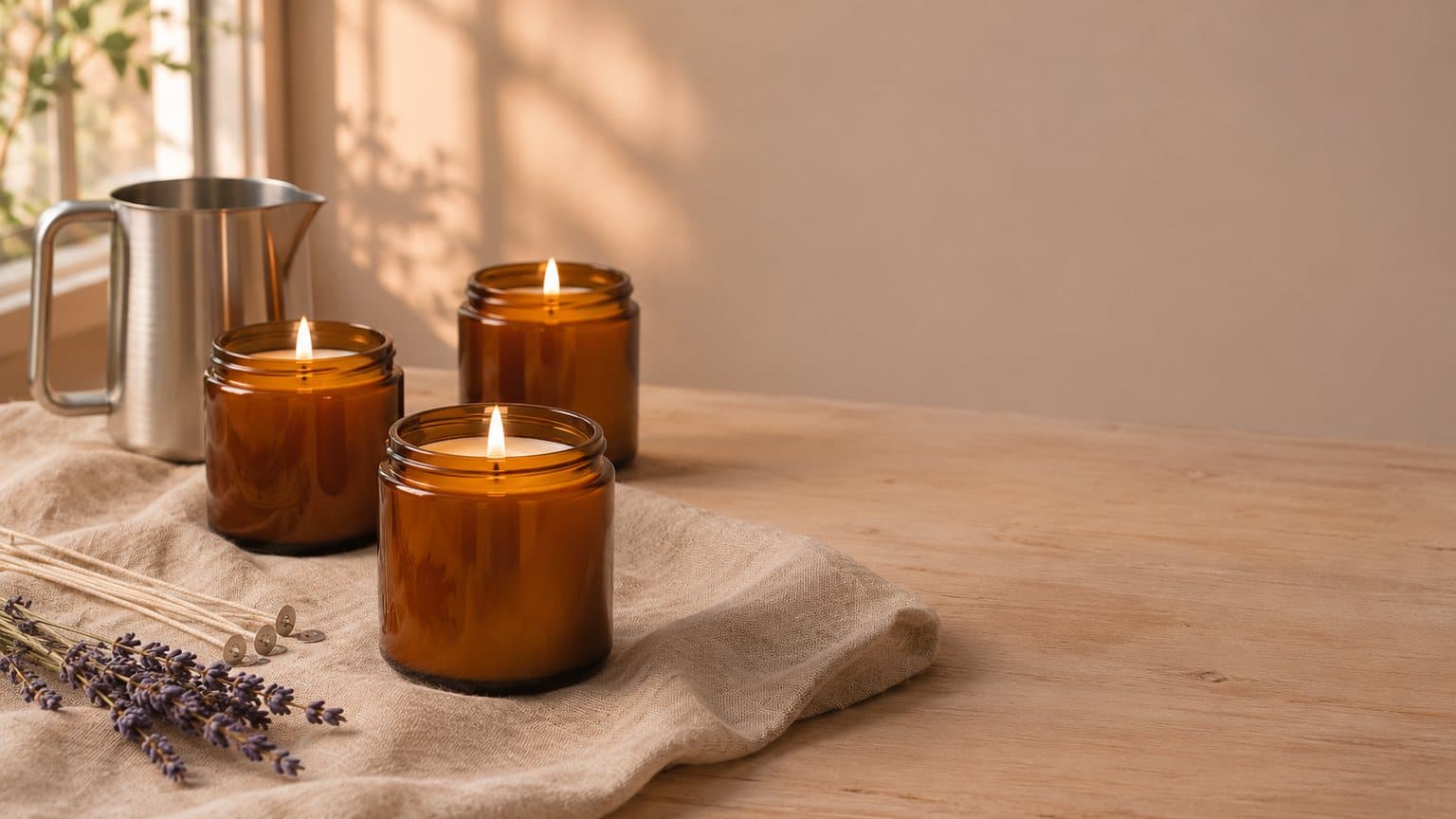
We never poured the amber candle in this guide's first picture. We made it with GPT Image 2.6 Sunburst to stand in for the photo you'd take on your own table. The candle is lit and its kraft label is blank. It sits on pale wood next to a twine-wrapped gift box and some dried lavender, with a thin curtain filtering the daylight behind it. Then we used our own Claude connector to turn that still into a 4-second Seedance 2.0 Mini clip. The flame flickers, the daylight dims slightly and the camera never moves. Nothing appears on the label in any frame, and that blank is where your own label would go.
Most weeks, a candle business asks the same thing of its ads. Whether a new scent is going live, gift sets have to ship before a holiday cutoff or a giveaway needs entries, the post has to sell a smell to someone scrolling with the sound off. All it can show is the jar, the flame, the wax and the words beside them, so each of those has to match the candle you'll actually ship.
On November 18, 2026, we read the search results page for "candle ads" along with the FTC's rule text on govinfo.gov and Billo's own pricing guide for creator videos. We priced every ad here from our own credit tables. The two written pages we could open on that results page (a template gallery and an AI video tool's landing page) didn't price a finished ad. Neither showed step by step how to make one with AI or named any rule on what a candle ad may claim. We made one still and one clip for this guide and didn't run any ads, so nothing here tells you which ad sells more candles.
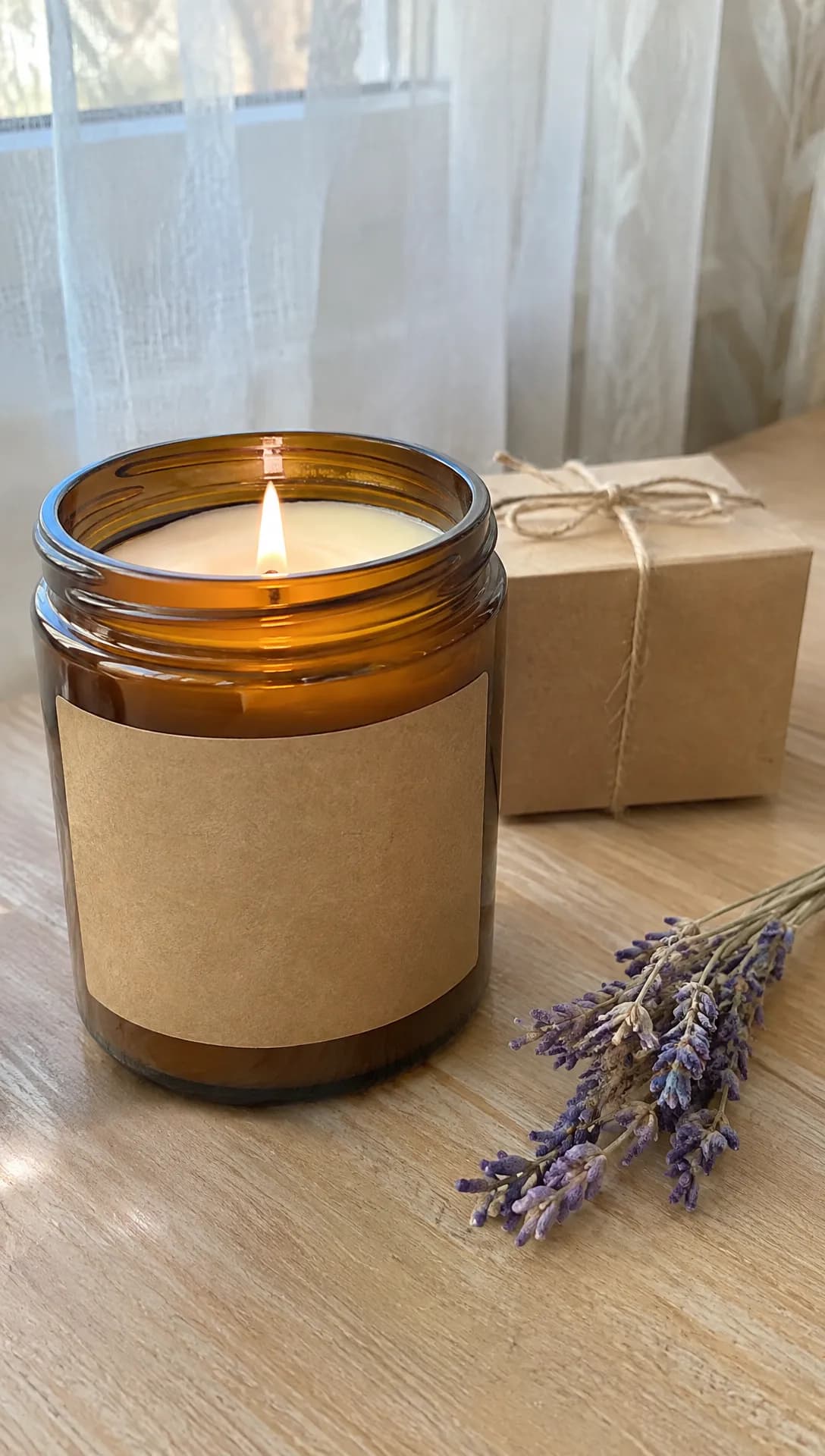
Made in Novoads with GPT Image 2.6 Sunburst · a lit amber jar candle with a blank kraft label, shot like a phone photo; it stands in for your own photo · 1 credit · 2026-11-18
Five candle ads that makers and shops run
The results page for "candle ads" is mostly idea boards and videos, with one template gallery and one AI video tool's page among them. From those pages and titles, we count five ads a candle maker runs through the year, and they overlap with the video ad formats any online shop uses.
The new scent or collection reveal
This is the post for the week a scent or a collection goes live. It has to make someone want a candle they can't smell, so it leans on what a camera can carry (a flame catching, a curl of smoke after the wick goes out, the color of the wax) and on a caption that names the notes. AI is good at the motion. Start a clip on your own photo of the lit jar, ask for a flicker or a slow push toward the glass, and then check that every frame still shows the jar you photographed.
The reveal must never show a candle that isn't yours. That rules out a different jar or lid, a label that's changed, a wax color you don't pour, a wood wick where you use cotton and a clean melt pool when yours tunnels. It also rules out a Made in USA badge on a candle that doesn't meet the FTC's standard, which we quote in the rule section further down. Before you pay to show the reveal to more people, test a few versions of its opening seconds, as our guide to ads that convert walks through.
The gift ad before the shipping cutoff
People buy candles as gifts for birthdays, anniversaries and the holidays, and the date that matters most in a gift ad is your last day to order for delivery in time. A picture ad does this well. Set your own product photo into a seasonal scene and put the gift set's contents and the cutoff in the caption. If the ad needs a voice, an AI presenter can read the offer and the cutoff from your script.
The scene can't add a gift box, a bundle or wrapping you don't sell. An AI person can't unbox your candle as if they were a customer, and the AI presenter is never introduced as you, the maker.
The giveaway or the discount code
A giveaway or a code for a weekend sale is the ad that asks for something right away, whether that's tagging a friend, following the shop or using the code by Sunday. An AI presenter reading the entry steps can carry it. So can a picture of your real candle with the offer written in the post's caption, where you can change the end date without making a new picture.
Never let AI add proof you don't have. Leave out winners who don't exist, reviews nobody wrote, star ratings you didn't earn and any discount you aren't running.
The pouring story
If you pour by hand, the pour itself is an ad. The melting wax, the centered wicks and the labels going on one jar at a time are yours alone, and they're worth a short sequence. AI can turn your own photos of each step into short clips, and captions or a few lines of text can tell the story in your words.
This is the one ad where an AI presenter doesn't belong, because the story is yours and a stranger telling it would pass someone else off as the maker. Every hand, pitcher, workbench and pour in those clips should come from your own photos and never from a model's idea of a candle studio.
The styled still for Facebook and Instagram
We think the aesthetic ad (a jar on marble, on linen or in a warm room at dusk) is the easiest of the five to make from a single product photo. If your buyers browse Pinterest for candle ideas, our Pinterest ads guide covers making ads there too.
What goes wrong here is the product itself, so watch for a jar that's grown, a lid that's turned gold or a matte finish gone glossy. The room is a set you made, so don't caption it as a customer's home.
How to make each candle ad in Novoads
Each ad above starts from a photo you took of your own candle, lit, on the surface where you shoot your listings, because a clip or a picture can only be as true as the photo it started from. If making ads with AI is new to you, our AI ads guide covers the basics. If you sell on Etsy, our Etsy ads guide covers Etsy's listing video, which plays silent.
A clip that opens on your photo of the lit jar
- In the editor, pick Video, open Settings and choose Kling 3.0 under Model. Set Duration to 10 seconds.
- Drop your photo of the lit candle into the box that reads "Drop a start frame or click to upload". The editor then shows "The video starts on this picture."
- In the box that reads "Describe your video...", write the motion you want, such as the flame flickering and a slow push toward the jar, with nothing else moving.
- Send it with the round up-arrow button.
For 20 credits, you get back a 10-second clip that opens on your photo. Kling 4.0 takes a start frame in the same box. Omni Flash and Wan 3.0 take one once you switch them from "Reference" to "Start / End Frames". On the Seedance models, the editor uses your photo only as a reference for the prompt, so the clip isn't made to open on it. Our guide to making product videos with AI goes further into turning one photo into a clip.
Before you post, hold the real candle next to the screen and check the jar's shape, the label, the wax color, the wick and the flame in every frame.
Our test with the amber jar
We skipped the editor for this guide's clip and used our own Claude connector to start a Seedance 2.0 Mini clip on the still at the top of the page. We kept it to 4 seconds at 480p with no sound, so it was a small, cheap check of the motion rather than a clip sized for posting. It came back clean on the first take, for 2 credits.
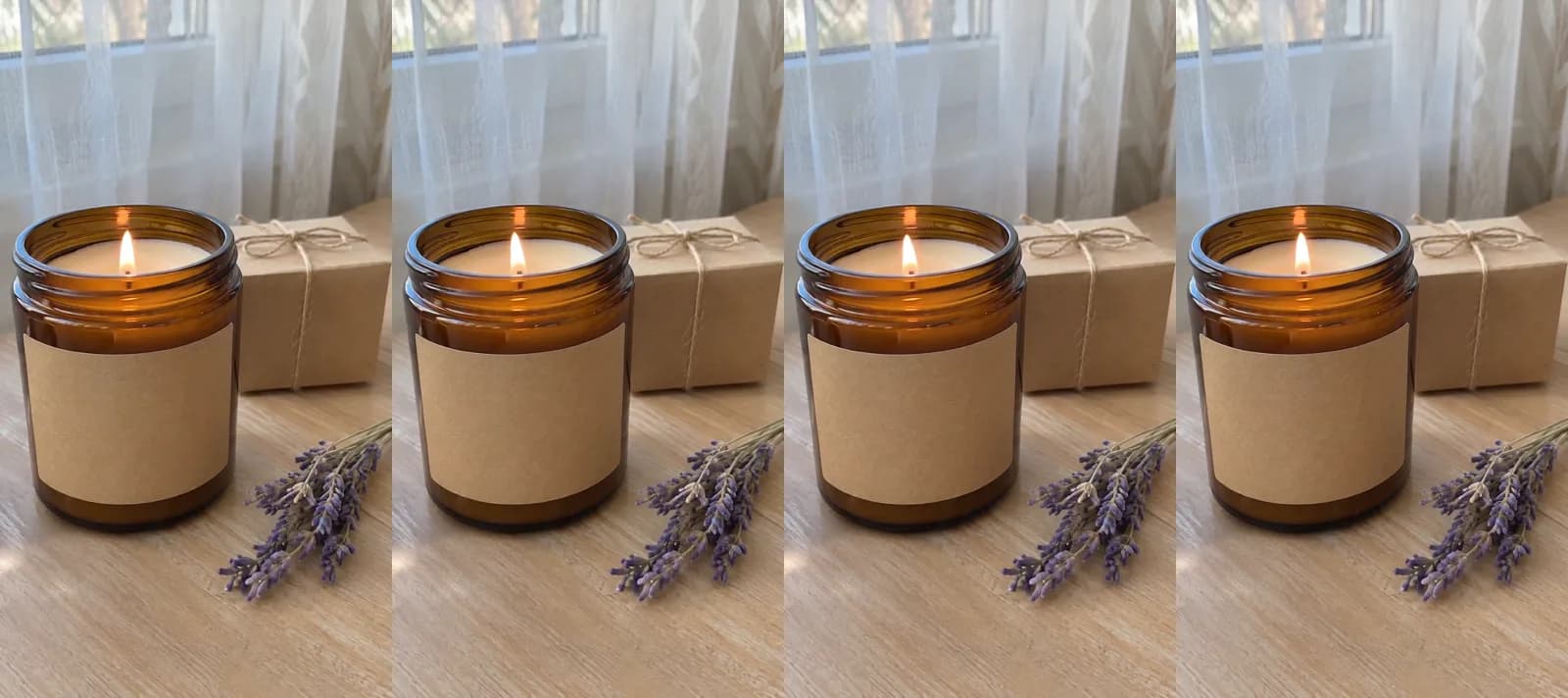
Made in Novoads with Seedance 2.0 Mini · the lit jar, its flame flickering under a fixed camera, no sound, 4 seconds at 480p · 2 credits · 2026-11-18
Only the flame and the daylight change across the four frames. The jar, the gift box and the lavender stay where they are, and the label is still blank in the last frame. You'd make a final ad at 720p. At that resolution, a 5-second Seedance 2.0 Mini clip costs 5 credits.
A gift or giveaway read by an AI presenter
- Pick Talking Actors and click Add actors to choose an AI actor.
- Write the script in the box that reads "Write what the actor will say...". Include the offer, what's in the gift set and the last day to order for delivery in time.
- Send it with the same round up-arrow button.
You get back a take of the actor speaking your script. It's billed by the started minute, so any take up to a minute is one charge. At 720p, the default, that's 200 credits. At 480p, it's 100.
Pair the take with your own clip or picture of the jar, so the candle on screen is the real one. You add captions as one more step on the finished take. The captions tool opens on the "TikTok, no box" look, one of six looks that each cost 3 credits per started minute. In the ad, the presenter stays an AI presenter and is never shown as you or as a customer.
Gift pictures from the Image tool
- Pick Image, click Reference and upload your candle photo (JPG, PNG or WebP).
- Describe the gift scene in the prompt, for example the jar on a table set for the holidays beside the gift box you actually sell.
- Open Settings, choose GPT Image 2 under Model and switch Quality from High to Medium.
- Send it. A run makes 3 pictures unless you change Images.
GPT Image 2 at Medium is 1 credit a picture, so the run is 3 credits. At High, it's 4 credits a picture. Its aspect ratios include square, 9:16 for stories and 16:9 for wide spots. For a 4:5 feed picture, switch to Nano Banana Pro, the model the Image tool opens on. It's 2 credits a picture at its 2K default.
Check each picture's jar, label and lid against the real candle, and the jar's size against everything around it.
What a week of candle ads costs
Prices as of November 18, 2026. The week we priced is a scent launch with a gift push. It's two 10-second Kling 3.0 clips, each starting on your own photo of a lit candle, and one run of three GPT Image 2 gift pictures at Medium with the candle's photo as the Reference.
| What you make | Model | Credits | Starter | Plus | Ultra 3,000 |
|---|---|---|---|---|---|
| A 10-second clip from your photo | Kling 3.0 | 20 | $1.50 | about 98 cents | about 86 cents |
| A second clip for another scent | Kling 3.0 | 20 | $1.50 | about 98 cents | about 86 cents |
| Three gift pictures, one run | GPT Image 2, Medium | 3 | about 23 cents | about 15 cents | about 13 cents |
| The week's ads | 43 | about $3.23 | about $2.11 | about $1.85 | |
| Weeks like this a month's credits cover | 4 | 23 | 69 |
We worked out each dollar figure above ourselves by spreading the plan's monthly price over its credits.
- Starter is $15 a month for 200 credits. That's 7.5 cents a credit.
- Plus is $49 a month for 1,000 credits. That's about 4.9 cents a credit.
- Ultra 3,000 is $129 a month. That's about 4.3 cents a credit.
You'll find what every plan's credits cover on our pricing page.
What the total leaves out
Every extra try at a clip or a picture is billed again at the same price. The total also leaves out joining the clips and pictures into one ad, a voice-over, captions and music, plus your ad spend and the time it takes to check each frame against the real jar.
An AI presenter changes the math. A 720p take of up to a minute costs 200 credits, a whole month's credits on Starter. At 480p it's 100. On Plus or Ultra 3,000, a presenter fits in beside the clips.
Compared with a creator filming your candle
Billo, where creators film your product from your brief, says in its own pricing guide that "Billo videos start at $99 per video," with prices as of October 2026. The same guide says "Your product, its shipping and any add-ons you choose are paid separately," which for a candle maker means paying for the candle and for shipping it to the creator. With Billo, a person films your real candle. A clip animated from your photo doesn't give you that, so the two prices aren't like for like.
What the FTC's Made in USA Labeling Rule says about a label in your ad
None of the written pages we could open on the results page names this rule. We think it matters for a candle ad the moment a clip or a picture shows a label carrying a Made in USA seal.
The rule in its own words
The Made in USA Labeling Rule is a federal rule the FTC issued in 2021. It took effect on August 13, 2021. We read it on govinfo.gov in the 2026 edition of the Code of Federal Regulations, where it's 16 CFR Part 323 under the heading "Made in USA Labeling". Section 323.3, "Applicability to mail order advertising", is one sentence.
To the extent that any mail order catalog or mail order promotional material includes a seal, mark, tag, or stamp labeling a product Made in the United States, such label must comply with § 323.2.
Section 323.2 makes it an unfair or deceptive act or practice "to label any product as Made in the United States unless the final assembly or processing of the product occurs in the United States, all significant processing that goes into the product occurs in the United States, and all or virtually all ingredients or components of the product are made and sourced in the United States."
What the rule calls mail order promotional material
Section 323.1(b) defines both terms at once.
The terms mail order catalog and mail order promotional material mean any materials, used in the direct sale or direct offering for sale of any product or service, that are disseminated in print or by electronic means, and that solicit the purchase of such product or service by mail, telephone, electronic mail, or some other method without examining the actual product purchased.
The rule's text doesn't mention video, social media or AI anywhere. We think an online ad that sells a candle to someone who has never held it comes close to that definition, since it's spread by electronic means and asks for an order without the buyer examining the candle. That's our reading. The rule's own page is in the sources below.
How far the rule reaches
Three limits keep the rule from reaching every line in an ad that says USA.
- It covers unqualified claims. Section 323.1(a) defines Made in the United States as "any unqualified representation, express or implied, that a product or service, or a specified component thereof, is of U.S. origin," and its examples include saying a product is "made," "manufactured," "built," "produced," "created," or "crafted" in the United States or in America. The FTC decides which of your own words count. We can't make that call for you.
- In mail order material, it reaches the label. Section 323.3 applies only to the extent the material includes a seal, mark, tag or stamp. The FTC's final rule, published in the Federal Register on July 14, 2021, says the Commission "has not focused on advertising more generally, but retains the proposed rule's focus on MUSA claims on labels or in mail order or catalog advertising, including in online marketplaces, that depict a product label." MUSA is the FTC's shorthand for Made in USA.
- The rest of an ad still answers to the FTC Act. The same document says the FTC's general authority under Sections 5 and 12 of the FTC Act "covers advertising, including advertising of qualified and unqualified MUSA claims."
What it means for the ads above
This part is our reading of the rule rather than its text, and it isn't legal advice.
- A reveal clip or a styled still that shows your label with a Made in USA seal puts that seal in front of a buyer who orders without holding the candle. So we'd treat the candle as needing to meet the standard quoted above, and we'd check every part of it, from the wax and the wick to the fragrance oil, the jar and the lid.
- Never let AI add a seal, a flag or a badge your real label doesn't carry. In our test, the label stayed blank in all four frames, and yours should stay exactly as printed.
- A gift picture or a giveaway clip made from your photo carries whatever your label says, so the check is the same for every ad on this page.
Start with the scent you're pouring this week
Take one photo of the candle you're launching, lit, on the table where you shoot everything else. Make a 10-second Kling 3.0 clip and three gift pictures from it, and check the label in every frame before any of it runs.
In Novoads, you turn your own product photos into ad clips and pictures, and an AI presenter reads your script when an ad needs a voice. Starter is $15 a month for 200 credits. That covers four weeks like the one we priced above.
Price your next scent launch
Two clips of the lit jar and three gift pictures add up to 43 credits. See what a month of credits covers on each plan.
See the plansMake the reveal first, and let the gift pictures follow once the scent is live.
Frequently Asked Questions
What should the caption on a candle ad say?
Name the scent's notes in plain words, the way your label does, and say what the candle is poured in. Then give the one thing a buyer needs to act on, such as the last day to order a gift in time or the date a code ends. We think the caption is where the scent lives, because no picture or clip can show a smell. Write it from the candle itself rather than from what the photo seems to suggest.
How do I make a candle brand look like luxury in an ad?
We think luxury in a candle ad comes from restraint (one jar, a quiet surface such as marble or linen, soft light and very few words). In Novoads, upload your own product photo as a Reference in the Image tool and describe that setting in the prompt. Then check that the jar, the lid and the finish didn't change. A styled room is a set you made, so never caption it as a customer's home.
Can my candle ad show a Made in USA seal?
The FTC's Made in USA Labeling Rule (16 CFR Part 323) says that when mail order promotional material includes a seal, mark, tag or stamp labeling a product Made in the United States, that label must meet the rule's standard. The standard asks for final assembly or processing and all significant processing to happen in the United States, and for all or virtually all ingredients or components to be made and sourced there. By our reading, a clip or picture that shows such a label carries it into the ad. This isn't legal advice. The rule's own text is on govinfo.gov.
How many candle ads does one Starter month cover?
Starter is $15 a month for 200 credits. In the week we priced, you make two 10-second Kling 3.0 clips from your own photos and one run of three GPT Image 2 gift pictures at Medium. That adds up to 43 credits. A Starter month covers four such weeks, with 28 credits left over. An AI presenter's take at 720p is 200 credits on its own, a whole Starter month.
Key Takeaways
- A candle ad can't carry a scent, so it sells with what a camera sees (the jar, the flame, the wax) and with words that name the notes. Each of those has to match the candle you ship.
- Start every clip and picture from your own photo of the real candle. A 10-second Kling 3.0 clip that opens on that photo costs 20 credits. The Image tool turns the same photo into three GPT Image 2 gift pictures for 3 credits.
- Two of those clips and one run of gift pictures make a week of ads for 43 credits. That's about $2.11 on Plus. A Starter month of 200 credits covers four such weeks.
- Don't let AI add anything that isn't yours, such as a different jar or wick, a gift box you don't sell, made-up winners or reviews, or an AI presenter passed off as you or as a customer.
- The FTC's Made in USA Labeling Rule has been in force since August 13, 2021. It says a Made in USA seal, mark, tag or stamp in mail order promotional material must meet its standard. The FTC also wrote that it hadn't focused the rule on advertising more generally.