Dental Ads: New-Patient Ad Ideas, and the ADA Code's Line for General Dentists
Five kinds of dental ads, how to make each with AI from your own photos or with an AI presenter, what one costs in credits and dollars, and the sentence the ADA's Code has for general dentists who advertise their services.

Mauricio Valdivia
·12 min
What Six Dental Ad Lists Leave Out
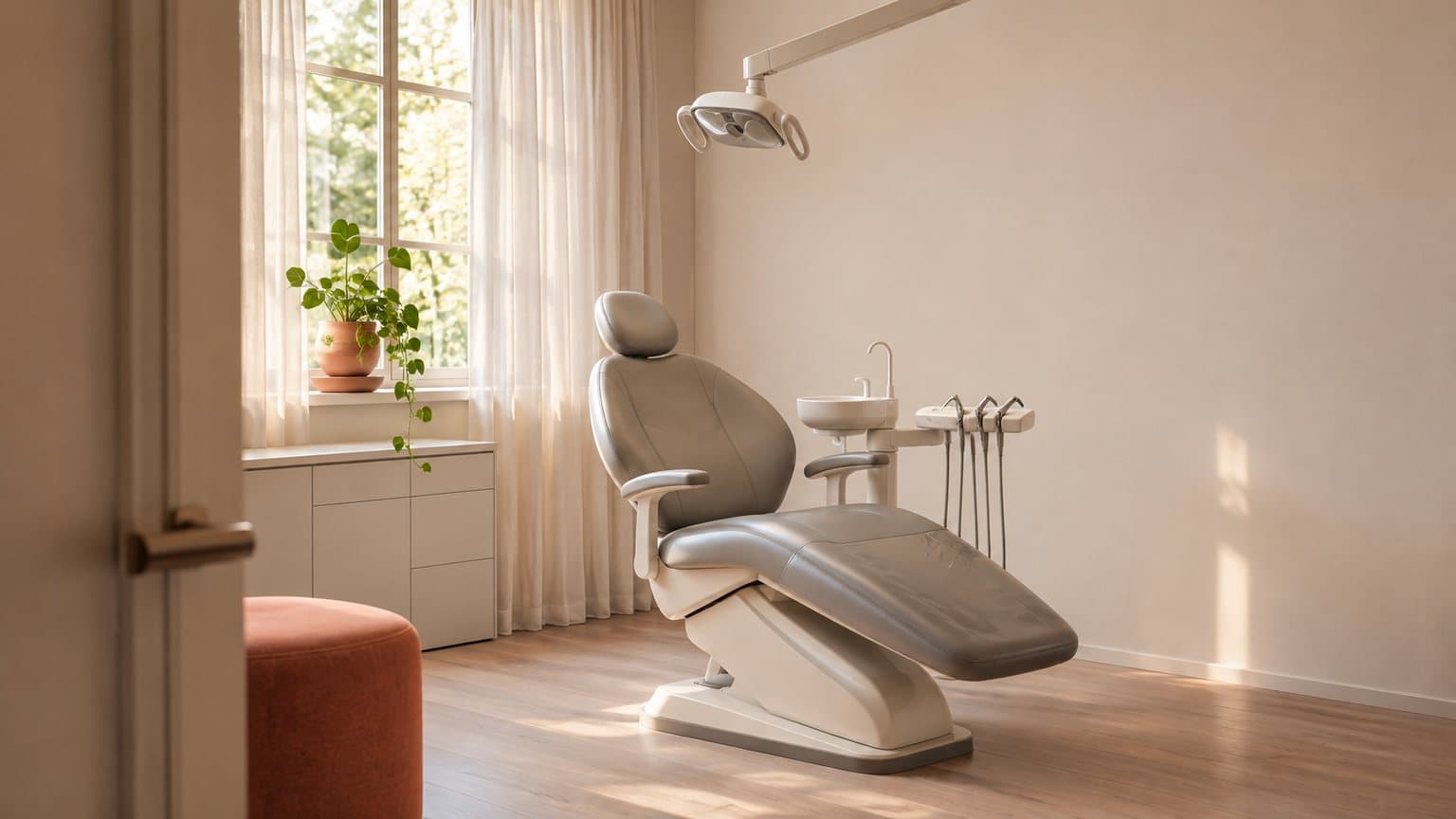
The treatment room in the strip below isn't a real practice. We drew it as a still picture in Novoads for 1 credit, to stand in for the phone photo you'd take of your own operatory. Then we spent 5 more credits on a five-second camera move toward the empty chair.
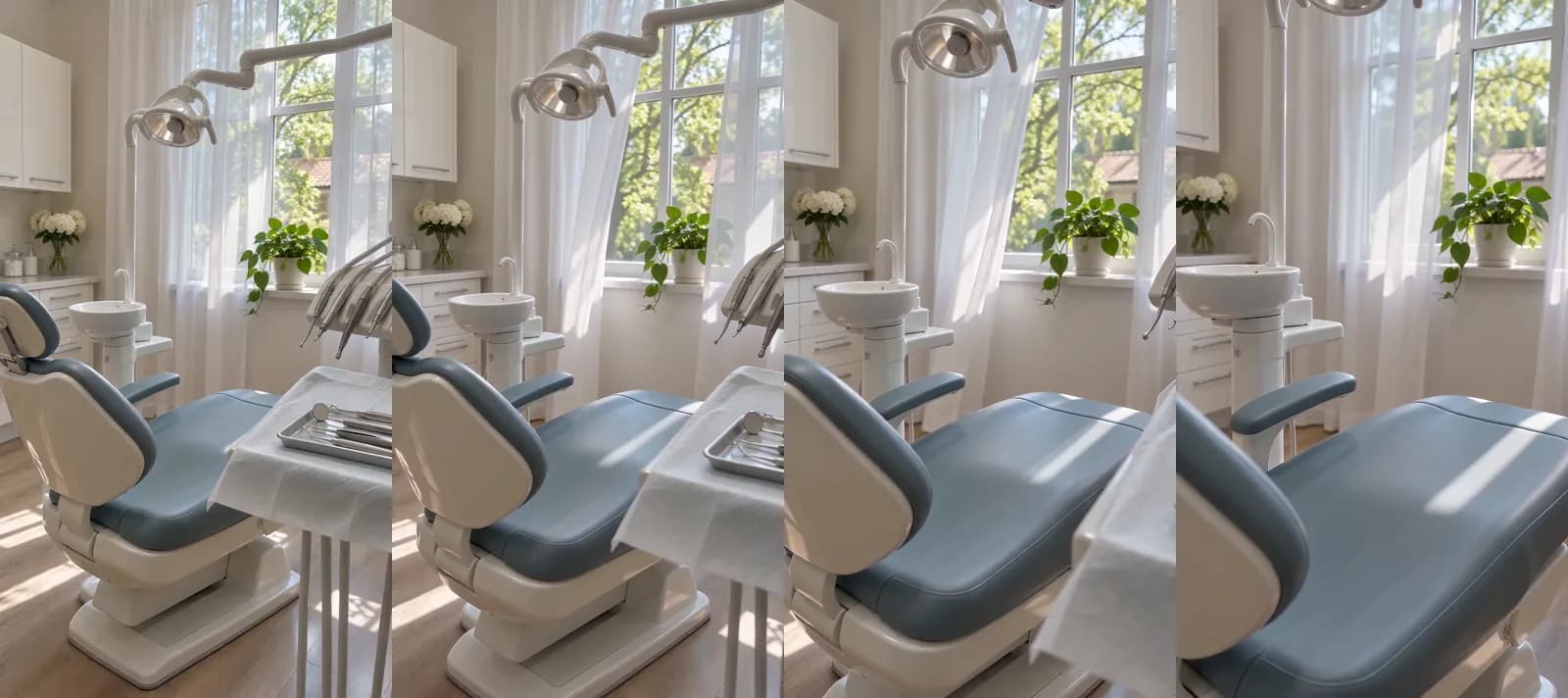 Made in Novoads with Seedance 2.0 Mini · prompt: the camera moves slowly in toward the empty dental chair, sound off · 5 seconds at 720p · 5 credits · 2026-11-13 · the room is made up and stands in for your own
Six credits is about 29 cents on our Plus plan. A clip like that won't fill Thursday's open hygiene slots by itself. It's one piece of the ad a practice needs when the schedule has holes, the new-patient exam is the offer, and the front desk answers the same three questions all day (do you take my insurance, what does a first visit cost, can you see me this week).
The pages that rank for "dental ads" hand you ideas for that ad. We opened six of them. None says what one finished ad costs to make, none shows how to make one with AI, and none mentions the American Dental Association's Code, which has a sentence written for general dentists who advertise their services.
Everything below comes from what we read on November 13, 2026 (those six pages, the ADA's own Code pages and our own price list) and from the one picture and one clip we made in Novoads that day. We didn't run an ad for a dental practice, and we didn't read any state dental board's rules.
The Five Ads Dental Practices Keep Running
The six pages come from a TV station group, a banner design tool, a hygienist staffing company, an office design studio and two healthcare marketing agencies, and the same five ads keep turning up on them.
The new-patient special
This is the ad that books first visits. It puts one price on the exam, the X-rays and a cleaning, so a person without insurance knows the number before they call. One of the pages we opened offers the headline "$99 New Patient Exam, X-rays & Cleaning" as a template. That's a sample offer for a patient, and it says nothing about what the ad costs to make.
AI does the talking and the b-roll well here. An AI presenter reads what the price covers and how to book, and your own photos of the front desk and a treatment room become short clips behind the voice. Don't dress the presenter in a white coat or introduce them as the dentist, a hygienist or anyone at your front desk.
If the ad also lists services (implants, aligners, root canals) and yours is a general practice, the end card and the caption are where the ADA's sentence can go.
The before and after
Whitening, veneers and aligner cases sell on the two photos side by side. Both should show a real patient of yours who agreed to it, and both should be untouched.
We wouldn't run either photo through an AI video model. A video model draws new frames, and the teeth in them are its guess. Among statements to avoid, the ADA's Code lists ones "likely to create an unjustified expectation about results the dentist can achieve." In our reading, an AI-made smile is that kind of statement.
What AI can add goes around the photos. A clip of your room opens the ad, and a presenter says one line about the treatment before the photos appear.
The patient testimonial
A patient saying in their own words why they stopped being afraid of the chair is the ad a competitor can't copy. The best version needs no AI at all, just the patient, a phone and their signed OK.
When the patient would rather not be on camera, an AI presenter can read their written review aloud, say plainly that it's a patient's review being read, and show it on screen. An AI actor posing as your patient is the version to refuse, along with any result the patient didn't get. Our hair salon ads guide builds the same review ad from a client's words.
The emergency or same-day ad
Someone with a cracked tooth at seven in the morning calls the first practice that picks up. This ad says your hours, your phone number and "call now" in about fifteen seconds, and it needs no clinical picture. A presenter says the three facts and the captions carry the number, so it still works with the sound off.
Keep promises about the outcome out of it. You can say you'll see them today, because that's your schedule, but "pain gone in one visit" promises a result you can't know before the exam. And if the ad shows a treatment room, it should be yours.
The short answer to a patient's question
Those three questions the front desk answers all day are scripts. Each one becomes a twenty-second answer, and a row of them becomes a series you can post for weeks.
A presenter reads an answer the dentist wrote or approved, and a health claim goes in only if the dentist would sign it.
Across all five ads, three things stay real.
- The people. The dentist, the team and the patients are themselves, or they aren't in the ad.
- The rooms. Clips start from your own photos of your own rooms.
- The results. Every smile is a real patient's, shown with permission and left untouched.
How to Make Each One in Novoads
Novoads is the AI ad tool we build. You pay from the first month and spend credits on each picture, clip or presenter video. What you make is a file you download and run wherever you advertise.
From your own photos
This is the route for the room, the front desk and the door. Our guide to making a product video from one photo walks through the same move with a bottle instead of a chair.
- Take the photo on your phone, vertical, with no patient in it and no screen showing a chart or a name.
- Open the Video tool and pick Kling 3.0 in the Model menu. It starts the clip on your own picture, while Seedance 2.0 Mini takes the photo only as a reference.
- Attach the photo below the prompt, where the editor asks you to "Drop a start frame or click to upload".
- Write what the camera does and what must stay out. Ours said the camera moves slowly in toward the empty chair, with no people and no text.
- Set five seconds and tap the arrow. Kling 3.0 has no Resolution to pick.
- Hold the clip next to your photo. If the model added a sign, a tool or a second chair, throw the clip away and run it again.
We made the clip at the top another way. For 5 credits, we gave the still to Seedance 2.0 Mini through our connector for AI assistants, which can start a Seedance clip on a picture.
We didn't have a practice's photo, so the picture below stands in for one. It's a GPT Image 2.6 Sunburst still at medium quality, and it cost 1 credit. Our prompt asked for an instrument tray covered with a paper sheet, and the picture came back with the tray sitting on top of the sheet and the tools showing. That's the kind of detail to check for, and it's why your own photo is the better place to start.
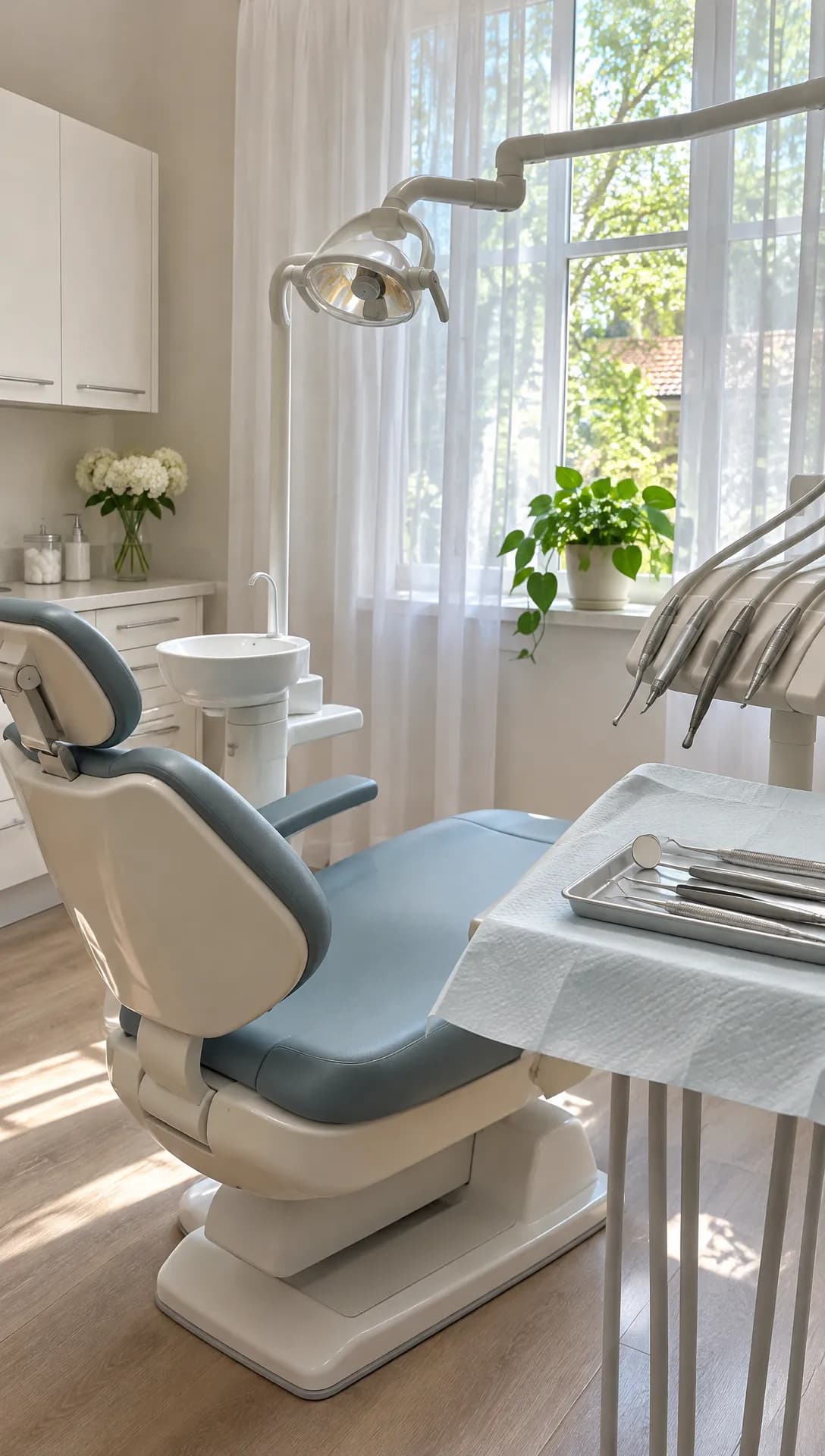 Made in Novoads with GPT Image 2.6 Sunburst · prompt: an empty dental treatment room in soft daylight as a vertical phone photo · 1 credit · 2026-11-13 · it stands in for your own photo and isn't a real practice
The clip at the top started from that picture. Over its five seconds the tray and the lamp slide out of the frame, the curtains shift a little, and the camera ends close on the seat and the armrest. The cabinets, the flowers and the plant stay where the still put them. Nothing in either image shows a patient, a smile or a treatment, so neither one can stand in for a result.
With an AI presenter
This is the route for the new-patient special, the emergency ad, the review being read and the short answers.
- Write the script and keep it under a minute, because we bill presenter videos by the started minute.
- Open Talking Actors, choose an actor, paste the script and pick a voice. The voice list covers 32 languages.
- On the price line, choose 720p or 480p. The lower one costs half as much per minute.
- Send it with the arrow button. The video comes back with the voice and the lip-sync done.
You add captions afterward, on the finished video, in the Captions tool. If you want your room clips cut in between the presenter's lines, join the pieces in the video editor you already use.
A script for the new-patient special can be this short.
New to the area? At [practice name], a first visit is [your price] and covers the exam, the X-rays and a cleaning. Our services are provided by general dentists. Call us or book online.
The third sentence is there because of the ADA's Code, which doesn't hand you wording. Staying close to its own words was our choice.
For the first seconds of any of these ads, the TikTok ad examples we collected show how real ads open. If you'd rather make one longer spot for the waiting-room screen or local TV, the steps are in our piece on AI commercials.
What Each Piece Costs
Prices as of November 13, 2026. The credits are the same on every plan, and the dollars change with what your plan pays per credit.
- Starter is $15 a month for 200 credits, or 7.5 cents a credit.
- Plus is $49 a month for 1,000 credits, or 4.9 cents a credit.
- Ultra 3,000 is $129 a month for 3,000 credits, or 4.3 cents a credit.
| Piece | Setting | Credits | Starter | Plus | Ultra 3,000 |
|---|---|---|---|---|---|
| AI presenter, up to 60 s | 480p | 100 | $7.50 | $4.90 | $4.30 |
| AI presenter, up to 60 s | 720p | 200 | $15.00 | $9.80 | $8.60 |
| Clip from your photo, 5 s | Kling 3.0 | 10 | 75 cents | 49 cents | 43 cents |
| Clip from your photo, 5 s | Seedance 2.0 Mini, 720p, through our connector | 5 | about 38 cents | about 25 cents | about 22 cents |
| Still picture | GPT Image 2.6, medium | 1 | about 8 cents | about 5 cents | about 4 cents |
A presenter video is one price from the first second to the sixtieth, so a fifteen-second emergency ad and a fifty-second new-patient ad cost the same. The second minute starts a second charge.
The new-patient ad, added up
Take the new-patient special as one presenter video at 480p and one five-second Kling 3.0 clip of your front desk. The presenter is 100 credits and the clip is 10. Together that's 110 credits.
- On Starter, 110 credits is $8.25.
- On Plus, it's about $5.39.
- On Ultra 3,000, it's about $4.73.
A Starter month covers one of those ads and leaves 90 credits for more room clips. A Plus month covers nine of them, and an Ultra 3,000 month covers 27.
The sum leaves a few things out.
- A re-roll costs the same again, so two tries at the front-desk clip come to 20 credits.
- Caption styles beyond the default cost 3 or 5 credits a started minute.
- Music, what you pay the platform to show the ad, and your time checking each clip against the real room aren't in it either.
What one studio charges for a filmed video
The other way to get a practice video is to hire a crew. Web Tonic, a marketing agency, keeps a roundup of 20 dental video studios. Its page says it was published on August 11, 2026 and updated on October 9. It lists one of the studios, NG Production Films in Orlando, at $6,000 to $12,000 "for a full overview video."
That's one studio's published rate, reported by an agency that puts itself second on the same list, so it isn't a survey of the market. It isn't the same product either. A crew films your real dentist and team, and the 110 credits above buy a presenter and a moving photo.
The Sentence the ADA's Code Has for General Dentists
The ADA's page for this part of its Code carries no date of its own, so what follows is the Code as we read it on November 13, 2026. This section isn't legal advice, and it can't tell you an ad is fine to run.
What the Code says
The ADA's Principles of Ethics and Code of Professional Conduct has a section titled "General Practitioner Announcement of Services." It's numbered 5.I today and opens with these two sentences.
General dentists who wish to announce the services available in their practices are permitted to announce the availability of those services so long as they avoid any communications that express or imply specialization. General dentists shall also state that the services are being provided by general dentists.
The same two sentences are in the PDF edition the ADA links from its Code of Ethics page, whose cover says "With official advisory opinions revised to October 2025."
So the Code asks two things of a general dentist who announces services.
- Nothing in the ad expresses or implies a specialty.
- The ad states that the services are provided by general dentists.
Implants, aligners and root canals are our examples of services a practice might announce. The Code's section names no treatment, and it gives no wording, type size or place on the screen for the statement.
Who it binds
The ADA's Code of Ethics page says "The Code of Professional Conduct is binding on members of the ADA, and violations may result in disciplinary action." It's a membership code. The same page says "Although ethics and the law are closely related, they are not the same."
Your state's dental practice law and its dental board are a separate matter. We didn't read any state's rules for this post, so nothing here describes yours.
The wording may change
The ADA's ethics council wrote in its 2026 annual report that a subcommittee "expressed dissatisfaction with the treatment of professional announcements in the ADA Code," and that it expected amendments to go to the House of Delegates in 2026.
The American Association of Endodontists reported on October 20, 2026 that the House adopted Resolution 501, which in the AAE's words "revised and reorganized Section 5" of the Code. We couldn't find the adopted text on a public ADA page, so we don't know whether the two sentences above changed. Read the current Code before you copy them into an ad.
What we'd do with the five ads
These are our readings of the Code for the ads above. They aren't the ADA's.
- Ads that list services. When you add a second line to the new-patient special (implants, aligners, emergency care), we'd put the general dentist statement on the end card and in the caption, in plain words.
- The word "specialize." One of the six pages is Stethon Digital Marketing's list of 15 templates, dated October 16, 2026. One template, which it says is best for "Endodontists and general dentists offering sedation or gentle techniques," has the copy angle "We specialize in treating patients who haven't seen a dentist in years." We'd keep that verb out of a general practice's ad, because the Code's phrase is "express or imply." Its 2026 edition lists twelve recognized specialties, among them endodontics, periodontics and prosthodontics.
- Before and after. The Code's test for any ad is whether it's "false or misleading in any material respect." A generated smile shows a result no patient got, and we'd treat it as false on its face.
- The presenter. The Code says "Dentists should not misrepresent their training and competence in any way that would be false or misleading in any material respect." An AI presenter introduced as the doctor claims training nobody behind it has, which is why we say a presenter is never the dentist.
What to Make First
Start with the ad your schedule needs this month. If that's the new-patient special, take three photos tomorrow before the first patient arrives (the door, the front desk, one treatment room), write the forty seconds the presenter will say, and add the general dentist line if the script lists services.
That ad is 110 credits in Novoads, and our page on UGC-style ads with AI actors shows the presenter side of it. We also keep a page on video ads for clinics, and a general guide to making ads with AI.
Make the new-patient ad this week
One AI presenter video at 480p and one clip from your own front-desk photo come to 110 credits. Starter is $15 a month for 200 credits, paid from the first month.
See AI actor adsThen check the finished ad twice before it runs, once against your own rooms and once against the current ADA Code and your state board's rules.
Frequently Asked Questions
Does a general dentist's ad have to say the services are provided by general dentists?
The American Dental Association's Code of Professional Conduct says it does, when the ad announces a practice's services. As the ADA prints it on November 13, 2026, general dentists may announce their services "so long as they avoid any communications that express or imply specialization," and "General dentists shall also state that the services are being provided by general dentists." The Code binds ADA members, and the ADA's own page says ethics and the law aren't the same thing, so your state dental board's rules are a separate matter. We didn't read them for this post. The American Association of Endodontists reported on October 20, 2026 that the ADA's House of Delegates revised Section 5 of the Code. We couldn't find the new text on a public page, so check the current Code before you rely on that wording.
Key Takeaways
- The same five ads turn up across the dental ad lists we opened: the new-patient special, the before and after, the patient testimonial, the emergency ad and the short answer to a patient's question.
- AI is useful around the practice's own material: a clip from your own photo of the room, or an AI presenter reading a script. It shouldn't draw a smile, a result, a room you don't have, a dentist or a patient.
- In Novoads, an AI presenter of up to a minute at 480p costs 100 credits. A five-second Kling 3.0 clip from your photo costs 10. A new-patient ad built from both is 110 credits, about $5.39 on Plus.
- The ADA's Code says general dentists who announce their services must avoid communications that express or imply specialization, and "shall also state that the services are being provided by general dentists."
- That Code binds ADA members, and the American Association of Endodontists reported that the ADA's House of Delegates revised its Section 5 in October 2026. So read the current Code and your state board's rules before an ad runs.