What TikTok Counts as Misleading in AI-Generated Ads: 4 Rules That Get Creatives Rejected
TikTok rejects ads for exaggerated results, mismatched landing pages, clickbait mechanics, and before-and-after comparisons. Here is how each rule in its misleading content policy maps to an AI generation failure mode, plus the pre-publish checklist that keeps your creatives approved.

Mauricio Valdivia
·11 min
An AI label will not save a misleading ad
TikTok can accept how you made an ad and still reject what it says. Those are two different reviews. The first one, AI disclosure, gets all the attention. The second one, TikTok's advertising policy on misleading and false content, is the one that actually kills creatives, and it was last updated in April 2026.
The policy bans four things: promised or exaggerated results, information that does not match your landing page, clickbait mechanics, and comparisons without evidence, including before-and-after results. None of those rules mention AI. All of them collide with it. Script models write superlatives by default, image models render perfect outcomes on request, and both will draw fake interface elements nobody asked for.
This guide maps each of the four rules to the AI failure mode that trips it, then hands you a pre-publish checklist so your reviewer never finds the violation first.
The rulebook behind TikTok ad rejections
Before the four rules, it helps to know what the policy is optimizing for, because every edge case gets resolved against that principle.
Four categories, one principle
TikTok frames the policy as an effort to "provide a reliable and trustworthy space for our diverse community." Everything else is implementation. The document then works through four enforcement categories:
- Misleading claims: promised or exaggerated results and absolute terms.
- Inconsistent information: the ad and the landing page telling different stories.
- Clickbait: visual tricks and interactive elements that do not work.
- Comparisons: before-and-after results, attacks on rivals, and unproven judgments.
Each category comes with concrete banned examples, which is unusually useful. You are not guessing at a reviewer's taste; you are checking your creative against a published list.
It covers your landing page too
The policy's first sentence sets the scope wider than most advertisers expect: "Ad content and landing pages must not promise or exaggerate results concerning a product's effect." That phrase, ad content and landing pages, repeats through the document. TikTok is reviewing the pair, not the clip. A clean video pointing at a page that overpromises fails. So does a modest page attached to a video that oversells.
For AI workflows this matters because generation usually happens in one tool and the landing page lives in another. Nobody owns the comparison unless you assign it.
This is not the AI-disclosure rule
TikTok separately requires creators to "label all AI-generated content that contains realistic images, audio, and video." That is a disclosure system: it tells viewers how the content was made, and we cover the toggle, the auto-label, and the banned likeness cases in our TikTok AI disclosure checklist. Platforms beyond TikTok run similar systems, compared in our guide to labeling AI-generated ads.
The misleading-content policy is a truth system. It judges what the ad claims, not how it was produced. A labeled ad with a fake discount fails. An unlabeled ad with honest claims also fails. You need to pass both reviews, and this post is about the second one.
Rule 1: Promised results and absolute claims
The first category is the one AI scripts trip most often, because it bans the exact language generative models reach for when you ask them to be persuasive.
What the policy bans, verbatim
TikTok restricts ads that mislead through false or exaggerated information, and it does "not allow ad content to feature absolute terms about a product in relation to time, region, or brand." The published examples are blunt:
- A lotion ad promising slim legs right away.
- A financial product saying "Get money in 10 seconds."
- Claims of cures for incurable diseases.
- Ranked absolutes like calling yourself the number 1 essence on TikTok.
Notice the pattern: every example compresses a result into an impossible timeframe or an unprovable rank. Speed, certainty, and superiority are the three flavors of the same violation.
The AI failure mode: models default to superlatives
Ask a language model for a "punchy, high-converting TikTok hook" and read what comes back: instantly, guaranteed, best on the market, in seconds, never worry again. The model is imitating a decade of aggressive ad copy, much of which would not pass this policy today. It does not know your product's evidence base, so it invents confidence.
This is a prompt problem, not a model problem. A script prompt that includes one line, "no absolute claims, no time-bound results, no rankings," removes most violations at the source. Our guide on how to make TikTok ads covers hook structures that create urgency without promising outcomes.
The rewrite that passes review
The fix is almost always specificity about the process instead of certainty about the result:
- Get slim legs right away becomes here is the routine I use it in.
- Get money in 10 seconds becomes the application took me one afternoon.
- Number 1 serum becomes the serum I kept reordering.
Weaker copy? Usually not. First-person process claims are what real creators sound like, and that register is the entire reason UGC-style ads outperform polished ones.
Rule 2: Your ad and your landing page must match
The second category, inconsistent information, is the quiet one. It generates rejections that feel random because the video itself was fine.
What counts as inconsistent
The policy bans "mismatched or inconsistent information on the promotion, price, discounts, or any such details," and it states plainly that missing disclaimers or terms and conditions are not allowed. The examples are concrete:
- The ad shows product A, the site sells product B.
- The ad announces prizes; the landing page never mentions them.
- The ad states a discount of up to 50% off while the website only offers up to 30% off.
- The site is too generic to tell whether it sells the advertised product at all.
None of these require bad intent. They require two assets drifting apart, which is the default state of any fast-moving ad account.
The AI failure mode: a scene your product page cannot back
AI creative drifts from reality in ways a filmed ad cannot:
- An image model asked for your skincare bottle renders a slightly wrong label.
- A video model stages the product in a luxury bathroom that implies a different price point.
- A script generator, told to "mention the offer," invents a 40% discount that has never existed.
Every one of those is an inconsistency violation waiting for a reviewer, and each one costs real money, because a rejected creative stalls the campaign while your TikTok budget keeps its schedule.
The two-minute parity check
Before uploading, open the ad and the landing page side by side and check four pairs:
- Same product, same variant, same packaging.
- Same price and same discount, to the digit.
- Every promise in the ad findable on the page.
- Required terms and disclaimers present, not implied.
Two minutes. It catches the entire category.
Rule 3: Clickbait mechanics and fake interactions
The third category is about the ad's surface: TikTok does "not allow ad content that uses visual elements or tactics designed to mislead, deceive, or manipulate viewers into engaging with an ad."
Every element must do what it looks like it does
The operating rule is simple: every interactive element within the ad must function as intended. The banned examples are a catalog of dark patterns:
- "Fake video play buttons that do not initiate video playback."
- Fake close buttons that do not actually close or dismiss the ad.
- Carousel dots or arrows suggesting slides that do not exist.
- Pop-ups and CTA buttons that mislead viewers into thinking they must interact.
If a pixel looks tappable, it must be tappable, and it must do the thing it advertises.
The AI failure mode: interface chrome nobody asked for
Here is the failure most AI advertisers have not thought about: image and video models love drawing interfaces. Ask for "a phone showing the app" and the output often includes chrome the model invented because ads in its training data had it:
- Painted-on play triangles sitting over a static frame.
- Close buttons and notification badges that lead nowhere.
- Fake cursors, progress bars, and carousel dots.
A generated still with a painted-on play button is precisely the first banned example on TikTok's list, produced by accident. Zoom into every generated frame that contains a screen or a button. If the chrome is decorative, remove it or regenerate.
Withholding and deceptive teasers
The same section bans the sleazier cousin: blurred or blocked suggestive images, implied sexual content, and deceptive language used to lure viewers into clicking. Curiosity-gap creative that hides the product behind a blur to force a click sits in banned territory, and AI makes that kind of tease trivially cheap to produce. Cheap and rejected is still rejected.
Rule 4: Comparisons and the before-and-after ban
The fourth category has teeth for anyone selling a transformation: skincare, fitness, finance, education.
Product-effect transformations are effectively off the table
The policy allows comparative claims only conditionally: "Comparative claims may be allowed, subjected to the provision of evidence or clear disclaimer(s)." But it explicitly bans product-effect comparisons "such as before-and-after results, which may cause viewers to have a false or distorted impression about a product's outcome/results." The worked example under misleading claims is the same idea: showing wrinkles disappearing by using a cream through a before-and-after comparison.
Read those together and the practical rule is: do not build paid creative around a transformation reveal of what your product did.
Rival brands: evidence or silence
The malicious-comparison rules protect competitors too. Three moves are off limits:
- Accusing or associating "a targeted brand and its product(s) of any serious violations."
- Content that insults or mocks users of a targeted brand or its products.
- Subjective negative judgments about a rival's price, features, functionality, or quality.
If you cannot document a comparative claim, the compliant version is to state what your product does and say nothing about theirs.
The AI failure mode: the perfect after, on demand
Before generative image models, a fake before-and-after at least required a photoshoot and an editor. Now the "after" is one prompt away: smoother skin, a flatter stomach, a fuller bank balance, rendered photorealistically for a person who does not exist. It is the single easiest misleading-content violation to produce with AI, which is exactly why a truth policy written for photographs now does its heaviest work on synthetic media.
Where synthetic people fit into a truth policy
The misleading-content policy never uses the phrase AI actor. That does not mean synthetic presenters are unregulated. It means the risk lands somewhere most advertisers do not look.
The presenter is not the violation. The script is.
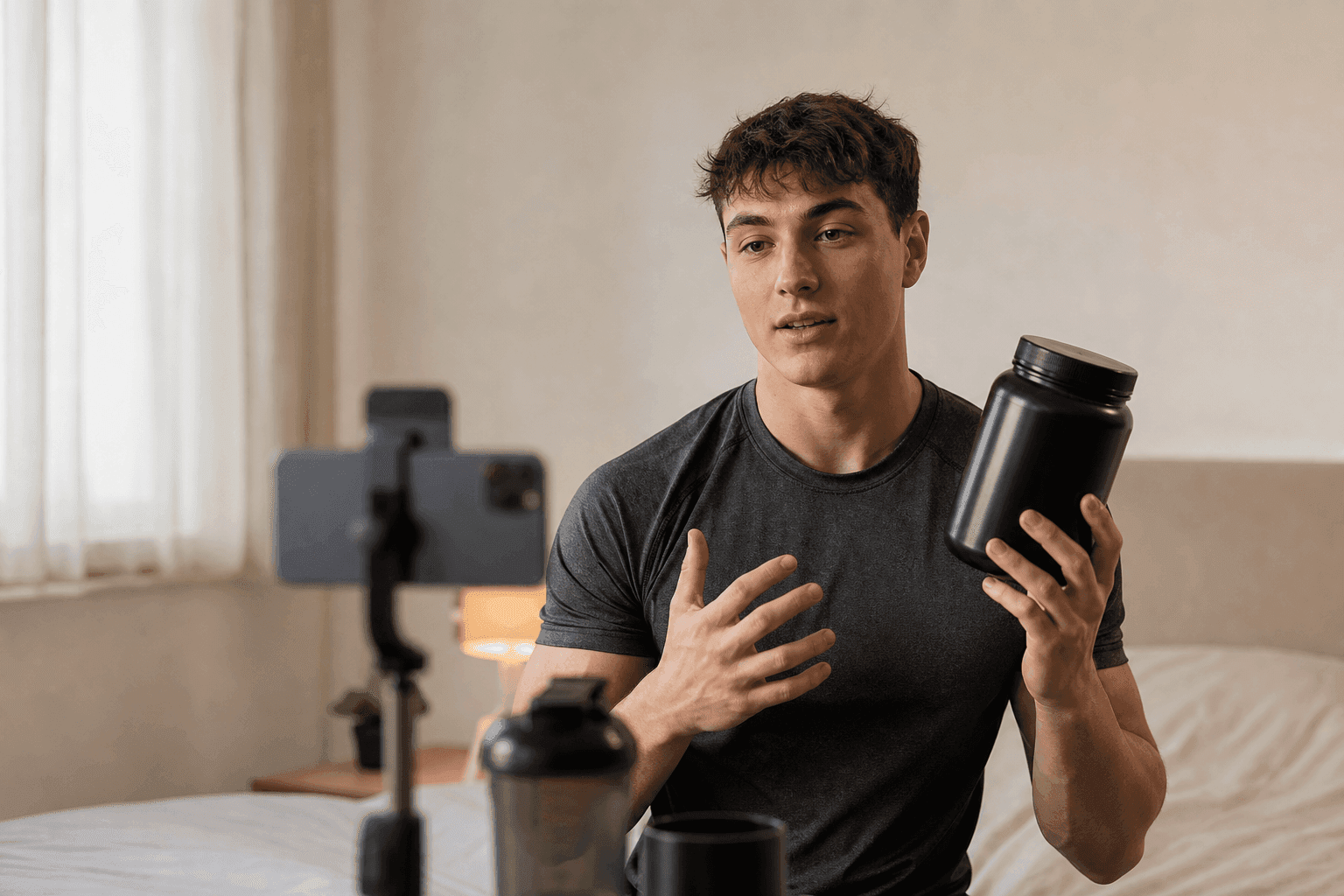
A synthetic spokesperson delivering "here are the three things this serum does" makes product claims, and those claims are checked like any other ad copy. The danger zone is the first-person results story: an AI actor saying "this erased my dark spots in a week" attaches a promised result to a personal experience that never happened. That is the exaggerated-results rule with a face on it, and it is how a fake testimonial gets rejected without any rule naming testimonials. If you are new to the format, our explainer on what a UGC creator is draws the line between a hired human witness and a synthetic presenter.
What the AIGC rules add on top
TikTok's AI-generated content rules stack three more constraints onto ads that use synthetic people:
- Realistic AI-generated content must be labeled.
- AI that "falsely shows public figures in certain contexts," including "making an endorsement, or being endorsed," is banned outright.
- So is using "the likeness of young people under the age of 18, or the likeness of adult private figures used without their permission."
Disclosure is mainstream at this point: TikTok reported that over 37 million creators had used its AI-labeling tool by mid-2024.
Honest synthetic UGC passes both tests
The compliant pattern is straightforward: a labeled synthetic presenter, a script that claims what the product page can prove, and no borrowed faces. That format is thriving on the platform, and the craft behind it, tone, pacing, native-style delivery, is what our guide to UGC-style ads breaks down. The policy does not punish synthetic media. It punishes synthetic evidence.
The pre-publish checklist for AI ads
Run this on every AI-generated creative before it goes into Ads Manager. It takes about five minutes and covers all four categories plus disclosure.
Seven checks before you upload
- Scan the script for absolutes: instantly, guaranteed, permanent, cure, number 1, best. Rewrite each into a process claim.
- Trace every stated result to something your landing page can prove. No proof, no claim.
- Check offer parity: price, discount, and promotion identical in ad and landing page, to the digit.
- Confirm the disclaimers your offer legally needs actually appear, in the ad or on the page, not in your intentions.
- Inspect generated frames for fake UI: play triangles, close buttons, carousel dots, pop-ups. Remove or regenerate.
- Kill transformation reveals: no before-and-after of product effects, no split screens, no wrinkles dissolving on camera.
- Audit rival mentions: no accusations, no mocked users, no unproven "better than" claims. Then turn on the AI label, per the broader rules in our TikTok ads guide.
A worked example: one skincare ad, two fixes
Say your AI actor's generated script opens with "This serum erased my dark spots in one week, best purchase of the year," over a split screen of before-and-after cheeks, ending on "50% off today" while your store runs 30% off.
That single creative fails three ways:
- "In one week" is a time-bound promised result.
- The split screen is a banned before-and-after comparison.
- The 50% claim mismatches the store's 30% offer.
The compliant rewrite keeps the same energy: "Three weeks into this serum, here is my honest routine," B-roll of the actual routine instead of the split screen, and "30% off today" matching the store. Same actor, same length, same hook structure. Every claim now survives review.
How Novoads solves the runaway-claim problem
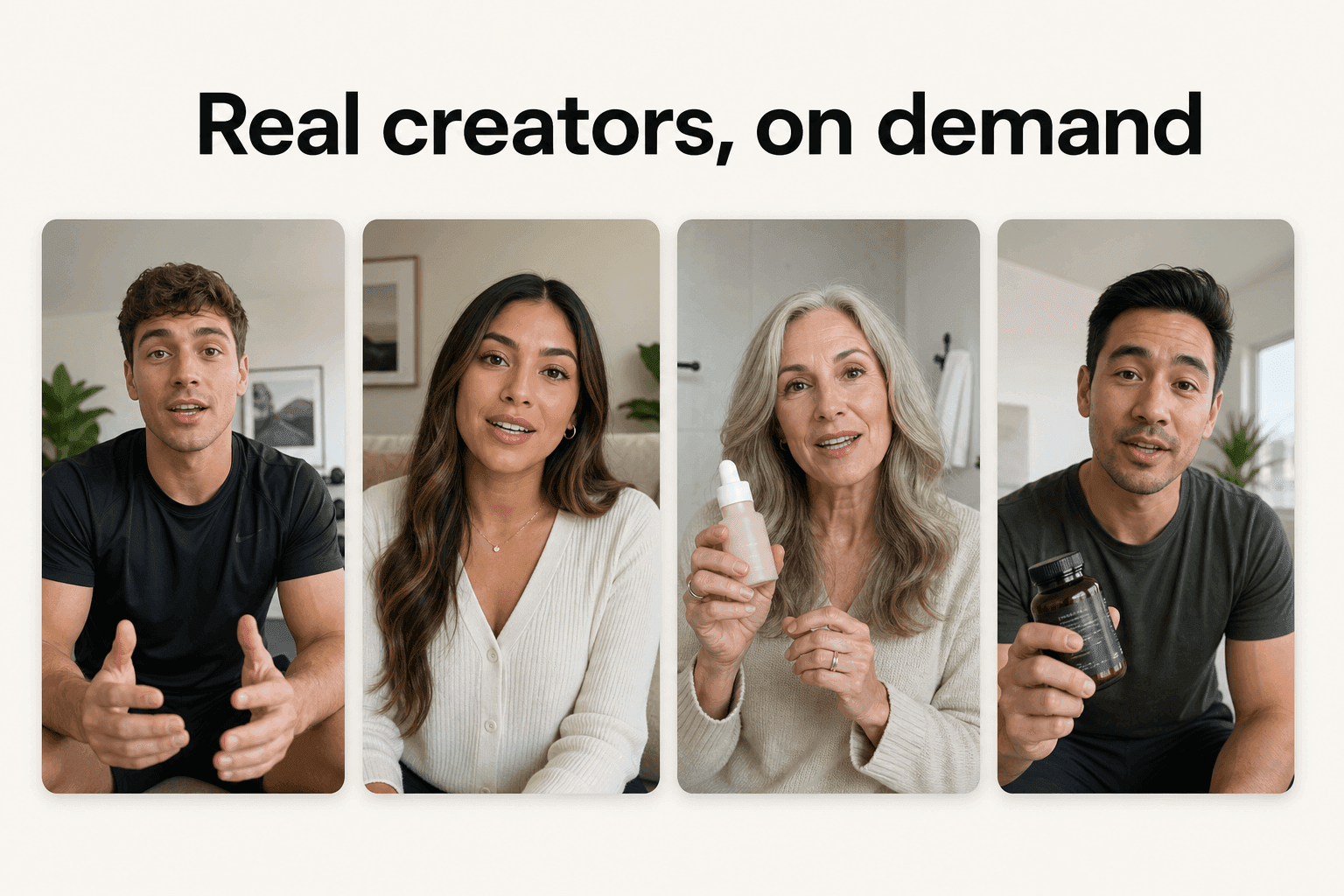
Most misleading-content violations enter AI ads at the script stage, so the fix is owning the script. In Novoads, the workflow is script-first: you write or auto-generate the script, edit every line, then pick an AI actor to deliver it, so no claim reaches the video that you did not approve in text. That makes the seven-point checklist above something you run in thirty seconds on a script box, not something you discover after rendering. The entry plan is $49/mo. Cancel anytime.
The policy is not anti-AI. It is anti-fiction.
Read the whole document and no rule targets how an ad was made. Every rule targets a gap between what the ad says and what is true: the result that will not happen, the discount that does not exist, the button that does nothing, the after that was never a before. AI just industrialized the ways that gap opens by accident. Close the gap at the script, match the page, label the synthesis, and TikTok's strictest ad policy becomes a formatting requirement instead of a threat.
Frequently Asked Questions
What does TikTok consider misleading in an ad?
TikTok's advertising policy groups misleading content into four buckets: claims that promise or exaggerate a product's results, information that is inconsistent between the ad and the landing page, clickbait tactics like fake buttons or deceptive teasers, and comparisons that lack evidence, including before-and-after product results. The policy applies to the ad creative and the landing page together.
Are before-and-after ads allowed on TikTok?
Product-effect comparisons such as before-and-after results are listed as not allowed in TikTok's advertising policy because they can give viewers a false or distorted impression of the product's outcome. The policy's own example is showing wrinkles disappearing through a before-and-after comparison. Treat transformation reveals of a product's effect as off the table for paid creatives.
Can I call my product number 1 in a TikTok ad?
Not without trouble. TikTok does not allow ad content to feature absolute terms about a product in relation to time, region, or brand, and its policy lists Number 1 song on TikTok and Number 1 essence on TikTok as examples of what is banned. Ranked and absolute claims are exactly what reviewers are told to catch.
Does the AI-generated label make a misleading ad compliant?
No. The AI label and the misleading-content policy are separate obligations. The label discloses that realistic content was made or edited with AI. The misleading-content policy judges the claims your ad makes, and an exaggerated result or fake discount is a violation whether or not the ad is labeled. A compliant AI ad needs both: honest claims and correct disclosure.
What happens if my ad shows a bigger discount than my website?
That is an inconsistent-information violation. TikTok's policy example is an ad stating a discount of up to 50% off while the website states only up to 30% off. Mismatched promotions, prices, or missing terms and conditions between the ad and the landing page are grounds for rejection, so check offer parity before you upload.
Are AI actors allowed in TikTok ads?
Yes. A synthetic presenter is not itself a policy violation. TikTok asks that realistic AI-generated content be labeled, and separately bans specific abuses like falsely showing public figures making or receiving endorsements or using someone's likeness without permission. The misleading-content risk lives in the script: an AI actor claiming personal results the product cannot prove is an exaggerated-results violation with a face on it.
Key Takeaways
- TikTok's misleading and false content policy (last updated April 2026) rejects ads in four categories: exaggerated or absolute claims, ad-to-landing-page inconsistency, clickbait mechanics, and unproven comparisons.
- AI generation trips each rule by default: script models write superlatives, image models render perfect outcomes, and both draw fake interface elements unless you stop them.
- The policy explicitly covers landing pages, so a discount, product, or promise that differs between the ad and the site is a rejection even when the video itself is clean.
- Before-and-after product results are effectively off the table, and an AI-generated after image is the easiest version of that violation to produce by accident.
- The AI-generated content label and the misleading-content policy are separate systems: the label discloses how the ad was made, the policy judges what it claims. A compliant ad passes both.