Carousel Ads: How Each Platform Runs Them, What the Cards Cost With AI, and TikTok's Music Rule
How Meta, TikTok, Google, Pinterest and LinkedIn run carousel ads, how to make each card from one product photo with AI, and what a set of cards costs.

Mauricio Valdivia
·12 min

We made two carousel cards from one blender photo
Both card pictures in this post started from one AI-made photo of a mint portable blender, a product we made up so no real brand would show. We uploaded that photo to Novoads, and GPT Image 2, working from a ready-made ad prompt, turned it into a finished ad picture for 1 credit. A second ready-made prompt gave us a second card for one more credit. Each one came back in a tall 4:5 shape with a headline we didn't write ("BLEND WELL. LIVE WELL." on the first). The words on both cards came from the model, so they're the first thing you'd change.
A carousel is a single ad with several cards that people swipe through, and the cards are only part of the work. Each platform sets its own rules for how many cards an ad takes, what shape they come in, whether a card can be a video and, on TikTok, whether the ad needs music. Whether you're planning a card for each of five new products, a before and an after from a finished job, or a few customer reviews worth a card each, the pictures have to fit those rules before you open an ads tool.
For this post, we read each platform's own carousel pages and seven of the articles in Google's top ten for "carousel ads", all on November 17, 2026. We priced the cards from our own price list and made the two cards in our own workspace, but we didn't build or run a carousel on any platform. The seven articles are about Meta's carousel on Facebook and Instagram, or about social ads in general. None of them covers TikTok, Google, Pinterest or LinkedIn, none mentions music, and none puts a price on making the cards. The one from an AI ad tool's blog tells you to shoot or generate your product visuals, but it doesn't show what generating them involves.
What brands put on the cards
Five ways of filling the cards suit a small brand, and each one asks something different of the pictures. AI helps most with the first three. The last two need your own photos and your customers' own words.
- One product per card. A new collection gets one card per product, each linked to that product's page where the platform gives every card its own link. AI can put each product in a scene from your photo, but every color, size and package it shows has to be one you actually sell.
- One product, one feature per card. A kitchen gadget can give its lid, jar and base a card each, and a jacket can do the same for its fabric, pockets and lining. AI can make those pictures from your photos, as long as no card shows a feature the product doesn't have or a result it doesn't deliver.
- A short story across the cards. The first card sets up the problem and the last one shows your product solving it. AI scenes work well for the cards in between, as long as none of them is passed off as your real shop, your staff or a real customer.
- Reviews, one per card. Each card carries one real review from a real customer, word for word. AI shouldn't write the review, and an AI actor shouldn't stand in for the customer who wrote it.
- Before and after. A cleaner, landscaper or renovator can show a job with one card for before and one for after. Both have to be your own photos of the real work, because an AI-made before or after shows a job that never happened.
Clothing brands have a few more formats to choose from, and our fashion advertising guide walks through them. A shirt brand has more to go on in our post on t-shirt ads, from the drop ad to the FTC's made-in-USA line.
How each platform runs a carousel
All five platforms below call the format a carousel ad, but their card counts, shapes and rules differ. Each page's rules apply only on its own platform. We read all the pages on November 17, 2026, and only TikTok's carry a date (a last update in September 2026).
| Platform | Cards in one ad | Card shape | Video cards |
|---|---|---|---|
| Meta (Facebook and Instagram) | 2 to 10 | 1:1 and at least 458 x 458 pixels on Facebook, at least 600 x 600 on Instagram | On Instagram, square and 60 seconds at most |
| TikTok (standard carousel ad) | 2 to 35 | 1200 x 628, 640 x 640 or 720 x 1280 | No, TikTok describes it as an image format |
| Google (Demand Gen) | 2 to 10 | Horizontal, square or vertical, the same on every card | No, images only |
| 2 to 5 (2 to 10 on the sales objective) | 1:1 or 2:3 | Only on the sales objective, from your catalog | |
| 2 to 10 | 1:1, at least 1080 x 1080 pixels | Not at this time |
Meta's carousel, from its developer documentation
We couldn't read Meta's help center for advertisers, so Meta's numbers here come from its developer documentation for the ads API, which isn't dated. It describes a carousel as 2 to 10 cards and says you should use at least 3 for the best results. On Instagram, each card has one picture or video and its own call-to-action button, and the whole ad shares one message.
A picture card for Instagram has to be at least 600 x 600 pixels, which the documentation calls significantly bigger than the minimum for Facebook carousel ads. For Facebook, it lists a 1:1 picture of at least 458 x 458 pixels for best display. A video card on Instagram has to be square, at least 600 pixels on each side, and no longer than 60 seconds.
TikTok's two kinds of carousel
TikTok's specifications page for carousel ads has a column for each of its two kinds. A standard carousel ad takes 2 to 35 pictures in one of three sizes (they're in the table above). It allows one caption, one call-to-action button and one link for all the pictures. The catalog carousel, which the page calls a VSA carousel, shows 2 to 20 of your catalog's product pictures, and each one can lead to its own product page. TikTok's carousel overview says the standard kind can run as a Spark Ad or a non-Spark ad, while the catalog kind is non-Spark only.
The overview describes the format as one that "supports images for TikTok-in-feed ads" and says it's meant for advertisers who don't have video or who want to reuse creative made for other platforms. If you do have video, our guide to making TikTok ads is a better place to start. If you'd rather turn the same pictures into a single video, our guide to slideshow ads covers that format. Both kinds of carousel need music, which we'll come back to at the end.
Google's carousel in Demand Gen campaigns
Google runs carousel ads in Demand Gen campaigns as a swipeable image carousel across its feeds. Its help page says they cost the same as single-image ads. A carousel takes 2 to 10 pictures, one per card, and every card has to be the same shape, whether that's horizontal, square or vertical. Each card can have its own landing page and its own headline, though Discover shows the ad's main headline on every card. If one card is disapproved, the others still run. The page also says carousels aren't available when a Demand Gen campaign uses a Google Merchant Center product feed.
The vertical shape matters for the cards in this post. Google's image specs list a vertical picture as 4:5 and at least 480 x 600 pixels. Our blender cards came out in that shape, at 1,024 x 1,280.
Pinterest's carousel and its sales version
Outside the sales objective, Pinterest's ad specs page allows 2 to 5 pictures per carousel, in a 1:1 or 2:3 shape. Each picture is a PNG or JPEG of up to 20 MB. On the sales objective the count changes, and the page says "2 to 10 images and video per carousel. This only applies to the sales objective." Those cards come from your catalog, and the page adds that dynamic carousels pull their cards from your product groups automatically. Our Pinterest ads guide covers Pinterest's other ad formats.
LinkedIn's carousel
LinkedIn's carousel ads take 2 to 10 cards, and its overview page says each picture gets its own link. The specs page asks for square pictures of at least 1080 x 1080 pixels. A card's headline can run up to 45 characters. The same page says LinkedIn's carousel ads "do not support video at this time", so every card has to be a picture.
Making each card in Novoads
Novoads makes the pictures and the clips for the cards. It doesn't have a carousel builder, so you put the ad itself together (card order, captions, links and music) in the platform's own ads tool.
Card pictures from one product photo
The Image tool takes your product photo as a reference picture and draws the card you describe, on the model you pick. Our two blender cards came from GPT Image 2, each with a ready-made ad prompt that asked it for a headline. In the Image tool you write that prompt yourself, so the steps below give you a card like ours rather than the same one.
- Click Image in the row of tools at the top of a new project.
- Click Reference and add your product photo. It takes a JPG, PNG or WebP file.
- In the prompt box, describe the scene and the light, and write out the words you want on the card, in the language you want them in.
- Click Settings, pick GPT Image 2 under Model and set Quality to Medium.
- Send it with the round up-arrow button. Each picture costs 1 credit, and a run makes as many as you set under Images.
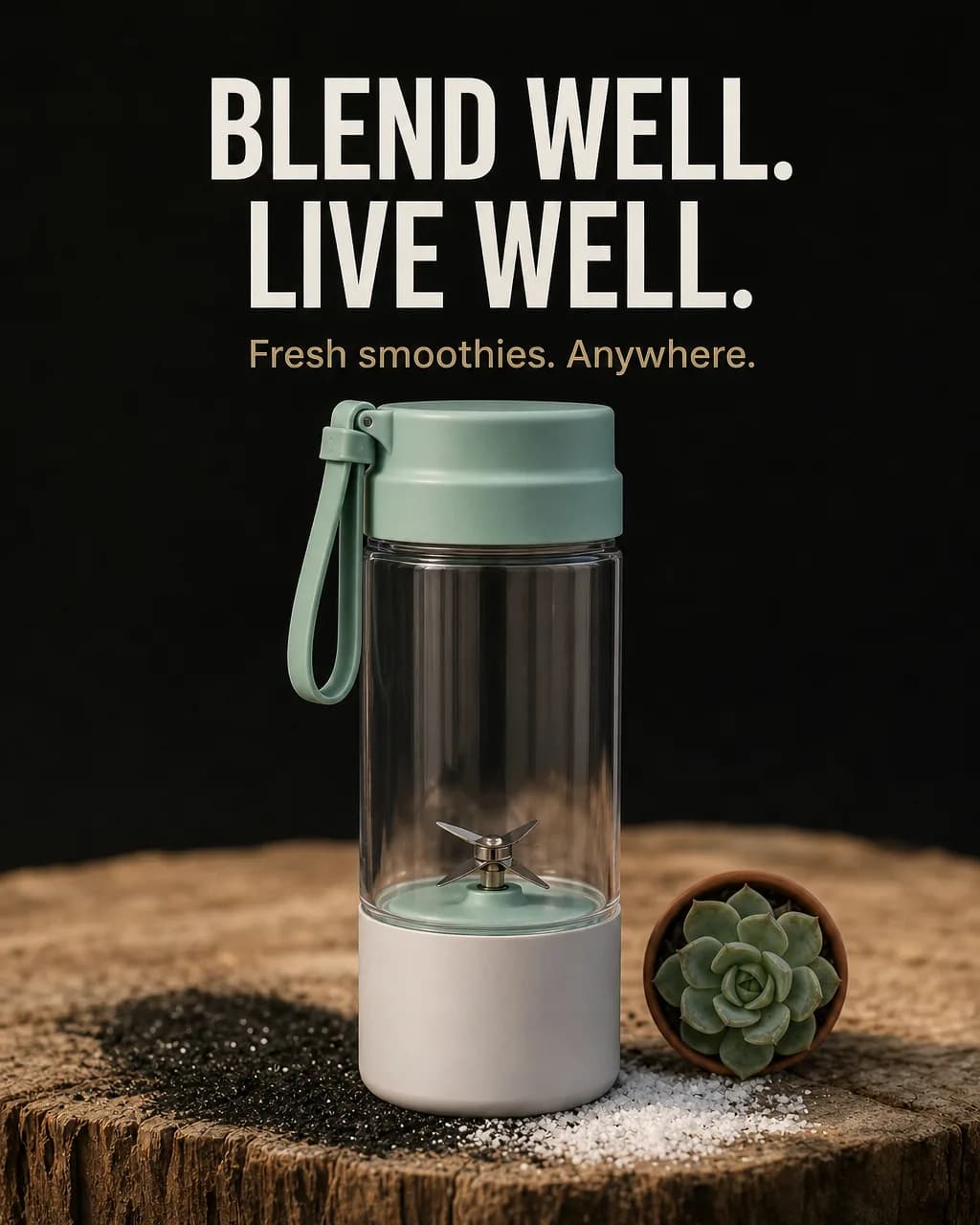 Made in Novoads with GPT Image 2 from an AI photo of a made-up blender that stands in for your own product photo · 1 credit · 2026-11-17
The words and shape on each card
The model wrote the words on both cards from the photo and those prompts alone. The first card says "BLEND WELL. LIVE WELL." and "Fresh smoothies. Anywhere.", and the second says "Blend more, live better." Before a card runs, swap in your own words and the true facts about your product. A third ready-made prompt we tried put supplement benefits on the blender card. So we left that card out, and we read every word the model writes before a card goes anywhere.
Both cards came out at 4:5, the vertical shape Google's carousel takes. But Meta's documentation gives Facebook cards a 1:1 shape, LinkedIn asks for square pictures, and none of TikTok's three sizes is 4:5. In the Image tool, you set the shape under Aspect ratio, and GPT Image 2 makes these at 1 credit a picture.
- 1:1 for Facebook, LinkedIn, Pinterest and TikTok's square size
- 2:3 for Pinterest
- 9:16 for TikTok's vertical size
For Google's 4:5, pick Nano Banana Pro under Model instead. It costs 2 credits a picture at its default size. To leave the words off, ask for none in your prompt, and put your own copy in the platform's caption and headline fields instead. Check each picture's pixel size against the platform's own specs before you upload it.
 Made in Novoads with GPT Image 2 from the same blender photo, with a second ready-made prompt · 1 credit · 2026-11-17
If you'd rather not write the prompt, the Images card on your Novoads home turns one product photo into four 4:5 ad pictures, with the words written for you and every word checked. A set costs 6 credits at most at Lite, the quality the card starts on.
Making a video card
Of the five platforms, only Meta's documentation describes a video card you upload yourself, for Instagram. Pinterest's sales carousel takes video too, but from your catalog. For an Instagram video card, make a square card picture first, then turn it into a clip that starts on that picture.
- Click Video in the same row of tools and pick Wan 3.0 in the model menu.
- Switch the frame option from Reference to Start / End Frames, then drop your card picture where it says "Drop a start frame or click to upload". The editor then shows "The video starts on this picture."
- In the settings, set Duration to 5 seconds, Aspect ratio to 1:1 and Resolution to 720p.
- Describe the movement you want in the prompt box (a slow turn of the product, for example) and send it with the round up-arrow button.
A five-second Wan 3.0 clip at 720p costs 9 credits. Kling 3.0 can start on your picture too, at 10 credits for five seconds. Our guide to product videos made with AI goes deeper into clips that start from one photo.
Putting the carousel together
Take the finished pictures and clips into the platform's own ads tool. That's where you pick the carousel format, put the cards in order and add each card's link and headline where the platform allows them. On TikTok, it's also where you choose the music. Novoads makes the cards, and the ad runs from your own ads account on each platform.
What the cards cost
Prices as of November 17, 2026.
| What you make in Novoads | Credits |
|---|---|
| A card picture from your product photo, on GPT Image 2 at medium quality | 1 |
| A 4:5 card picture for Google, on Nano Banana Pro at its default size | 2 |
| A five-second Wan 3.0 clip at 720p that starts on a card picture | 9 |
| A five-second Kling 3.0 clip that starts on a card picture | 10 |
A carousel with five square picture cards and one Wan 3.0 clip card comes to 14 credits. What that costs in dollars depends on your plan.
| Plan | Price a month | Credits a month | Five pictures and one clip | Sets a month |
|---|---|---|---|---|
| Starter | $15 | 200 | $1.05 | 14 |
| Plus | $49 | 1,000 | about 69 cents | 71 |
| Ultra 3,000 | $129 | 3,000 | about 60 cents | 214 |
Our pricing page lists each plan's monthly credits and price.
For comparison, Freshy, a web design agency, has a guide to what graphic designers cost (updated in June 2026). It says individual posts from a freelance designer range from $25 to $150 each, depending on complexity. That's an agency's estimate for one social media graphic. At that rate, five cards would run $125 to $750, though a designer may well quote a set of cards as one job.
The 14 credits cover the pictures and the clip. They leave out the ad spend, the words and the link on each card, the music TikTok asks for, and the time it takes to check each card against the real product. If a card comes back wrong, the way our third card did, making it again costs the same credits a second time.
Make the pictures for your next carousel
Add one product photo as a reference and get a card picture on GPT Image 2 for 1 credit, then build the carousel in your own ads tool.
See the plansTikTok's music rule, and what it means for your cards
What TikTok's specifications page says
TikTok's specifications page for carousel ads says "Music is essential for Carousel Ads. You can either choose music from the CML or upload your own." CML is TikTok's Commercial Music Library. In the column for a standard carousel ad, the page lists "Music is a must (will play loop playback)", so the track loops while people swipe through the pictures. A standard carousel ad takes music from the library or an MP3 you upload, at least 2 seconds long. The catalog carousel takes only uploaded music.
Where library music goes silent
The same page warns that library music plays only on TikTok itself. In its words, "If you select CML music for your Carousel Ads, it will only play on TikTok, making the ads silent for TikTok Ad Network placement." The page offers two ways around that. You can upload your own music, which plays in both places, or you can make two carousels (one set to TikTok only with library music, and one set to TikTok Ad Network only with your own track). TikTok's carousel overview adds that automatic placement filters TikTok Ad Network out, so as we read it, the silence is limited to that one placement.
We'd say the music rule changes your checklist more than your cards, because you put the track under the pictures in TikTok's own ads tool. A standard carousel ad on TikTok needs a track picked there. If the ad will also run on TikTok Ad Network, make it a track you upload.
Frequently Asked Questions
How do I post a carousel ad on Instagram?
You build it in Meta's own ads tool with at least two cards, each with one picture or video and its own call-to-action button. Meta's developer documentation asks for picture cards of at least 600 x 600 pixels on Instagram, and for video cards that are square and no longer than 60 seconds. Novoads can make the pictures and clips for the cards, but you post the ad from your own Meta account.
What is the best size for Facebook carousel ads?
Meta's developer documentation lists a 1:1 picture of at least 458 x 458 pixels for best display on a Facebook carousel card. For Instagram, it asks for at least 600 x 600 pixels, so a square picture at least 600 pixels on a side works for both. In Novoads, the Image tool makes a square picture when you set its Aspect ratio to 1:1.
Does a TikTok carousel ad need music?
Yes. TikTok's specifications page says a standard carousel ad must have music, picked from its Commercial Music Library or uploaded as your own MP3. Library music plays only on TikTok and leaves the ad silent on TikTok Ad Network placements, so the page suggests uploading your own track or making two ads. You pick the track in TikTok's ads tool.
What does it cost to make carousel cards with AI?
As of November 17, 2026, a card picture made from your product photo in Novoads costs 1 credit on GPT Image 2 at medium quality, or 2 on Nano Banana Pro for Google's 4:5 shape. A five-second Wan 3.0 clip at 720p costs 9 credits. Five square pictures and one clip come to 14 credits. That's $1.05 on Starter and about 69 cents on Plus, and it doesn't include your ad spend, the music or any card you make again.
Key Takeaways
- Novoads makes the pictures and clips for a carousel's cards. You put the carousel itself together (card order, links and captions) in each platform's own ads tool.
- Every platform sets its own card limits. TikTok's specifications page allows 2 to 35 pictures in a standard carousel ad. Pinterest's ad specs allow 2 to 5 outside its sales objective.
- Meta's developer documentation, Google's Demand Gen help page and LinkedIn's specs page all allow 2 to 10 cards. LinkedIn's page adds that its carousel ads don't support video at this time.
- A card picture from your product photo costs 1 credit on GPT Image 2 at medium quality in a square, 2:3 or 9:16 shape, or 2 credits on Nano Banana Pro at 4:5, the vertical shape Google's carousel takes. Five square pictures and one five-second Wan 3.0 clip come to 14 credits. On Plus, that's about 69 cents.
- TikTok's specifications page says a standard carousel ad must have music, either from its Commercial Music Library or your own file. It adds that library music leaves the ad silent on TikTok Ad Network placements.
Sources
- •TikTok Ads Manager help: Specifications for Carousel Ads
- •TikTok Ads Manager help: About Carousel Ads
- •Meta for Developers: Instagram Carousel Ads
- •Meta for Developers: Video and carousel ads
- •Google Ads Help: Image asset specifications for Demand Gen campaigns
- •Pinterest Business help: Review ad specs
- •LinkedIn Marketing Solutions: Carousel Ads specifications
- •Freshy: How much do graphic designers cost?