T-Shirt Ads: Video Ideas for a Shirt Brand, What Each Costs With AI, and the FTC's Made-in-USA Line
Five t-shirt ads to make for a drop, how to build each in Novoads from your own shirt photos or with an AI presenter, what they cost on each plan, and the FTC's made in U.S.A., imported, or both line for a shirt sold by mail order, online included.

Mauricio Valdivia
·12 min
Three Shirts on a Worktable, Four Seconds of Motion
Three folded t-shirts in heather grey, black and white sit on a wooden worktable, each printed on the chest with the same thin line drawing of three mountain peaks. Next to them are a stack of kraft mailer bags and a roll of brown tape. We made that picture for this post with GPT Image 2.6 Sunburst, as a stand-in for the phone photo a small shirt shop takes of its own stock. Then we turned it into a four-second Seedance 2.0 Mini clip through our own Claude connector, with the camera gliding along the stack toward the mailers. Both came back on the first try, with no person, logo or readable text in them. The mountain drawing came from a written prompt, so it's nobody's design.
If you run a shirt brand or a print-on-demand shop, that table is your week. Three new designs go live Friday, and each one needs something that moves. A shopper writes in to ask which size to order, because they can't try the shirt on. And the holiday code you just set up needs a clip before the weekend, made by the same person who answers the inbox and packs the orders.
The pages that rank for "t-shirt ads" mostly show other brands' ads, or shirts printed to work as ads themselves. None of the ones we opened puts a price on making an ad, shows how to make one with AI, or mentions the origin line a shirt sold by mail order has to carry. On November 17, 2026, we read those pages in US search results, the FTC's Textile Rules (in the government's edition revised as of January 1, 2026) and our own price tables. The still and the clip are the only tests we ran for this post. We didn't run either one as an ad, so nothing here claims a sale.
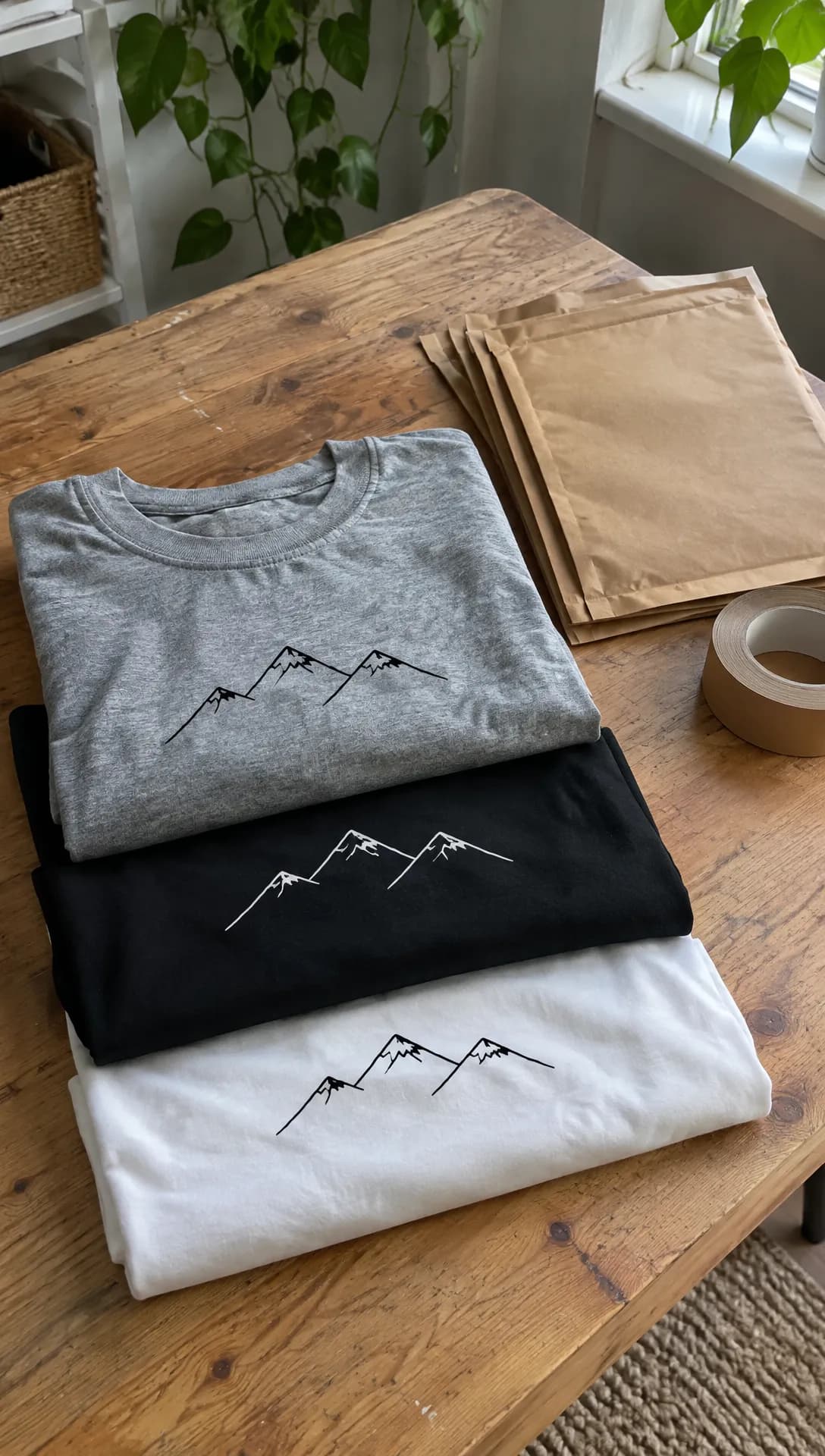 Made in Novoads with GPT Image 2.6 Sunburst · three printed tees folded beside kraft mailers, as a small shop's own product photo · stands in for your own photo · 1 credit · 2026-11-17
The Ads That Shirt Brands and Print-on-Demand Shops Run
Five kinds of ads come up across the pages we read. Every one of them can start from photos you already have, and every one has something AI must never put on screen. If you sell more than shirts, our guide to ecommerce video ads takes the wider view.
The fit and size ad
A shopper looking at a screen can't feel the cotton or hold the shirt up to a mirror, so this ad answers the questions that already land in your inbox. How does the cut run, what size is the person in your photo wearing, and what happens if the size is wrong? One of the ranking pages describes a brand that runs it as UGC-style video of real customers with different body types.
With AI, the honest version is an AI presenter reading fit facts you already keep, such as these.
- The height of the model in your photo and the size they're wearing.
- How wide each size is across the chest.
- How long a shopper has to send a shirt back.
Intercut the presenter with clips made from your real on-model photos, so the shirt on screen is the one you ship.
Two things stay off screen. One is the presenter posing as a customer who bought and wore the shirt, since it's an AI actor speaking for your brand. The other is an AI-made body standing in for how your shirt fits. A stock actor from our library also has empty hands, so the shirt itself comes from your photos.
The drop ad for a new run of designs
When three designs go up at once, each print deserves its own few seconds. The pages we read show it as a single ad with several prints or colorways, either as a carousel or as a slideshow. AI is good at this one, because a flat-lay or on-model photo of each design can become a short clip. Then you join the clips into one video, or give each design its own card when you build a carousel in the ad platform. If you also sell on Etsy, our post on Etsy ads covers its listing videos.
The print is the thing to watch. When a video model moves the fabric, it can redraw a fine line or a letter along the way. Check every frame against the shirt you'll actually ship, and never show a design you don't sell. In the four frames from our clip further down, the peaks keep their shape for as long as the shirts stay in view.
The offer ad with a code and an end date
This is the blunt one, the ad for a promo code that has to be live by Friday. It shows a close shot of the shirt, the discount in big type, the end date and one button. With AI, it's either an ad picture made from your product photo or a short clip that starts on that photo, with the code in the ad's own text.
Keep it true to the shirt and to the sale. Don't show a fabric close-up that isn't your fabric, and don't show a discount you aren't running. When an AI tool writes words onto a picture for you, read every one before the ad goes anywhere.
The origin ad about how your shirts are made
If your brand has a sourcing story (organic cotton, a print shop down the street, a supplier you've visited), it belongs in an ad, because nobody can see it on the shirt. An AI presenter can tell that story from your script while the clip shows your own photos of the press, the screens or the packing table.
It must not show a factory, a print shop or workers that aren't yours. It also never calls a shirt made in USA when the shirt's label says it's imported, and that's where the FTC rule further down comes in.
The seasonal clip that carries a promo code
A short vertical clip tied to a season, a game day or a local event is the ad that carries the code. AI adds slow movement to your real on-model photo. You add a voice reading the code, plus subtitles that work with the sound off. Don't cast AI-made people as your customers or your community, and don't show an event that never happened.
How to Make Each Ad in Novoads
Every ad above starts from a photo of your shirt, an AI presenter reading your words, or both. In the Novoads editor, those parts come from four tools. Words in quotes are labels you'll see on screen. If you've never made a clip from a product photo, our walkthrough of product videos made with AI starts there, and our guide to AI ads covers the wider process.
A clip that starts on each design's photo
For drop clips, reach for Kling 3.0, because in the editor it opens the clip on your photo.
- In a new project, choose Video and pick Kling 3.0 in the model menu.
- Drop the design's photo into the box that reads "Drop a start frame or click to upload". Once it's in, the editor tells you "The video starts on this picture."
- Pick 9:16 for a vertical feed and keep the length at 5 seconds, Kling 3.0's default. In the prompt, describe the motion you want, such as a slow push toward the print in soft window light.
- Send it with the round button that has an up arrow. You get back a five-second clip that opens on your photo. It costs 10 credits.
Do that once per design, then check each clip frame by frame against the real shirt (its print, its color, its neckline). Other models in the menu treat your photo in their own ways.
- Kling 4.0 and Google Veo 3.1 also open a clip on a photo dropped in the same box.
- Omni Flash and Wan 3.0 open on it once you switch "Reference" to "Start / End Frames".
- Seedance uses your photo only as a reference (you call it @Image1 in the prompt), so its clip doesn't open on your shirt.
The clip in this post took a different route. We made it through our own Claude connector, which can start a Seedance 2.0 Mini clip on a picture. We kept it at 480p and four seconds because it was a cheap test of the motion. For a real ad, you can make the clip at 720p. At that size, five seconds of Seedance 2.0 Mini costs 5 credits.
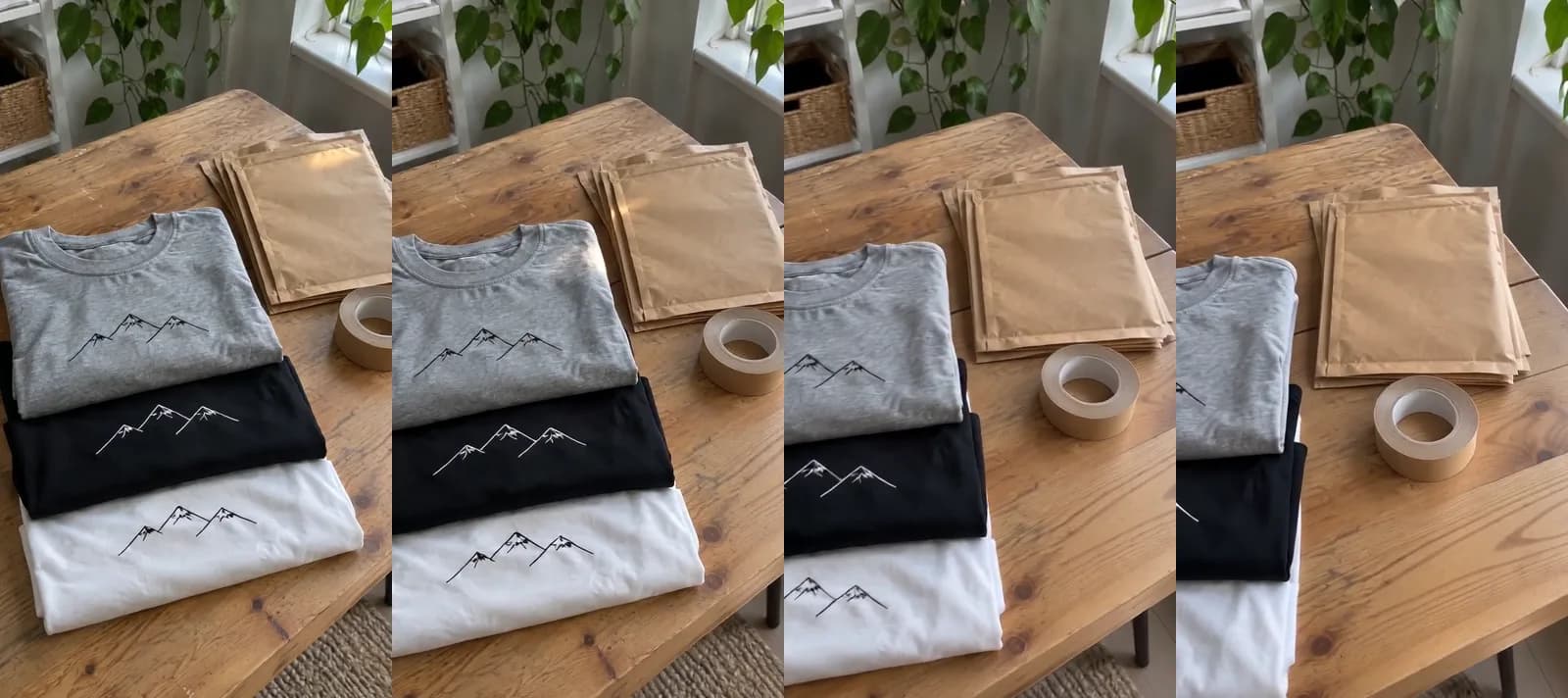 Made in Novoads with Seedance 2.0 Mini · the camera glides along the folded shirts to the mailers, started on the still above through our Claude connector, 480p, sound off · 2 credits · 2026-11-17
A fit ad read by an AI presenter
In the fit ad and the origin ad, an AI presenter does the talking.
- Choose Talking Actors and pick an AI actor.
- Paste a script built from your size chart, written in your brand's voice and never as a customer. It should cover who's wearing which size in your photos, how the cut runs and how returns work.
- On the price line, keep 720p, the default, or switch to 480p, which costs half as much for the same minute.
- Send it. Back comes the AI actor speaking your script, with voice and lip-sync. Subtitles are a separate step.
We bill talking actors by the started minute, so any read up to a minute costs the same. Between the presenter's lines, cut in the Kling 3.0 clips of your real shirt, so shoppers see the shirt you ship while they hear how it fits.
An offer picture from your product photo
The static offer ad uses a different tool.
- Choose Image, click "Reference" and add the shirt photo.
- In the prompt, describe the picture and write out the words you want on it, in your shoppers' language.
- Under "Settings", pick "GPT Image 2" as the "Model", "Medium" as the "Quality" and how many pictures you want under "Images", then send it. Each picture costs 1 credit.
Any words it writes come out in the language you wrote them in. Read every one before the picture runs, and put your code and the end date in the ad's own text wherever you run it.
Subtitles for feeds that play muted
Choose Captions to put subtitles on a finished video, such as the fit ad or a clip with a voice reading your code. The tool opens on the "TikTok, no box" look. It's one of six looks, and each costs 3 credits per started minute at any size. For vertical clips headed to TikTok itself, our guide to making TikTok ads covers the platform's side, and if you sell through TikTok Shop, our post on TikTok Shop ads covers that side too.
The Credit Math Behind a Three-Design Drop
Credits and plan prices here come from our price tables as of November 17, 2026. We worked out each dollar figure ourselves by multiplying the credits by what one credit costs on that plan.
- Starter is $15 a month for 200 credits (about 7.5 cents a credit), billed monthly only.
- Plus is $49 a month for 1,000 credits (about 4.9 cents a credit), or $39 a month billed yearly.
- Ultra 3,000 is $129 a month for 3,000 credits (about 4.3 cents a credit), or $99 a month billed yearly.
You'll find every plan and what its credits cover on our pricing page. Every clip in the table runs five seconds.
| What you make | Credits | Starter | Plus | Ultra 3,000 |
|---|---|---|---|---|
| Fit ad, AI presenter, 480p | 100 | $7.50 | $4.90 | $4.30 |
| Fit ad, AI presenter, 720p | 200 | $15.00 | $9.80 | $8.60 |
| One design clip, Kling 3.0 | 10 | 75 cents | 49 cents | 43 cents |
| Three design clips, Kling 3.0 | 30 | $2.25 | $1.47 | $1.29 |
| One design clip, Kling 4.0, 1080p | 27 | about $2.03 | about $1.32 | about $1.16 |
| One offer picture | 1 | about 8 cents | about 5 cents | about 4 cents |
| Subtitles, per started minute | 3 | about 23 cents | about 15 cents | about 13 cents |
| Fit ad at 480p, three design clips | 130 | $9.75 | $6.37 | $5.59 |
The set we priced for a drop is the fit ad at 480p plus one Kling 3.0 clip per design. With three designs, that's 130 credits in all. On Plus, billed monthly, it comes to $6.37. A Starter month covers one set with 70 credits left over. Plus covers seven sets a month. Ultra 3,000 covers 23. At 720p, the talking actor's default, the fit ad alone takes 200 credits, a whole Starter month.
That total leaves a few things out.
- Each time you redo a clip, you pay its credits from the table again.
- Subtitles count only if you add them.
- It doesn't cover a voice reading your code or joining the clips into one video, because we can't price either step from our tables here.
- The money you spend running the ads is yours to set, and so is the time it takes to check each clip against the real shirt.
Launchpoint, a UGC vendor, updated its rate guide for fashion creators in March 2026. It says "UGC creators in the fashion and apparel sector typically charge between $150 and $500 per ad-ready video". The same page describes these creators as showcasing garments "on real bodies in relatable settings". Nothing in our table puts your shirt on a real body, so the two prices cover different jobs.
You make the clips, the presenter and the pictures in Novoads, and you run the ads wherever you sell. Every Novoads plan is paid from the first month.
Price your next drop before Friday
Starter, Plus and Ultra are on one page, each with the credits a month brings.
Compare the plansWhat the FTC's Textile Rules Ask of a Shirt Listing
None of the ranking pages we opened mentions this rule. It matters most for ads that send a shopper to a listing, and for the origin ad, which is about where the shirt comes from.
What section 303.34 says
Section 303.34 of the FTC's Rules and Regulations Under the Textile Fiber Products Identification Act (the Textile Rules, for short) covers country of origin in mail order advertising.
When a textile fiber product is advertised in any mail order catalog or mail order promotional material, the description of such product shall contain a clear and conspicuous statement that the product was either made in U.S.A., imported, or both. Other words or phrases with the same meaning may be used. The statement of origin required by this section shall not be inconsistent with the origin labeling of the product being advertised.
We read it in the edition of Title 16 revised as of January 1, 2026, on govinfo.gov. The section isn't new. It dates from April 17, 1985. Section 303.1(j) defines wearing apparel as "any costume or article of clothing or covering for any part of the body worn or intended to be worn by individuals". By our reading, a t-shirt falls squarely inside that definition.
Mail order material, as the rules define it
"Mail order" sounds like a paper catalog, but section 303.1(u) defines both of the rule's terms, mail order catalog and mail order promotional material, as any materials "used in the direct sale or direct offering for sale of textile products, that are disseminated to ultimate consumers in print or by electronic means, other than by broadcast, and that solicit ultimate consumers to purchase such textile products by mail, telephone, electronic mail, or some other method without examining the actual product purchased." In the edition revised as of January 1, 2026, that definition was last amended on April 4, 2014. A product page or an emailed promo reaches a shopper by electronic means, which is why we read the rule as covering a shirt sold online.
Who it binds and what it means for your ads
It's a US federal rule about mail order material, so it covers the material that sells a shirt directly to a shopper who can't examine it first. Measured against that definition, the material falls into three groups.
- An online catalog, a product listing a shopper can buy from, or an emailed promo fits those words.
- A TV spot falls outside them, since broadcast is carved out.
- A brand video with no product description isn't clearly inside them.
Applied to the five ads above, our reading goes like this. It isn't legal advice.
- The drop ad and the offer ad usually send a shopper to a listing, so the listing they land on is where we'd state made in U.S.A., imported, or both, in words that match the label.
- A shop ad that describes the shirt so a shopper can order it, such as a product card with its price and sizes, reads to us as mail order material too, so we'd put the line in the ad's own text.
- The origin ad talks about where the shirt comes from, so we'd check its words against the shirt's origin label before it runs.
- If you print on blanks made by someone else, we'd find out where the blank was made before writing the line, because the statement can't contradict the shirt's origin label.
- A fit ad or a seasonal clip with no product description isn't clearly covered by the rule, but the listing it sends people to is.
You can read section 303.34 and section 303.1 yourself on govinfo.gov, the government's own copy.
What to Make First for Friday's Drop
Start with one Kling 3.0 clip per design, since you already have a photo of each design and each clip costs 10 credits. Then make one fit ad from your size chart and use it all season, because the fit of a blank doesn't change when the print does. Save the offer picture and the seasonal clip for the week the code goes live. Before any of it runs, read the origin label on the shirt you ship, and make sure the line on your listing (made in U.S.A., imported, or both) matches it.
Frequently Asked Questions
Does every t-shirt ad have to say made in USA or imported?
Not according to the rule's own words. Section 303.34 of the FTC's Textile Rules says the description of a textile product advertised in a mail order catalog or mail order promotional material 'shall contain a clear and conspicuous statement that the product was either made in U.S.A., imported, or both'. Section 303.1(u) defines that as material sent to shoppers in print or by electronic means, other than by broadcast, that asks them to buy without examining the product. An online catalog, a product listing a shopper can buy from or an emailed promo fits those words. A TV spot doesn't, and a brand video with no product description isn't clearly covered. That's our reading of the rule's text in the edition revised as of January 1, 2026, and it isn't legal advice.
Key Takeaways
- Five kinds of t-shirt ads come up on the pages that rank for the term (a fit and size ad, a drop ad for new designs, an offer ad, an origin ad and a short seasonal clip), and every one of them can start from your own shirt photos.
- In the Novoads editor, Kling 3.0 opens the clip on the photo you drop in as its start frame. Seedance only uses a photo there as a reference, so its clip doesn't open on your shirt.
- The set we priced is a fit ad read by an AI presenter at 480p plus a Kling 3.0 clip for each of three designs. It comes to 130 credits, or $6.37 on Plus, billed monthly.
- Launchpoint, a UGC vendor, updated its rate guide in March 2026. It says fashion and apparel UGC creators typically charge between $150 and $500 per ad-ready video.
- Under the FTC's Textile Rules, when a shirt is advertised in mail order material (which the rules define to include material sent by electronic means, other than broadcast), its description has to carry a clear and conspicuous statement that it was made in U.S.A., imported, or both. That statement can't contradict the shirt's origin label.