Comparison Ads: How to Make a Us-Versus-Them Video With AI, What It Costs, and What the FTC Encourages
The shapes a comparison ad can take, how to build each one with AI from your own product photos, what one costs on each Novoads plan, and what the FTC's 1979 policy statement says about naming a rival.

Mauricio Valdivia
·11 min

Two mugs on a counter and a rival's lower price
In a still we made in Novoads for this post, two travel mugs stand side by side on a sunlit wooden counter. One is a matte sage green steel mug with a bamboo lid, and the other is a clear plastic tumbler with a white flip lid. It's the shot an online shop wants the week a cheaper rival starts showing up in the same feeds, or the week a review lines up both products and picks one. For a cleaning company, the same problem sounds like "the other guys quoted less". For a software team, it shows up the week a launch needs a plain reason for people to switch.
A comparison ad is how you answer it in public. It names the rival or clearly points to it, and it shows where your product comes out ahead on something a buyer can check, like how long the coffee stays hot, how fast an invoice goes out or what the whole job costs.
On November 16, 2026, we read the search results page for "comparison ads", the FTC's policy statement on comparative advertising, the section of federal trademark law on false descriptions and our own current prices. The still stands in for your product photo, and we made one five-second clip from it through our own Claude connector. We didn't run the still or the clip as an ad or test them on buyers, and we didn't have a lawyer read what follows.
The shapes a comparison ad takes, and where AI should stop
Most of the articles we opened from the results page lean on famous soda, burger and phone rivalries, and none of them prices out an ad or shows how to make one with AI. Those campaigns had big budgets and legal teams behind them. But the same shapes work for a shop, a local service or a software team, and each one has a part AI builds well and a part it should stay out of. We made up every example in this section, brands included. If you run an online shop, you can read them alongside the everyday formats in our guide to ecommerce video ads.
The side-by-side test
This is the ad for the week a review compares you with a rival and you've got a number of your own, like heat kept, stains lifted or minutes saved. Both products share one frame or a split screen, and the claim is one measured thing that anyone could check again.
- AI handles the frame well. It can put your product in a clean shot from your own photo, move the camera a little and hand the result to an AI presenter who reads out what you measured, how and when.
- Don't let it show a test that never ran, or the rival's product failing in a shot the model made up.
In our made-up version, the mug shop fills both mugs with the same coffee in the morning and checks them with a kitchen thermometer after lunch, and the presenter says when and how the shop took the readings.
The switcher story
"I used to buy theirs, and now I buy ours" is the classic comparison, and it's the one AI gets wrong most easily. A real customer telling that story is giving a testimonial, and that brings the FTC's Endorsement Guides into play. Our post on supplement ads covers them.
- AI handles the version where an AI presenter speaks for the brand. The script says "we" and gives the reasons people switch over (setup time, support hours, what's included), while your product stays on screen in a real photo.
- Never pass off an AI actor as a customer who switched, and never show a review nobody wrote.
Our made-up bookkeeping app has its AI presenter speak in the company's own voice and walk through what changes in the first week after a team leaves its spreadsheets behind.
The price or value comparison
Local services and online shops reach for this one when the question they keep hearing is about price. It puts your price and what's included next to the rival's on clean cards, with a presenter or a voice-over reading them over quick cuts.
- AI handles the cards, the voice and the pacing, all built around a still of your own product, van or storefront.
- Skip any rival price that isn't current or that you can't source. Put on screen where and when you found the rival's price, and check it again before each new run of the ad, since prices change.
Our made-up window cleaner puts its flat price for a whole house next to the hourly rate a rival lists on its own site, along with the day it checked that rate.
Two characters for two brands
Big brands like to cast two people as the two sides, one fussy and one relaxed, or one stuck in the old way and one who's already moved on. The two sides could also be cartoon characters, and our post on 3D and claymation animated ads walks through making them with AI.
- With AI, each persona is its own AI presenter clip. You cut the clips together, and your real product shows up on your side of the story.
- Leave out the rival's logo, its packaging and its spokesperson, and anything close enough to them to confuse a viewer about who's who. Have the other persona play a type of buyer.
If what you're after is the shape of a rival's own ad, so you can learn from it, that's a different job. Our guide to cloning a competitor's ad draws the line between learning from an ad and copying it.
The playful jab
A jab is a short joke at the rival's expense, often a reply to something it posted.
- AI is quick at this one. You can have a tight script, an AI presenter and captions ready while people are still talking about the rival's post.
- Don't mock the rival's customers, and don't let the joke carry a claim about the rival that isn't true.
How to make each piece in Novoads
Most of the shapes above come down to three pieces. There's a still of your product, a short clip that moves it and an AI presenter who makes the comparison, and plenty of ads only need one of them. If you haven't made an ad with AI before, start with the basics in our step-by-step guide to AI ads.
A still of your own product
Start from a product photo you've checked for accuracy, since every step after it copies what's in it.
- Open Image. The picture tool opens on Nano Banana Pro, so switch the model to GPT Image 2.6 Sunburst.
- Add your product photo as a reference image and describe the shot you want, like your product alone on a counter or next to a plain, unbranded stand-in for the kind of product you're up against. Ask for no logos and no text.
- Pick medium quality, which costs 1 credit a picture, and press the arrow.
What you get back is a still you can hold up next to the real thing before anything moves. We made ours from a prompt alone, since this post has no product of its own.
 Made in Novoads with GPT Image 2.6 Sunburst · two unbranded travel mugs on a sunny wooden counter, a stand-in for the product photo you'd upload · 1 credit · 2026-11-16
The steel mug plays the shop's own product here, and the plastic tumbler plays the cheaper kind of mug it's up against. Neither is a real brand. Once your ad names a real rival, its side should be the real product, unedited, or just its name next to the number you measured.
A clip that starts on your photo
In the editor's Video tab, only some models can start a clip on your photo. Kling 3.0, Kling 4.0 and Google Veo 3.1 take it in the box that reads "Drop a start frame or click to upload". Omni Flash and Wan 3.0 take it once you switch from "Reference" to "Start / End Frames". Seedance only uses a photo as a reference, which your prompt calls @Image1, so its clip won't open on your picture.
- Open Video and use the sliders button to pick Kling 3.0.
- Drop your still, or your original photo, into the start-frame box. The editor then shows "The video starts on this picture."
- Describe a small move, like the camera easing in or the light shifting, and nothing that would change the product.
- Press the round arrow button.
A 5-second Kling 3.0 clip costs 10 credits. We made ours through our own Claude connector instead. The connector can start a Seedance 2.0 Mini clip on a picture for 5 credits, and our clip's frames are in the cost section below. Our guide to product videos from one photo goes deeper on this step.
An AI presenter who makes the comparison
Open Talking Actors, write your script, choose an actor and press the arrow. You get back the actor saying your script, with the voice and the lip-sync done. It comes out at 720p unless you pick 480p. We bill per started minute, so any script up to a minute long is a single charge.
Write the basis of the comparison into the script itself (what you measured, when, and where the rival's price came from), so the presenter says it out loud. Captions are one more step, done on the finished video in the Captions tool, and they put those same words on screen. The Karaoke look costs 0 credits in the app.
Keep the script in the brand's voice. The presenter is an AI actor speaking for you, so never present it as a customer, an employee or the owner.
What a comparison ad costs in credits and dollars
Prices as of November 16, 2026. We priced each credit at its own plan's rate, which is the monthly price divided by that month's credits.
- Starter is $15 a month for 200 credits, or 7.5 cents a credit.
- Plus is $49 a month for 1,000 credits, or 4.9 cents a credit.
- Ultra 3,000 is $129 a month for 3,000 credits, or 4.3 cents a credit.
| Piece | Credits | Starter | Plus | Ultra 3,000 |
|---|---|---|---|---|
| GPT Image 2.6 still, medium | 1 | about 8 cents | about 5 cents | about 4 cents |
| Seedance 2.0 Mini clip, 5 s, 720p | 5 | about 38 cents | about 25 cents | about 22 cents |
| Kling 3.0 clip, 5 s | 10 | 75 cents | 49 cents | 43 cents |
| Talking actor, up to 60 s, 480p | 100 | $7.50 | $4.90 | $4.30 |
| Talking actor, up to 60 s, 720p | 200 | $15.00 | $9.80 | $8.60 |
| Our worked ad | 107 | $8.03 | $5.24 | $4.60 |
The worked ad, piece by piece
The worked ad in the table's last row uses every piece of a full comparison.
- Two GPT Image 2.6 stills of your product at medium quality come to 2 credits.
- One 5-second Seedance 2.0 Mini clip at 720p is 5 credits.
- A talking actor making the comparison for up to a minute at 480p is 100 credits.
That's 107 credits, about $5.24 on Plus.
- A month on Starter covers one, with 93 credits left over.
- A month on Plus covers nine.
- A month on Ultra 3,000 covers 28.
The total leaves out re-rolls, and each new try costs the same credits again. It also leaves out putting the pieces together into one ad, music, a voice-over and any caption look that charges. And it doesn't count the money you spend running the ad or your time checking each clip against the real product.
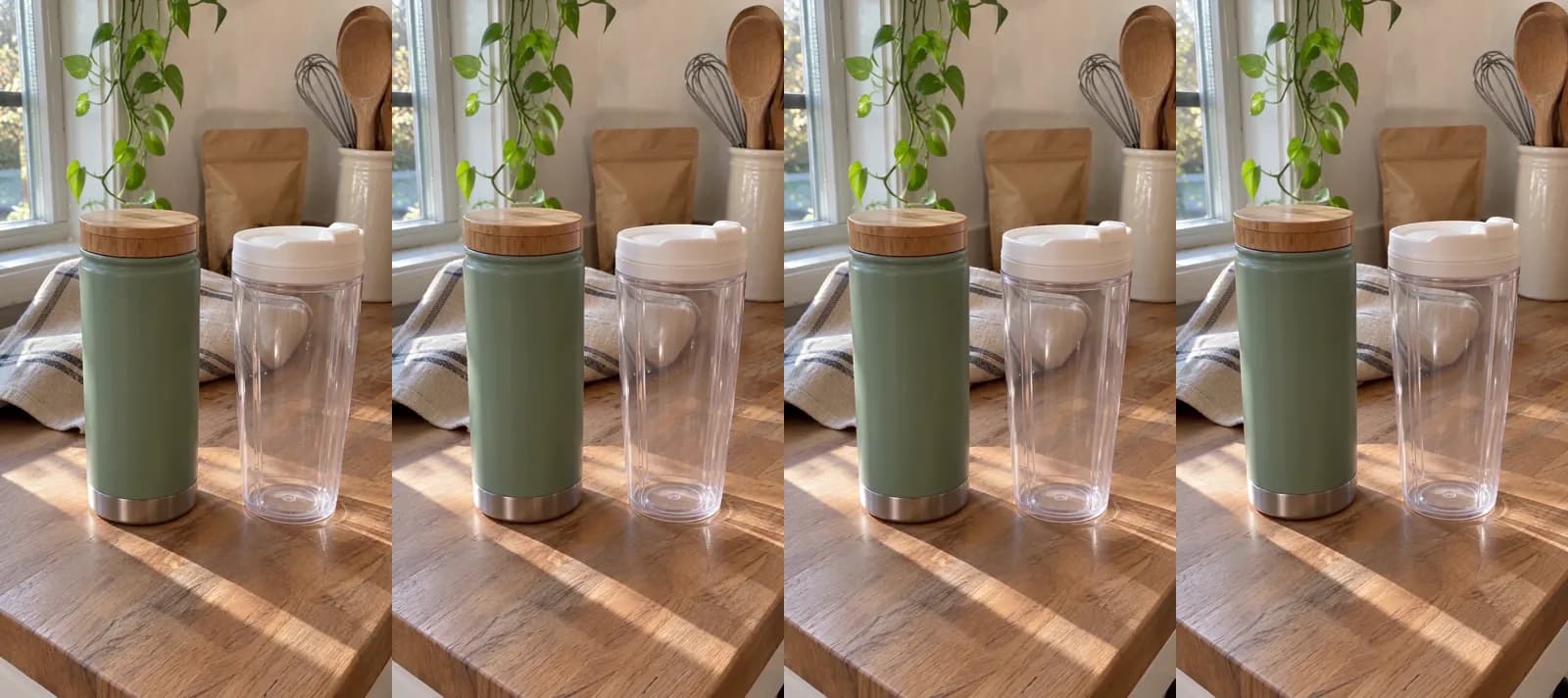 Made in Novoads with Seedance 2.0 Mini, started on the still above through our Claude connector · a slow push toward the two mugs, five seconds at 720p, no sound · 5 credits · 2026-11-16
That clip is the 5-credit row in the table. The camera slides a little toward the mugs and settles while the stripes of sunlight on the counter move.
What a creator video costs, for scale
Billo, a marketplace that sells UGC videos, updated its rates guide on November 10, 2026. It puts the standard market rate for a single creator video at $200 to $400, citing a rate guide from Freelance Nation. That's a vendor's summary rather than a survey, and it isn't apples to apples. A creator films your product, while our pieces either move your own photos or use an AI presenter.
Every plan is on our pricing page, and you pay for each one from the first month. You make the pieces in Novoads and run the finished ad wherever you buy your media.
Build your side of the comparison
Turn your own product photo into a still, a short clip and an AI presenter in Novoads, and check every claim before the ad runs. Every plan is paid from the first month.
Compare the plansWhat the FTC's policy statement says about naming a rival
The line the top results leave out
The first result for this search is a field guide for local advertisers from ENS Media. It tells you not to "mention your competitor by name unless you absolutely have to", and it points to trademark law as the reason. The guide isn't dated, and we read it on November 16, 2026.
The FTC's policy statement on comparative advertising takes the opposite view on naming a rival. It's 16 CFR 14.15, which the FTC published in the Federal Register on August 13, 1979. It's unchanged in the edition of the federal rules revised as of January 1, 2026. Commission policy, it says, encourages naming or referring to competitors, and it "requires clarity, and, if necessary, disclosure to avoid deception of the consumer."
The statement adds that the Commission has supported brand comparisons where the basis of the comparison is clearly identified. It calls truthful, nondeceptive comparative advertising "a source of important information to consumers".
How far the statement reaches
A footnote sets the scope. The statement is about ads that compare brands "on objectively measurable attributes or price" and identify the other brand "by name, illustration or other distinctive information". We read that as covering a side-by-side test or a price comparison that names the rival, and as leaving out a vague jab with nothing measured.
The statement also says the Commission "evaluates comparative advertising in the same manner as it evaluates all other advertising techniques", and that the question is whether an ad has a "tendency or capacity to be false or deceptive". We found no disclaimer wording anywhere in it. "If necessary" is as far as it goes on disclosure, so we won't invent a line for you to paste.
It's the FTC's statement of how the Commission itself treats comparison ads, so it speaks to anyone who makes or carries one. In its own words, restating the policy is "of benefit to advertisers, advertising agencies, broadcasters, and self-regulation entities".
A rival you name can still sue
The FTC's encouragement doesn't stop the rival you name from going to court. Section 43(a) of the Lanham Act, printed in the US Code as 15 U.S.C. 1125(a), covers anyone who, "in commercial advertising or promotion, misrepresents the nature, characteristics, qualities, or geographic origin of his or her or another person's goods, services, or commercial activities". Such a person "shall be liable in a civil action by any person who believes that he or she is or is likely to be damaged by such act."
In plain terms, a rival can sue over a comparison it believes is false and likely to hurt it. Ad platforms have rules of their own, too. We cover TikTok's comparison rule in our post on TikTok's misleading-content policy. If a rival bids on your brand name on Google, our post on defending branded traffic covers what to do.
This is our reading of two federal texts, and it isn't legal advice. The statement's own page, linked in the sources, is where to read it in full.
What we'd do with each shape
We'd hold every comparison ad above to the same habits.
- Name the rival plainly or not at all, since the statement asks for clarity.
- Compare one thing you can measure, or the price, and put the basis on screen (what you measured, when, and where the rival's price came from).
- Keep the receipts, like your test notes and a dated screenshot of the rival's price.
- Let AI build and move only your side. The rival's side is its name and your number, or an unedited photo of the real thing.
- Give the AI presenter the brand's voice, and save switcher stories for real customers.
- Write any disclosure yourself, in plain words, since the statement gives no wording to copy.
Which comparison ad to make first
Start with a side-by-side built on the one number you've already measured and would happily show the rival. Make the still and a short clip from your own photo first, since that's the cheapest way to see whether the claim reads clearly on screen. Once it does, add an AI presenter.
Frequently Asked Questions
What is comparative advertising in marketing?
It's advertising that puts your brand up against a rival's on something a buyer can check, such as a measurable feature or the price, and makes it clear which rival you mean. The FTC's 1979 policy statement defines it in much the same terms, as ads that compare brands on objectively measurable attributes or price and identify the other brand by name, illustration or other distinctive information.
What is a us-versus-them comparison ad?
It's a comparison ad built as a contest between your product and a rival's. Brands tend to run it as a side-by-side test, a switcher story, a price comparison, two characters who stand for the two brands, or a playful jab. Whatever the shape, the claim has to be true and its basis clear, and AI should build only your side of it.
Can you name a competitor in an ad?
In the US, the FTC's policy statement on comparative advertising encourages naming or referring to competitors, and it requires clarity and, if necessary, disclosure to avoid deceiving the consumer. A rival you name can still sue under section 43(a) of the Lanham Act over an ad that misrepresents its goods or services. That's our reading of the two federal texts, and it isn't legal advice.
How much does a comparison ad cost to make with AI?
Our worked example in Novoads uses two stills of your product, a short clip and a talking actor making the comparison at 480p. It comes to 107 credits. That's about $5.24 on Plus and about $8.03 on Starter, before re-rolls and the money you spend running the ad.
Key Takeaways
- A comparison ad sets your product against a rival you name or clearly point to, on something a buyer can check, like a measured result or a price.
- AI can make stills and clips of your own product and voice your script through an AI presenter, but it shouldn't make the rival's product, a test that never ran or a customer who switched.
- Our worked example of a comparison ad in Novoads comes to 107 credits, about $5.24 on Plus.
- The FTC's 1979 policy statement on comparative advertising, unchanged in the 2026 edition of the federal rules, encourages naming competitors but requires clarity and, if necessary, disclosure.
- A rival you name can still sue under section 43(a) of the Lanham Act over a comparison that misrepresents its goods, so keep the proof behind every claim you put on screen.