Tattoo Ads: Portfolio Video Ideas, What Each Costs With AI, and Google's Under-18 Rule
Five kinds of tattoo ads that shops and artists run, how to make each one in Novoads from your own healed-work photos, what each clip costs on Starter, Plus and Ultra, and the Google policy that restricts tattoo ads for accounts it treats as under 18.

Mauricio Valdivia
·12 min
Three ink caps, a steel tray and six credits
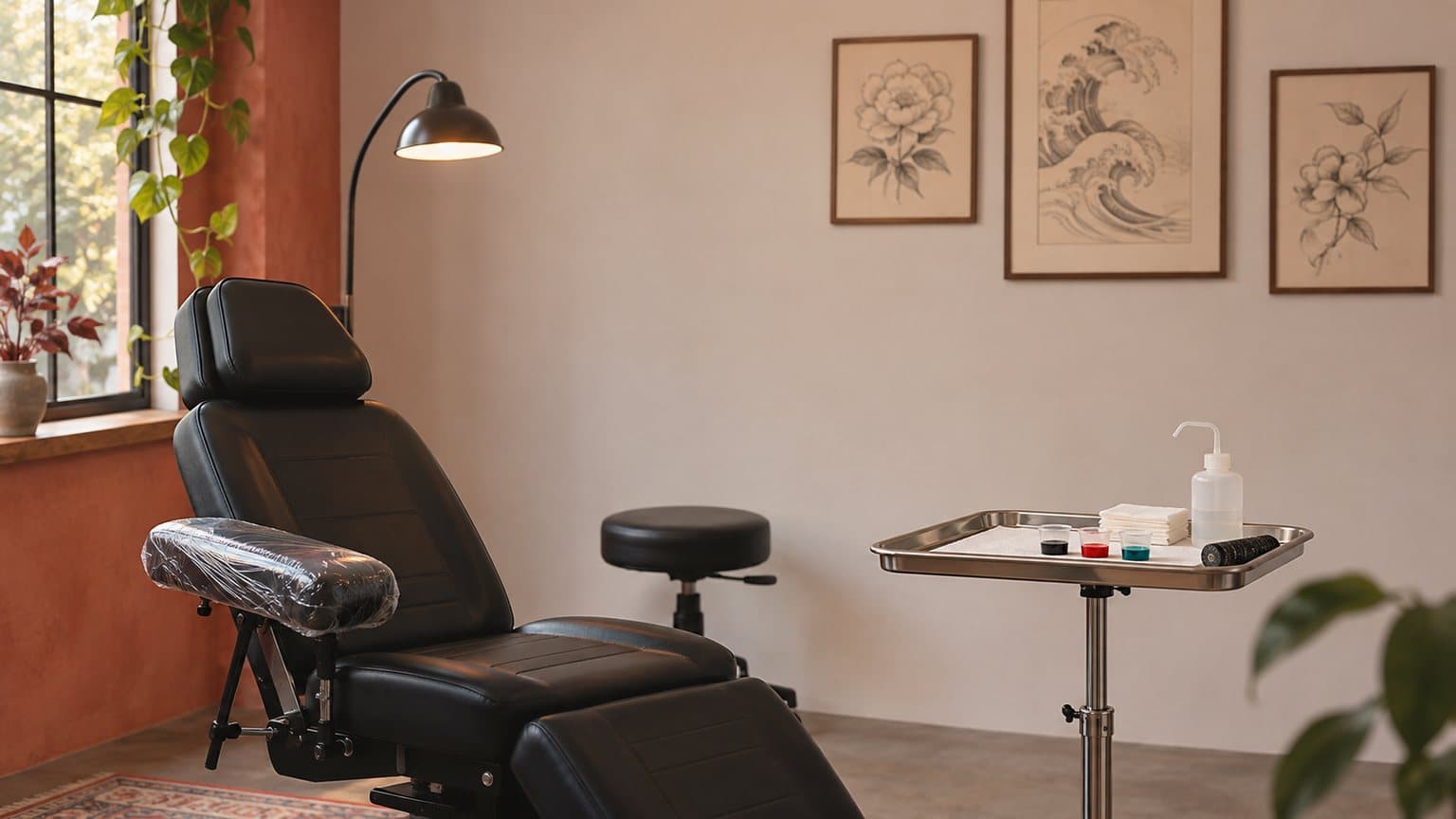
Black, red and teal ink sit in three caps on a steel tray wrapped in clear film, beside a tattoo machine in its sleeve, a stack of blue paper towels and a dark box of gloves. On the wall behind them hang framed sketches of a rose, a swallow and a dagger. It's a made-up station. We generated it for this post with GPT Image 2.6 Sunburst, as a stand-in for the phone photo you'd take of your own, and it cost 1 credit. Then we animated it with Seedance 2.0 Mini through our own connector for AI assistants, for another 5 credits. Over five seconds the camera eased toward the tray while the chair slid out of frame.
You already have most of what you need for a month of ads. There are healed-work photos from last month on your phone, a flash day coming up on the calendar, and someone in your DMs asking to see your linework before they put down a deposit. The hard part is turning all that into short videos that look finished without giving up a day a week to editing, and knowing which platform will show them to whom.
We read the first page of results for "tattoo ads" on November 15, 2026 (we could open three of its pages), then Google's own policy pages and our prices the next day. The still and the clip further down are the only renders we made for this post. We didn't run any of these ads, so nothing here tells you how one will perform.
The kinds of ads tattoo shops and artists run
The agencies and marketers who write about tattoo ads keep coming back to a short list, and every kind of ad on it rests on real healed work. Digital Ink, an agency that runs ads for tattoo artists and studios, published twelve creatives from its own campaigns on July 14, 2026. Eight are videos and four are statics, and each one has a click rate beside it. A 2024 guide to Facebook ads for tattoo clients, from a marketing firm, adds before-and-afters, process time-lapses and client testimonials. Under each kind below, the notes on what AI can add and what it must never show are our own reading of the trade. If AI-made ads are new to you, our guide to AI ads walks through making one.
Style reels built from healed pieces
Digital Ink's fine-line reel is the plainest kind of tattoo ad. It strings together "Sequential cuts of fine line pieces" in one consistent style, and the agency adds "No voiceover." The 2024 Facebook ads guide suggests "carousel ads to showcase multiple tattoos" to do the same job with stills.
- AI can give each healed-piece photo a few seconds of slow movement, so a run of stills plays like video and the style reads in the first second.
- It must never show a tattoo the model invented, or one of your pieces whose lines or shading drifted while the camera moved.
People book for exact linework, so every piece on screen should be a photo of a tattoo you made, and you should check every clip against that photo before it runs. Jewelers have the same problem with a ring a model might reshape, and our jewelry ads post prices their version.
The studio walk-through
Digital Ink's walk-through shows "Studio space first, then an artist at work, then cuts of finished pieces." The agency reports a 3.6% click rate for it from its own campaigns, the highest of the twelve.
- AI can turn your own photos of the front door, the stations and the flash wall into short moving clips, so the opening seconds show a place a client can picture walking into.
- It must never show a studio, a station or an artist a client won't find at your address.
We generated the station in our still, which is why it only stands in for a photo of your own.
Guest spots, conventions and flash days
Digital Ink's guest-spot ad leads with the artist, and then "Text overlays introduce the guest spot: city, dates, availability." Its convention ad puts three portfolio pieces above the artist at work, with the location and the dates. In our view a flash day fits the same shape, with the flash sheet, the date and how to book.
- An AI presenter can read out the city, the dates and how to book, and captions can put those words on screen. The artist's face and work stay in the artist's own photos.
- Keep out any presenter introduced as the artist, any presenter whose own tattoos could pass for the shop's work, and any dates or open spots that aren't real.
Process clips, cover-ups and client testimonials
"Highlight before-and-after transformations, time-lapse videos of the tattoo process, and client testimonials," the 2024 guide tells shops. Each of the three shows a real tattoo or a real client, so you have to film or photograph each one for real.
- AI's part is small here. A presenter can introduce a clip you filmed, and captions can carry what's said in it.
- It must never show a generated time-lapse, a cover-up "before" that never existed, healed skin that isn't a real photo, or an AI actor speaking as your client.
We'd leave this kind of ad to your own phone.
One strong piece and a question
In Digital Ink's static version, "A striking sleeve tattoo fills the frame," with the words "LOOKING FOR A TATTOO ARTIST?" laid over it, the artist's styles listed below and a line asking people to message to book.
- AI can give that one photo a few seconds of slow movement, or an AI presenter can ask the question out loud and name your styles.
- It must never show a piece you didn't make.
Turning your own photos into clips in Novoads
Every ad above starts from something you shot. In Novoads you can put that photo in motion or put an AI presenter in front of your dates.
A clip that opens on your photo
- In the editor, pick Video, choose Kling 3.0 and drop the photo of a healed piece where it says "Drop a start frame or click to upload". The editor then shows "The video starts on this picture."
- Ask for slow camera movement and nothing else, for example "slow push-in toward the forearm, the tattoo stays sharp and unchanged, soft daylight".
- Pick five seconds and press the round button with the up arrow. Five seconds of Kling 3.0 costs 10 credits.
- Hold the clip up against the photo. If a line thickened or a shadow moved, make a new take (it costs the same credits again) or use the plain photo for that piece.
Omni Flash and Wan 3.0 clips can open on your photo too, once you pick "Start / End Frames" instead of "Reference". In the editor, every Seedance model takes a photo only as a reference you name in the prompt as @Image1, so its clip doesn't start on your photo. We wouldn't use one for a piece that has to stay exactly as you inked it. The same steps for a product photo are in our guide to product videos with AI.
The station still and what five seconds did to it
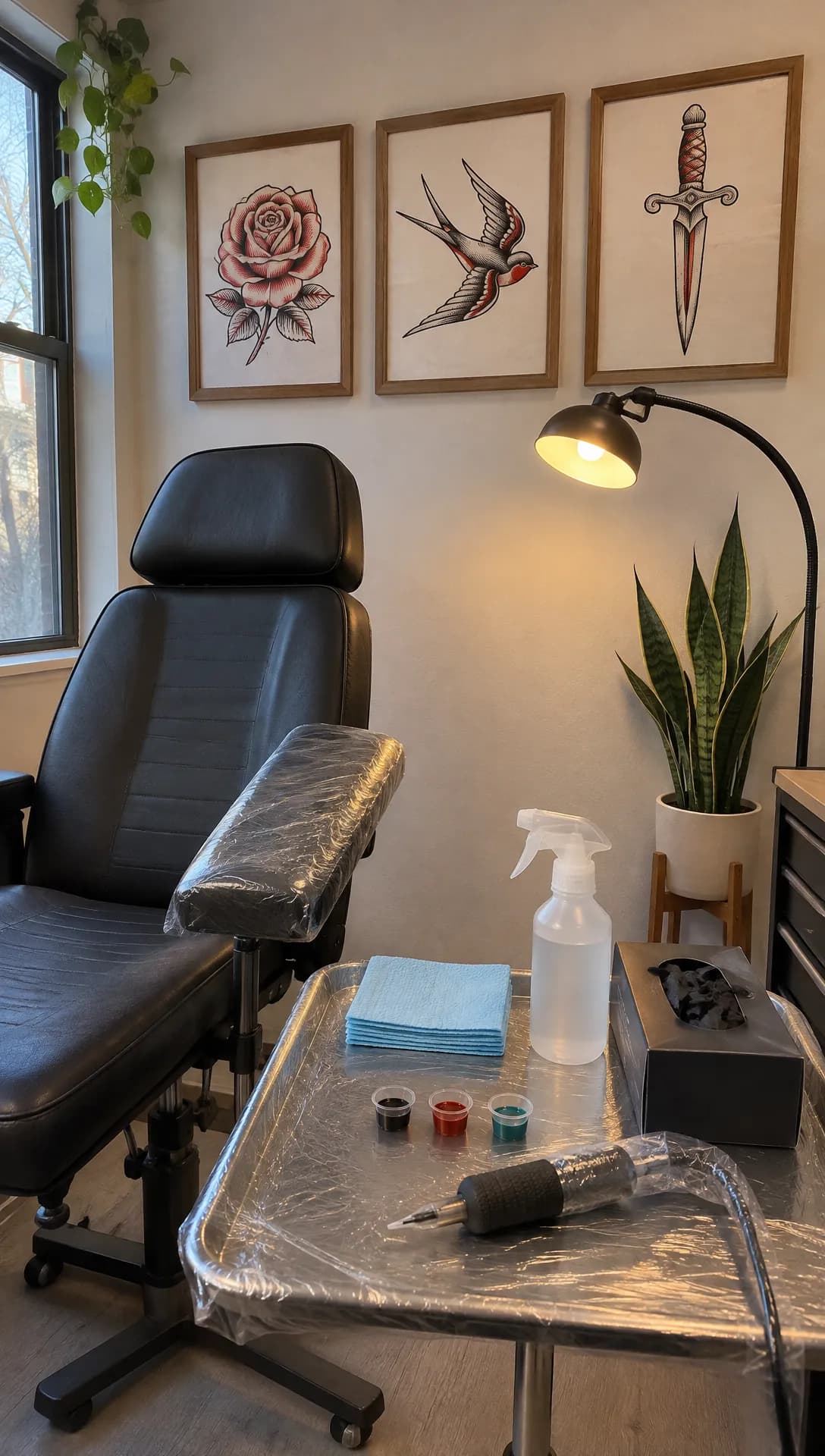 Made in Novoads with GPT Image 2.6 Sunburst · an empty tattoo station before the first client, as an artist's phone photo, standing in for a photo of your own station · 1 credit · 2026-11-16
We made that still with GPT Image 2.6 Sunburst at medium quality, asking for an ordinary vertical phone photo of an empty station. The prompt kept out people, signs and readable text. In a real ad, your own photo of your own station goes here.
We made the clip through our own connector for AI assistants, which can start a Seedance 2.0 Mini clip from a picture. Ours ran five seconds at 720p with the sound off. It cost 5 credits, and the first take came back clean. The camera moves in toward the tray of ink caps, the chair leaves the frame on the left, and the lamp's light turns warmer. In the editor you'd get that kind of clip from Kling 3.0 on a start frame, at 10 credits for five seconds.
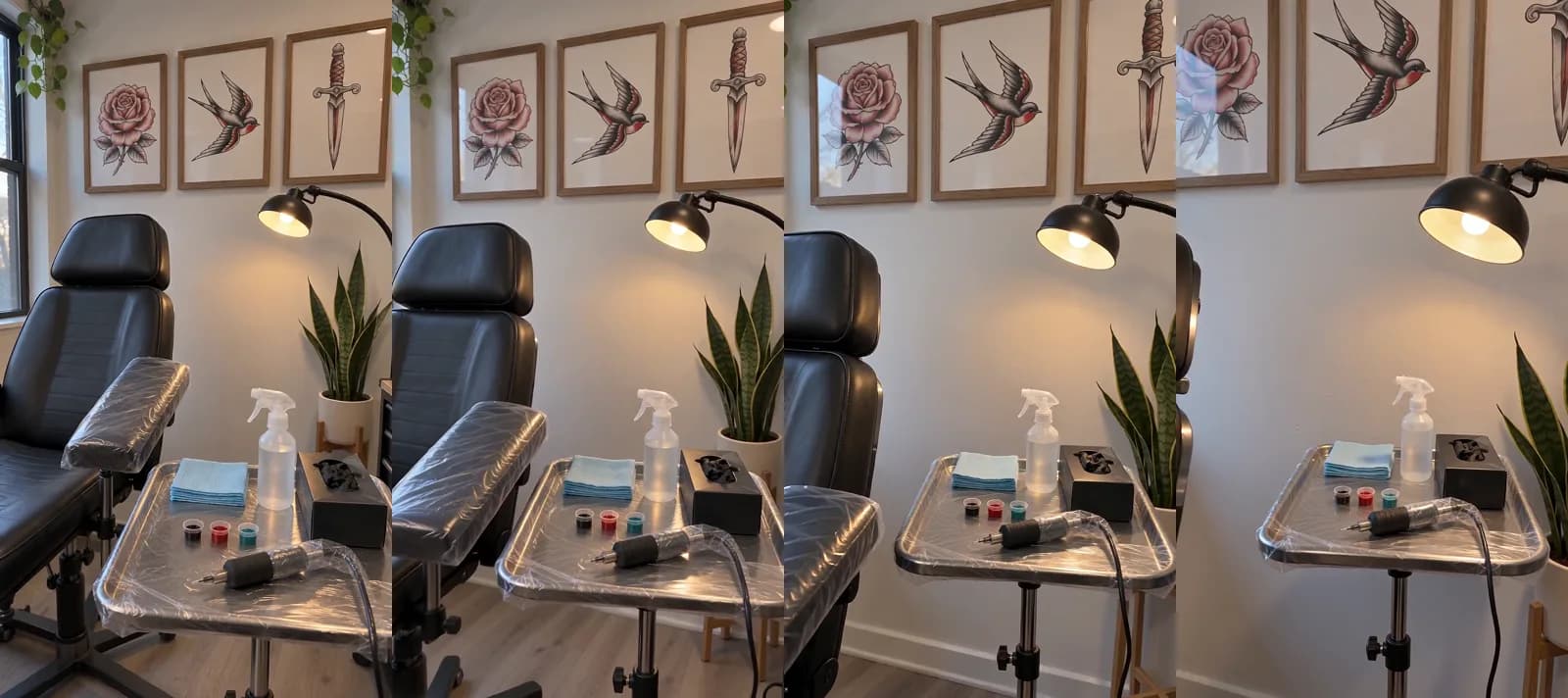 Made in Novoads with Seedance 2.0 Mini · the station still animated through our connector, a slow move in on the ink caps, sound off · 5 credits · 2026-11-16
An AI presenter for your dates
In Talking Actors the screen walks you through "Write or pick a script", "Choose an actor" and "Press the arrow to generate". The clip comes back with voice and lip-sync. Anything up to a minute costs 200 credits at 720p. At 480p it's 100 credits.
Write the script so the presenter talks about the artist and never as the artist. "The guest artist is in town Friday to Sunday" works, while "I'll be tattooing this weekend" puts the presenter in the artist's place. Choose an actor whose arms and neck show no ink, so nobody takes the presenter's skin for your work.
Captions are one more step. In Add captions you pick your clips and a look, and the words spoken in each clip go on a copy of it. The look called "Karaoke, yellow" costs 0 credits in the app. On a computer the tool opens on a paid look, so you'll have to pick that one yourself. If clients book with you in Spanish as often as in English, the voice list covers 32 languages.
What a style reel costs on each plan
Prices as of November 16, 2026. The plans are on our pricing page, and every cent figure below is our own arithmetic at each plan's rate.
| Plan | Price a month | Credits a month | Cost a credit |
|---|---|---|---|
| Starter | $15 | 200 | 7.5 cents |
| Plus | $49 | 1,000 | 4.9 cents |
| Ultra 3,000 | $129 | 3,000 | 4.3 cents |
Clip prices for the ads above
| Clip | Credits | Starter | Plus | Ultra 3,000 |
|---|---|---|---|---|
| Kling 3.0, 5 s | 10 | 75 cents | 49 cents | 43 cents |
| Wan 3.0, 5 s, 720p | 9 | 68 cents | 44 cents | 39 cents |
| Omni Flash, 4 s, 720p | 12 | 90 cents | 59 cents | 52 cents |
| Seedance 2.0 Mini, 5 s, 720p, through our connector | 5 | 38 cents | 25 cents | 22 cents |
| Talking actor, up to 60 s, 720p | 200 | $15.00 | $9.80 | $8.60 |
| Talking actor, up to 60 s, 480p | 100 | $7.50 | $4.90 | $4.30 |
There's no five-second Omni Flash clip, so its row shows the four-second one. We charge a talking actor by the minute, rounding up, so a 20-second date announcement costs the same as a 60-second one. Hair salons work from the same kind of phone photos, and our hair salon ads post prices the clips for that trade.
Pricing three healed pieces and a studio clip
The set we priced has four clips.
- Three healed pieces as five-second Kling 3.0 clips, at 10 credits each
- The studio as a five-second Seedance 2.0 Mini clip at 720p, made through our connector the way we made ours, at 5 credits
Together the four clips come to 35 credits.
- About $2.63 on Starter
- About $1.72 on Plus
- About $1.51 on Ultra 3,000
A Starter month covers five of those sets, and a Plus month covers 28. If you make the whole set in the editor, with Kling 3.0 for the studio clip too, it comes to 40 credits. That's about $1.96 on Plus.
That sum leaves out five costs.
- Re-takes, which cost each clip's credits again. Any piece that drifted from its photo needs one.
- Putting the clips together into one ad, and any voice-over, since we don't list a fixed credit price for either.
- Captions, which cost 0 credits in the "Karaoke, yellow" look in the app and cost credits in the other looks.
- What you spend to run the ad on any platform.
- The time it takes you to check every clip against the photo it came from.
What a freelancer quotes for a one-minute promo
Vidico, a B2B explainer video company, answers what a one-minute promo video costs in a guide dated May 21, 2026. The guide leads with an agency price. Basic freelancer production "can bring this down to $1,000 to $2,000," it says.
But the two prices buy different things. Vidico's price is for a finished minute someone else films and edits, while the 35 credits above buy short clips cut from photos you already took. We think the comparison only helps you decide whether your healed-work photos are sharp enough to skip a shoot for now. A full TV-style spot is a bigger build, and our post on AI commercials prices one.
Google restricts tattoo ads for accounts it treats as under 18
None of the three first-page results we could open for "tattoo ads" mentions this rule. Digital Ink's guide to running ads for tattoo artists, the highest-ranking of the three, goes channel by channel. On Google it tells them "as a tattoo artist, focus on one only", and the campaign type it names is Search.
What Google's teen policy says
As we read it on November 16, 2026, Google's Ad-serving Protections for Teens policy "introduces additional safeguards for users under 18". On those users' Google Accounts, Google says it doesn't allow ads personalization and restricts sensitive ad categories. One of them is "Body modification and weight loss", which the page describes as "Ads for body-modification products or services such as cosmetic procedures, weight loss, tanning, piercings, and tattoos".
The page words the restriction two ways. It says "Google may restrict ads in the following categories from serving to teens." It also says the listed categories "are restricted globally on Google Accounts, even if these ad categories are generally permissible on Google."
Its English version says "These restrictions apply to YouTube, Google Display, and Search ad campaigns and may expand to more products over time." The policy covers ads in those categories no matter who runs them, and Google applies it on its end. The page tells advertisers "While you may notice an impact on ad campaign reach or performance, there's no action required on your part."
Only the English policy page names Search
The English policy page is the only Google page we read that puts Search inside the teen restriction. Google's overview of its ad protections for children and teens says the teen policy "applies on YouTube, Google Display Ads, and Display & Video 360 campaigns", and its 2022 notice of the policy named the same three. Google also says "The English version is the official language used to enforce Google Ads policies." So when this post says the restriction covers Search, that rests on the English policy page alone.
When the rule started and who counts as under 18
The policy page itself isn't dated, so we date the rule from Google's notices.
- Google posted notice of the policy on June 15, 2022, and said it would begin enforcing it on August 15, 2022.
- In a notice posted in November 2023, Google said it would revise the teen policy's wording "for clarity" in December 2023, and that "There are no enforcement changes."
- In a post dated July 30, 2025, Google said it would begin to "roll out age assurance to a small set of users in the U.S." When its tools estimate a user might be younger than 18, the post lists "restricting age-sensitive ad categories" among the protections.
Which accounts count as under 18 is Google's call. The policy is written about Google Accounts, so as we read it, a teen who isn't signed in falls outside it. Google keeps a separate policy for children, which lists the same body-modification category for YouTube, Google Display Ads and Display & Video 360.
What the rule changes for the ads above
This part is our own reading. The page asks nothing of you, so there's no setting to change in Google Ads. But Google may not show a style reel on YouTube or a guest-spot ad on Search to accounts it treats as under 18, and if a campaign reaches fewer people than you expected, that may be part of the reason. The policy covers Google's own ad products and says nothing about Instagram or TikTok. We couldn't read Meta's own pages on tattoo ads, so this post doesn't cover either platform's rules on them.
Where to start with your own healed photos
Pick three healed pieces in a single style, shot in daylight, and make a five-second clip of each before you plan anything bigger. Hold each clip up against its photo. If the lines held, you've got the start of a style reel. The studio clip and a presenter for your next flash day can follow once the reel has run. If the reel is headed for TikTok, our TikTok ads guide covers how to launch it there.
With Novoads you can turn the photos already on your phone into those clips, and put an AI presenter in front of your dates when you want one. Every plan is paid from the first month.
Price your first style reel
Starter is $15 a month for 200 credits. That covers the four-clip set above five times, and Plus and Ultra add more credits each month.
Compare the plansStart with the three healed pieces you'd most want a new client to see.
Frequently Asked Questions
Does Google restrict tattoo ads?
Yes, for some accounts. Under its Ad-serving Protections for Teens policy, Google restricts ads for body-modification products or services, tattoos and piercings among them, on the Google Accounts of users it treats as under 18. The English version of the policy page applies that to YouTube, Google Display and Search campaigns. Google says there's no action required on your part, though you may notice an impact on reach or performance.
Should a tattoo shop use AI-generated tattoo images in its ads?
Not as its own work, in our view. A client books for your exact linework and shading, so every piece on screen should be a photo of a tattoo you made. If a video model turns that photo into a clip, check the clip against the photo before it runs. AI helps with a slow camera move on your own photo or an AI presenter reading your dates. It shouldn't make a tattoo, healed skin or a client.
How much does it cost to make a tattoo video ad with AI?
In Novoads, a five-second Kling 3.0 clip that opens on your photo costs 10 credits. On Plus that's 49 cents. The style reel priced in this post (three healed pieces and a studio clip) comes to 35 credits. That's about $1.72 on Plus and about $2.63 at Starter's rate, before re-takes, captions in a paid look and your ad spend.
Can an AI presenter announce a guest spot or flash day?
Yes, as long as it isn't introduced as the artist. In Novoads you write the script with the city, the dates and how to book, choose an AI actor and get a clip back with voice and lip-sync. Anything up to a minute costs 200 credits at 720p. Write the script so the presenter talks about the artist rather than as the artist, pick an actor with no visible tattoos, and let your own photos carry the work.
Key Takeaways
- Tattoo ads sell real healed work, so every kind of ad that keeps coming up (style reels, studio walk-throughs, guest-spot and convention dates, process clips and cover-ups, one strong piece with a question) starts from photos or footage of pieces you made.
- AI helps with motion and delivery, like a slow camera move on a photo you took or an AI presenter reading your dates. It should never make the tattoo, the healed skin, the studio or the client.
- A style reel of three healed pieces plus a studio clip comes to 35 credits in Novoads. That's about $1.72 on Plus.
- Under its Ad-serving Protections for Teens policy, Google restricts ads for body-modification products or services, tattoos and piercings among them, on Google Accounts it treats as under 18. It says there's no action required on your part.
- Only Google's English policy page puts Search inside that restriction, and Google calls the English version the official language used to enforce its ad policies. Google's overview of its ad protections for children and teens names YouTube, Google Display Ads and Display & Video 360.
Sources
- •Google Advertising Policies Help: Ad-serving protections for teens
- •Google Advertising Policies Help: Ad protections for children and teens
- •Google Advertising Policies Help: Ad-serving Protections for Teens (August 2022)
- •Google: Ensuring a safer online experience for U.S. kids and teens
- •Digital Ink: 12 High-Performing Meta Ad Creatives for Tattoo Studios and Artists
- •Vidico: Promo Video Cost