Jewelry Ads: Video Ideas, What Each Costs With AI, and the FTC's Note on Enlarged Stones
Five kinds of jewelry video ads and how to build each one from a photo of the real piece or with an AI presenter, what every clip costs in credits and dollars, and the FTC Jewelry Guides' note on a stone pictured bigger than it is.

Mauricio Valdivia
·12 min
A jewelry ad has to show the ring you'll ship
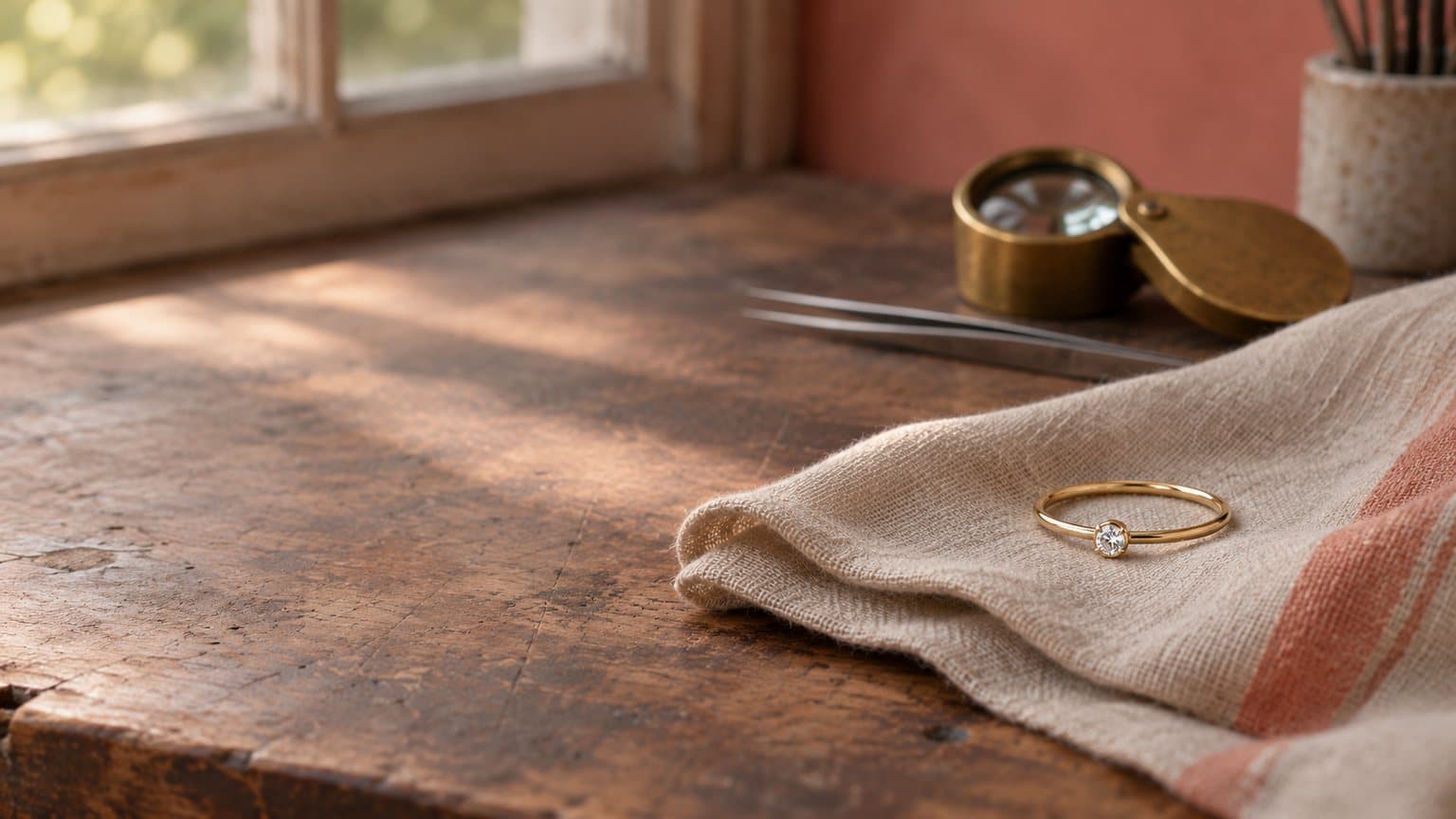
We gave an AI video model one photo of a thin ring with a single small stone, lying on folded linen by a window, and asked for a slow move around it without getting any closer. Five seconds of video came back. The ring stays the same small size in every frame. The linen doesn't behave as well. Its folded edge shifts from frame to frame, even though we'd asked for it to stay still.
A video model will move a camera through your photo for well under a dollar on the cheapest one. It'll also change small things you never asked it to touch. Nobody minds a moving cloth. If the model does the same to a prong or the size of a center stone, your ad shows a piece you don't sell.
So what do you make when engagement season, the holiday gift guide and Mother's Day each call for new ads, and a shoot for every piece isn't in the budget? We opened four of the first-page results for "jewelry ads". They're lookbacks at famous campaigns and lists of big-brand examples. None prices a single ad or shows how one gets made, and none mentions the FTC's Jewelry Guides, which say a picture that shows a stone larger than it is "may mislead consumers" unless there's a disclosure about the item's true size.
We read those pages on November 13, 2026, along with the FTC's Jewelry Guides in the government's official printed edition and a Shopify guide to photography prices. Every Novoads price below is our own credit cost. For this post, we made one still and one clip of a ring that doesn't exist. We didn't run anything as a paid ad or test anything on a real piece, and nothing here is legal advice.
Five kinds of jewelry ads, and where AI has to stop
The top result for "jewelry ads" when we looked was a list from Cropink, a tool that turns product images into catalog ads. The page says it was last updated on March 24, 2026. It sorts eight brands' ads by what each leans on, and its headings make a fair map of what jewelry brands run. The notes about AI are our reading.
The close-up on a clean background
Cropink's note on Angara's ads is "clean backgrounds, minimalist layouts, and the jewelry front and center". The close-up sells the piece itself, one ring or one pendant and nothing else.
- AI helps most here, and with the least risk, because the clip starts from your own product photo and adds a few seconds of motion, like a slow move around the piece or light sliding across the stone.
- The clip can't change the piece. If it comes back with a bigger stone, a different cut, an extra prong or a second stone, throw it out.
- A close-up spreads a small stone across a whole phone screen, which is where the FTC's note comes in.
The lifestyle moment
Cropink files Tiffany & Co. under "Lifestyle over product". The idea is an ad built around an occasion (a proposal, an anniversary, a gift being opened) more than around the object.
- AI can make a short scene around your product photo, and it costs little enough to try the same scene three ways.
- The risk is the piece on the person. A model that draws a hand also redraws the ring on it, and the ring can come back a different shape or out of scale with the finger.
- An invented couple is still invented, so don't caption them as your customers.
A polished brand film is a bigger job, and our post on AI commercials covers it.
A story told to camera
Bryan Anthonys is on Cropink's list under "Real people, real stories", for ads built on customers' own photos and words. That kind of ad needs the real customer, and an AI actor reading a review nobody wrote is a made-up testimonial.
- An AI presenter can read your own words about how a piece is made, what a design means or why the shop exists.
- Write the script about the shop, in the third person, so nobody takes the presenter for you or for someone at your bench.
- An actor from the library holds nothing, so cut to a clip of the real piece while the story runs.
The offer, the financing line or the event
Two entries on Cropink's list are about the deal more than the jewelry. David Yurman is listed under "Financing for the win", and Hart is there for "limited-time pop-ups, exclusive drops". A holiday gift guide, a pay-over-time line and a trunk show all belong here.
- The presenter says the offer, the dates and the place out loud, captions repeat them, and clips of the real pieces cut in between.
- Every term and date the presenter says has to be one your shop really offers, and the FTC's Guides cover the words an ad uses for gold and for a stone.
Many pieces in one ad
BaubleBar's entry is "Scroll-stopping variety", which Cropink describes as stackable rings, color variations and whole lookbooks in a single ad.
- Each of your product photos becomes its own short clip, and you cut them together with a caption for each piece.
- Every stack, color and variant on screen has to be one you sell, so start each clip from a real photo.
- Don't ask a model to imagine a rose-colored version of a ring you only make in white metal.
Google's vehicle ads make the same point to car dealers, asking their inventory feed for a photo of the actual car, as our car dealership ads guide explains. Our post on ecommerce video ads has more formats that online stores run.
How to make each one in Novoads
Novoads is our tool for making video ads with AI models. You hand it a photo or a script and choose a model, and a clip comes back for you to run wherever you advertise. Every plan is paid from the first month. Our guide to AI ads has the general walk-through.
A close-up from one product photo
- Open the Video tool and pick Kling 3.0 under Model, because its clip opens on your photo.
- Set the Duration and the Aspect ratio (9:16 for a vertical ad). Kling 3.0 has no resolution to pick.
- Put the product photo in the box that says "Drop a start frame or click to upload". A photo already in that shape goes in as it is, and the app tells you, "The video starts on this picture."
- Describe the camera move, and say what has to stay put. Our prompt asked the camera to stay at the same distance "so the ring keeps its size in the frame".
- Press the arrow to send it. Five seconds on Kling 3.0 is 10 credits.
You get back one clip at the length you chose. For a gift guide, run the same steps and prompt once for each photo, so the clips match.
Seedance 2.0 Mini is the least expensive model we sell for a short clip, and at 720p its five seconds cost half what Kling's do. In the editor it takes your photo as a reference image, not a start frame, and the app's hint says, "Write your prompt and use @Image1 to reference your images inside the prompt." For Seedance you also pick a Resolution, and there's a Generate Audio switch. Our how-to on product videos goes deeper on prompts.
Our test with a ring on folded linen
We don't have a jeweler's photo, so we made a picture to stand in for one. The still below came from GPT Image 2.6 Sunburst for 1 credit. The prompt asked for "a vertical phone photo" with "the ring shown at its real size in the frame, not a macro close-up". There's no piece behind the picture, so we won't name its metal or its stone.
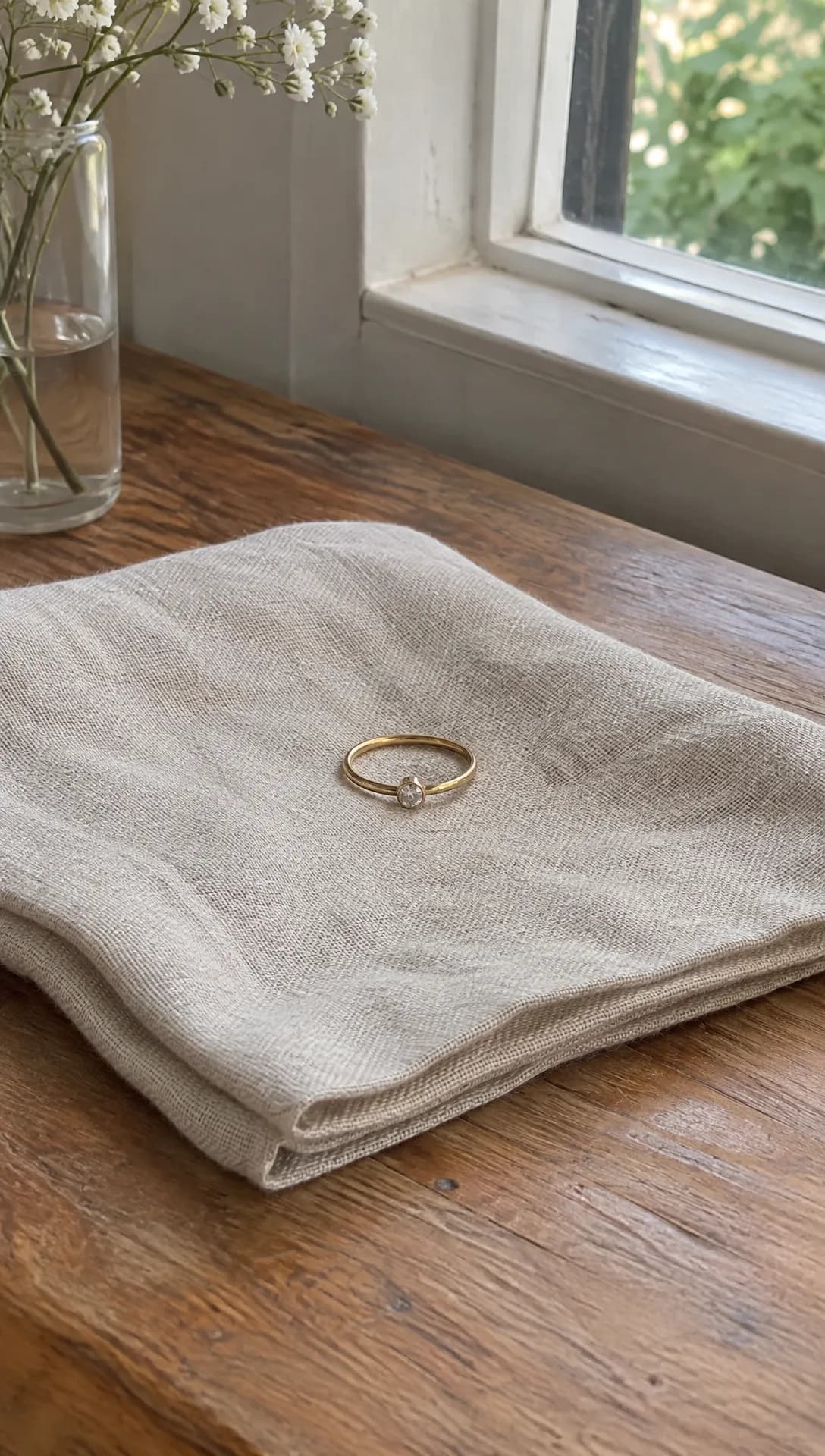 Made in Novoads with GPT Image 2.6 Sunburst · a made-up ring on folded linen, standing in for your own product photo · 1 credit · 2026-11-13
We sent that still to Seedance 2.0 Mini as the clip's start picture, through our own connector for AI assistants, and asked for five silent seconds at 720p. It cost 5 credits. The connector takes a start picture on Seedance, while the editor takes a reference.
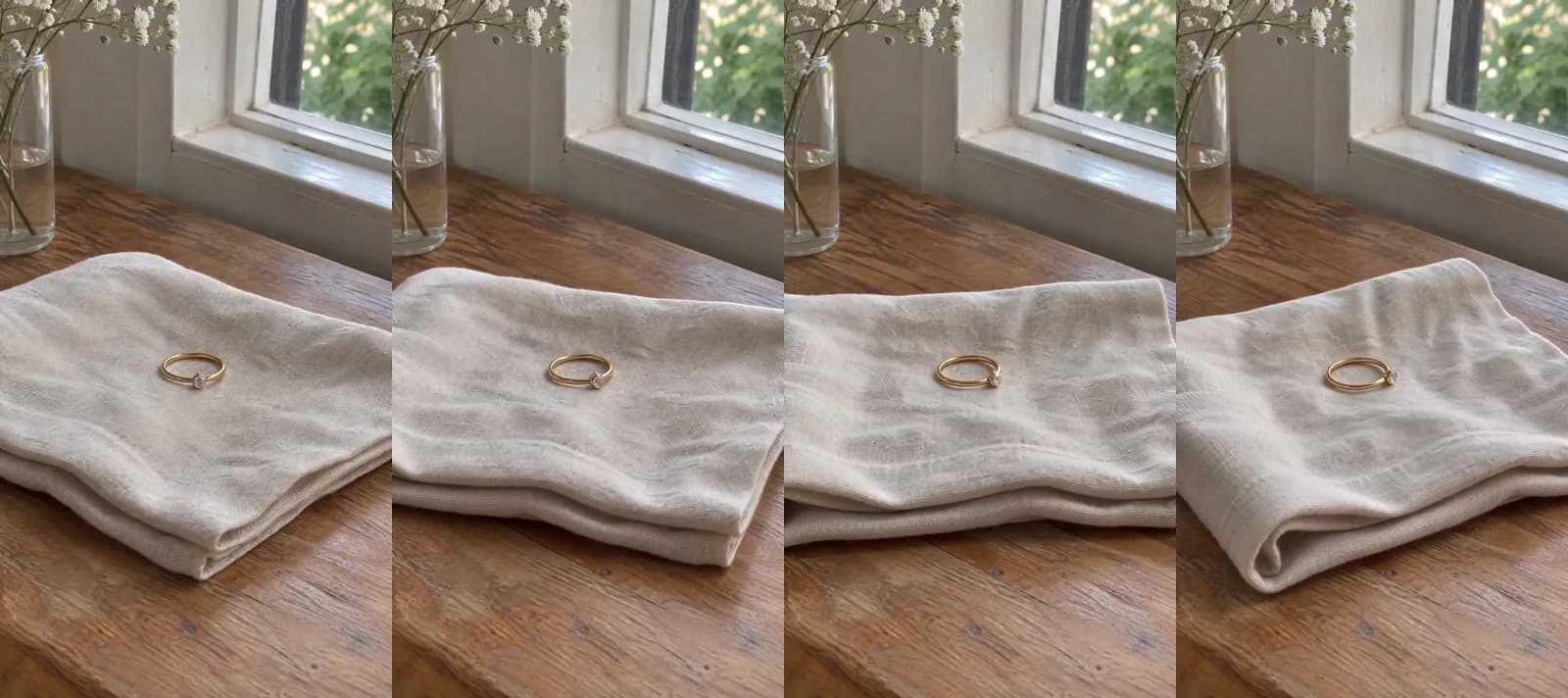 Made in Novoads with Seedance 2.0 Mini · the still above as the start picture, a slow move around the ring, 5 seconds at 720p, sound off · 5 credits · 2026-11-13
The camera drifts around the ring without closing in, and the ring stays the same small size from the first frame to the last. The cloth's folded edge shifts a little between frames, though, and that's the model's doing, since the prompt asked for still linen. So check every clip against the photo you uploaded, piece first.
- Compare the stone's size against the band.
- Count the stones and the prongs.
- Look at the shape of the setting.
If a clip fails any of those, don't run it.
A presenter for the story or the offer
In the Talking Actors tool, you write or paste the script, choose an actor and pick a voice. Our voice list covers 32 languages. What comes back is a finished video, voiced and lip-synced. Captions go on afterward as a separate step, and the app's Karaoke style adds 0 credits.
An AI presenter is an AI actor, so don't cast it as you, your staff or a customer. For a piece shown on a person, Create Actor has an Upload option ("Transform a picture into a talking actor") that turns a photo of someone wearing your real piece into the presenter. Use a photo you have the right to use, with that person's agreement, and check the piece in the result.
What each jewelry ad costs to make
Prices as of November 13, 2026. We worked out the dollars ourselves, multiplying the credits by one credit's cost on each plan. A credit works out to 7.5 cents on Starter and 4.9 cents on Plus. On Ultra 3,000 it's 4.3 cents. The two bold rows add clips together, and the pricing page lists each plan's monthly price.
| What you make | Credits | Starter | Plus | Ultra 3,000 |
|---|---|---|---|---|
| Close-up, Seedance 2.0 Mini, 5 s at 720p | 5 | about 38 cents | about 25 cents | about 22 cents |
| Close-up, Kling 3.0, 5 s | 10 | 75 cents | 49 cents | 43 cents |
| Close-up, Omni Flash, 4 s at 1080p | 18 | $1.35 | about 88 cents | about 77 cents |
| Close-up, Seedance 2.5, 5 s at 1080p | 60 | $4.50 | $2.94 | $2.58 |
| Presenter, up to 60 s at 480p | 100 | $7.50 | $4.90 | $4.30 |
| Presenter, up to 60 s at 720p | 200 | $15.00 | $9.80 | $8.60 |
| One ring, two clips | 78 | $5.85 | about $3.82 | about $3.35 |
| Gift guide with a presenter | 120 | $9.00 | $5.88 | $5.16 |
One ring from two photos
The first bold row is a ring ad cut from two photos of the same piece. One becomes a 5-second clip on Seedance 2.5. The other becomes a 4-second clip on Omni Flash. Both are at 1080p.
- A Starter month is 200 credits. That covers two of those ads, with 44 credits left.
- A Plus month is 1,000 credits, which covers 12.
- An Ultra 3,000 month covers 38.
A gift guide with a presenter
The second bold row pairs one presenter read of a minute or less, at 480p, with four close-ups on Seedance 2.0 Mini. Each close-up is 5 seconds at 720p. The presenter is 100 credits and the clips add 20. We charge presenter time in whole minutes, counted from the first second, so 20 seconds of script costs the same as 60.
What those figures leave out
- Re-rolls. You pay the same price again for every new take, and our linen shows why you'll sometimes want one.
- Joining, captions and music. Each is its own step after the clips exist.
- The ad spend. Novoads makes the ad. You run it, and you pay the platform.
- Your time. Somebody who knows the piece has to compare each clip with it.
Compared with a product photographer's rate
Shopify's guide to product photography pricing is dated January 27, 2026. It says, "Per-image pricing can land anywhere between $50 and $350, with room on either end for outliers." That's a vendor's guide to product photography in general, and it isn't about jewelry alone. The range is for a finished still, so it isn't a like-for-like price for a clip that animates a photo you already have.
Price a month of jewelry clips
A 5-second close-up from your own product photo is 5 credits on Seedance 2.0 Mini at 720p. Every plan and its credits are on the pricing page.
See the plansWe also have a separate page on AI video ads for jewelry.
What the FTC's Jewelry Guides say about a stone shown bigger than it is
The note in the FTC's own words
The FTC's Guides for the Jewelry, Precious Metals, and Pewter Industries are Part 23 of Title 16 in the Code of Federal Regulations. Section 23.1 covers deception in general, and its third note reads:
"An illustration or depiction of a diamond or other gemstone that portrays it in greater than its actual size may mislead consumers, unless a disclosure is made about the item's true size."
That's Note 3 to 16 CFR 23.1, as printed in the Government Publishing Office's edition revised as of January 1, 2026.
- It says "may mislead", so it doesn't ban an enlarged picture.
- It carries its own condition, a disclosure about the item's true size.
- It names "a diamond or other gemstone", so it isn't about a plain band, pearls or a watch.
- It doesn't say an ad has to print measurements or show a stone at its real size.
Who the Guides cover, and how much force they have
The Guides say they apply "at every level of the trade (including but not limited to manufacturers, suppliers, and retailers)". They cover claims "included in labeling, advertising, promotional materials, and all other forms of marketing", and the same paragraph lists illustrations and depictions among the ways a claim gets made. We read that as including a shop's video ad.
They're guidance. In their own words, "They do not confer any rights on any person and do not operate to bind the FTC or the public." The next sentence says the Commission "may take action under the FTC Act if a marketer or other industry member makes a claim inconsistent with the guides." They're US guidance, and we didn't read any other country's rules.
An old note in this year's edition
The note isn't new. When the FTC revised the Guides in 2018, it removed a section on misleading illustrations but kept this note, writing that "the former Note to Section 23.2 has been transferred to Section 23.1". That revision took effect on August 16, 2018. National Jeweler's refresher on those changes, updated on September 9, 2026, says the FTC "is not scheduled to revisit the guides until 2028". The date above, January 1, 2026, belongs to the printed edition.
What we'd do with it in an AI-made ad
The note doesn't mention AI, so this part is our reading. A close-up clip is a depiction, and a video model can also make the stone bigger than it is in your photo. We'd treat those as two problems.
- The model's mistake. If the stone's size, shape or count didn't match your photo, we wouldn't run the clip. Section 23.1 itself calls it unfair or deceptive to misrepresent a product's "size, weight, cut, color", among other things.
- The honest close-up. Here the piece is right, and only the framing makes it look big. The note points to a disclosure about the item's true size, and Note 2 to the same section says disclosures "should be sufficiently clear and prominent".
While the close-up plays, we'd put a line on screen that says the piece is shown enlarged or gives its size, in type a phone viewer can read. Whether that's enough for your ad is a question for the note's own page and your lawyer. Platforms' rules on labeling AI-generated ads are a separate matter.
Gold and a stone's name in your script
A presenter's script and your captions are words in an ad, so two more parts of the Guides matter.
- Gold. The Guides give examples of descriptions "that may be misleading". One is the word "Gold" for an alloy "unless a correct designation of the karat fineness of the alloy immediately precedes the word". "14 Karat Gold" is one of the Guides' own examples of the wording done right.
- A stone's name. The Guides call it unfair or deceptive to use a stone's name for a laboratory-grown, laboratory-created, imitation or simulated stone "unless such word or name is immediately preceded with equal conspicuousness by the word" that says which it is.
An AI voice reads whatever you type, so check those words in the script.
Start with one piece and its real photo
We'd start with the one piece your holiday gift guide leans on, photographed the way it really looks. Make one 5-second close-up on Seedance 2.0 Mini, and hold its frames against the photo.
If the piece comes through unchanged, make the sharper version on Seedance 2.5 and put the size line on the close-up. Then write the presenter's script with the karat and the stone named the way the Guides describe, and only then make the rest. Our post on Black Friday video ads covers the timing.
Frequently Asked Questions
What are some of the best jewelry ads?
It depends on whose list you read, and no list we read ranks its ads by results. JCK's gallery, dated December 24, 2011, calls itself 'a collection of 50 of the most memorable jewelry ads from the 1800s to the present day', drawn from the magazine's own pages. Cropink's list, last updated March 24, 2026, picks eight brands' social ads and sorts them by approach, from lifestyle scenes to financing offers. Both make good idea files, but neither tells you how any of those ads performed.
What are some successful jewelry ad campaigns?
One lookback we read puts De Beers first. CINCO, a jewelry brand that keeps a blog, called 'A Diamond Is Forever' 'one of the most famous jewelry campaigns in history' in a post dated December 4, 2024. We didn't find sales or ad results on any page we read, so we can't say which jewelry campaigns sold the most. Those pages only support calling a campaign famous, which isn't the same as calling it successful.
How much does a jewelry video ad cost to make with AI?
These are Novoads prices as of November 13, 2026. A 5-second close-up made from your own product photo costs 5 credits on Seedance 2.0 Mini at 720p. On Seedance 2.5 at 1080p, it's 60. Each started minute of a presenter's read is 100 credits at 480p or 200 at 720p. On Starter, where a credit works out to 7.5 cents, that 5-credit close-up is about 38 cents. Those figures leave out re-rolls, joining clips, captions, music and what you pay the ad platforms.
Can a jewelry ad show a diamond bigger than it really is?
The FTC's Jewelry Guides don't ban it. Note 3 to 16 CFR 23.1 says a picture that shows a diamond or other gemstone larger than its actual size 'may mislead consumers, unless a disclosure is made about the item's true size.' The Guides are guidance for the US jewelry trade, and they say they don't bind the FTC or the public, though the FTC may act under the FTC Act against claims that conflict with them. This isn't legal advice. Read the note on its own page before you rely on it.
Can AI show my ring on a model's hand?
It can, and that's the shot to check most carefully. A video model that draws a hand also redraws the ring on it, so the ring can come back a different shape or out of scale with the finger. In Novoads, you can make your own actor from a photo of someone wearing the real piece, and that actor presents it on camera. Whichever way you do it, compare the piece in the result with the piece in your case before the ad runs.
Key Takeaways
- The jewelry ads we found sort into five kinds: the close-up, the lifestyle moment, a story told to camera, the offer or event, and many pieces in one ad. AI is on firmest ground in the close-up, because the clip starts from your own product photo.
- In our own test, a 5-second Seedance 2.0 Mini clip of a made-up ring kept the ring the same size in every frame but moved the linen under it, which we'd asked the model to keep still. Compare every clip with the photo you uploaded before you run it.
- As of November 13, 2026, a 5-second close-up costs 5 credits on Seedance 2.0 Mini at 720p. On Seedance 2.5 at 1080p, it's 60. Each started minute of a presenter's read is 100 credits at 480p or 200 at 720p.
- Note 3 to 16 CFR 23.1 in the FTC's Jewelry Guides says a picture that shows a diamond or other gemstone larger than its actual size 'may mislead consumers, unless a disclosure is made about the item's true size.' It doesn't ban close-ups.
- The Guides are FTC guidance that 'do not operate to bind the FTC or the public', though the FTC may act under the FTC Act. The Guides also cover how an ad uses the word gold and how it names a laboratory-grown stone.
Sources
- •FTC Jewelry Guides, 16 CFR 23.1 with Note 3 (GPO edition of Title 16, revised as of January 1, 2026)
- •FTC Guides for the Jewelry, Precious Metals, and Pewter Industries, 16 CFR Part 23 (GPO edition of Title 16, revised as of January 1, 2026)
- •Federal Register, August 16, 2018: the FTC's revised Guides for the Jewelry, Precious Metals, and Pewter Industries
- •National Jeweler: 8 Key Changes the FTC Made to the Jewelry Guides: A Refresher (first published July 2018, updated September 9, 2026)
- •Shopify: Product Photography Pricing Factors: How Much Photos Cost (January 27, 2026)
- •Cropink: Best Jewelry Ads Examples (last updated March 24, 2026)
- •JCK: The 50 Most Memorable Jewelry Ads of All Time (December 24, 2011)
- •CINCO: Cool jewelry advertising campaigns that shaped the industry (December 4, 2024)