Therapist Ads: Video Ideas for a Private Practice, What Each Costs With AI, and Google's Health Audience Rule
The video ads a private practice runs, how to make them with AI in Novoads, what they cost in credits and dollars, and the audiences Google lets a counseling ad use.

Mauricio Valdivia
·13 min

A slow five-second camera move across a calm, sunlit room
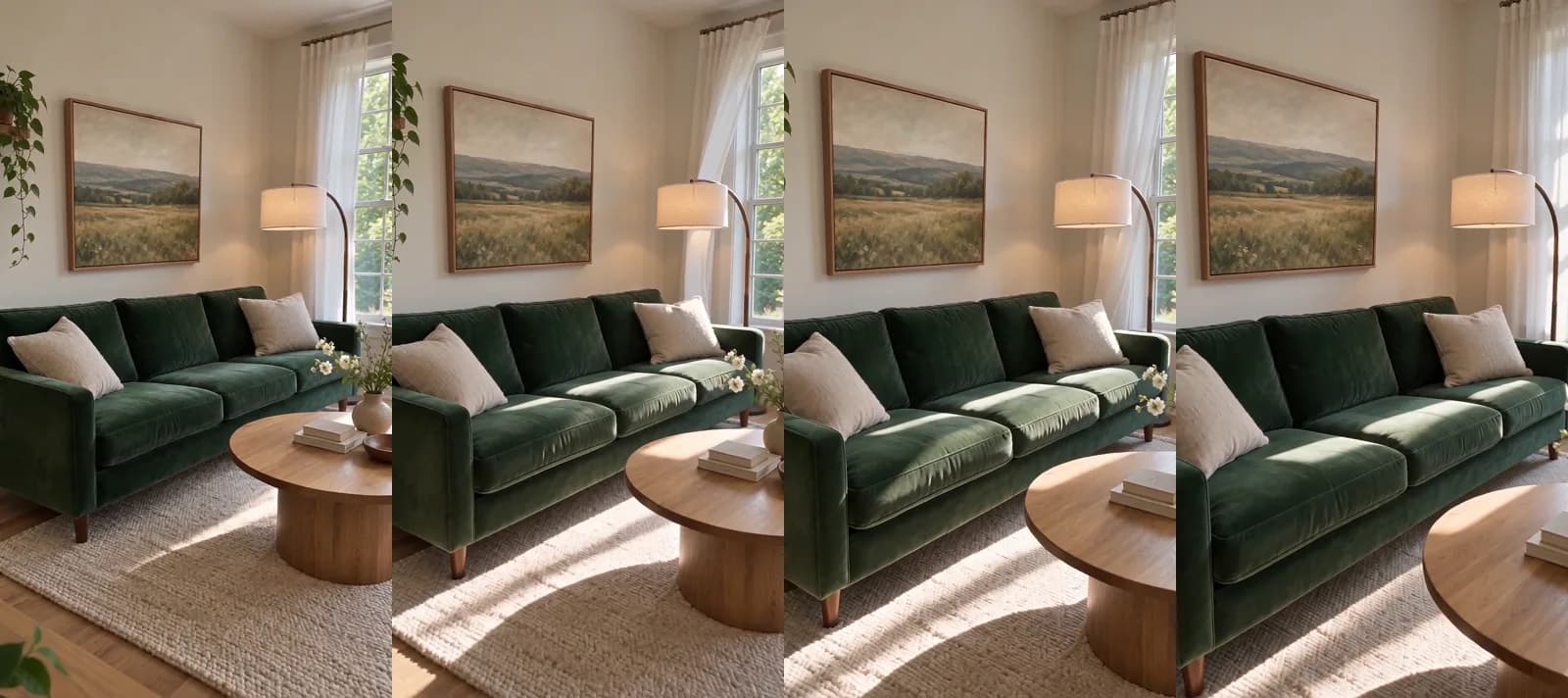 Made in Novoads with Seedance 2.0 Mini · a still of a sunlit room turned into one slow camera move, sound off, started from the still through our connector · 5 credits · 2026-11-15
The strip above shows four frames from a five-second clip. It began as a still of a green velvet sofa in a sunlit room. As the clip plays, the camera eases toward the cushions and along them while bands of light slide across the rug and the curtain moves. We made the still and the clip for another of our guides and picked them for this one because they're the closest thing in our library to a quiet office. A photo of your own office goes through the same steps.
The phone at a private practice keeps ringing with the same questions. What happens in a first session? Do you see couples? Do you work with teenagers, and how involved are the parents? Meanwhile, the calendar has afternoon hours you'd like to fill, and there's a specialty (trauma work or couples counseling, for instance) you'd like to be booked for more often. Each of those questions can be its own short video ad, and none of those ads needs a film crew or a client on camera.
We wrote this guide from the pages that rank on Google for "therapist ads", Google's own advertising policy pages and our own prices, all read on November 17, 2026. The pictures are our renders from November 15, reused at no extra cost. We didn't run any of these ads or interview a practice for this guide.
The video ads therapists and counselors run, one by one
The pages that rank for this search keep coming back to the same few videos. Marketing For Therapists, for one, builds its video package around "An Intro Video", "A Specialty Video" and a getting-started video, and the other guides on the first page of results add an explainer and a client story.
A practice introduction that says how you help
Marketing For Therapists gives its intro video the working title "How we help clients", and that sums up the job. The ad says who you see, what you work on, whether sessions are in person or online, and how someone books. It's the ad a stranger might watch before deciding to call, so it should look and sound like your practice.
AI is good at the parts around you. A slow clip that starts on your waiting-room picture gives the ad an opening shot, captions carry it for people watching with the sound off, and the same script can go out in a second language. If you'd rather not be on camera, an AI presenter can read the practice's message, as long as it talks about the practice in the third person and never introduces itself as you.
The agency's page says "Most of our clients record using their smartphone." We'd do the same for this one ad, because the introduction is where a caller decides whether they could talk to you. It should never show an AI presenter introduced as you, a colleague or a client, or a room that isn't yours, since a caller who books will walk into the room they saw.
A specialty ad for couples, trauma or teen work
Psychotherapy Growth's guide opens its list of what advertising does for a practice with "Builds awareness for your niche (such as couples, trauma, or teen therapy)". Marketing For Therapists says its specialty video "will highlight a target market, condition, or modality". It's the ad to run for the kind of work you'd like more of.
An AI presenter can explain your approach in plain words (what a couples session involves, how you pace trauma work, how parents fit into a teenager's therapy), and a room clip and captions finish it. Name the work itself, such as trauma-focused therapy for adults, and let the right viewer recognize it.
It should never show a couple arguing, a person in distress or a session in progress, and its words should never tell the viewer they have a condition. For teen therapy, we'd address the ad to the parent, and the section on Google's rules further down explains why that matters on Google.
A getting-started ad that walks through the first call
Marketing For Therapists' third video "will tell a prospective how to move forward", which on its page means explaining the consult or intake session. It's for the caller who's ready to start but isn't sure what the steps are.
An AI presenter can read the steps in the order a new client goes through them, with captions on screen.
- Calling the practice or booking online.
- A short consult to see whether it's a fit.
- The intake forms.
- The first appointment, with your real openings named (weekday afternoons, if that's where your calendar has room).
It should never show a countdown, a line about spots running out, or a promise of how someone will feel after a few sessions. Digital Ipsum's guide to paid ads for therapists, dated March 2026, says to "Avoid fear-based headlines, outcome guarantees, countdown timers", and the same sentence warns against limited-slots language.
An explainer on what a first session is like
TherapySites tells practices to make videos and posts that "explain therapy treatments". Digital Ipsum's guide goes further and says "Ads that acknowledge hesitation, explain what therapy looks like, and invite learning instead of immediate booking perform best". That's the agency's claim, and it fits the caller who asks what actually happens at the first appointment.
An AI presenter can walk through the practical details a nervous caller wonders about.
- How long the first appointment runs.
- What paperwork comes before it.
- The kinds of questions you'll ask.
- What happens if it isn't a good fit.
It should never show a client on a couch, a therapist taking notes across from someone, or anything else that looks like a real session, and it should never promise a result.
Client stories, the one ad we'd keep away from AI
TherapySites' list of marketing ideas, dated October 1, 2025, says "Share a client testimonial with a photo (with their permission) to build trust." Whatever you decide about real testimonials, don't make one with AI. An AI actor speaking as a past client is a client who doesn't exist, so we'd never make that ad, and this guide doesn't show how. If a real client's words ever appear in your marketing, they stay real, they're recorded with permission, and they come from outside Novoads.
Making these ads in Novoads with your photos or an AI presenter
Novoads makes the video files, and you run them on Google, on Meta or wherever the practice already advertises. Two tools cover everything above. The talking actor makes the presenter ads, and the video editor makes short clips that begin on pictures you took. Captions come last, on the finished video.
Presenter ads with a talking actor
- Open the Talking Actors tab and click "Add actors" to choose an AI presenter from the library.
- In the box that reads "Write what the actor will say...", write a script that talks about the practice in the third person ("The practice sees couples and adults, with weekday afternoon times"), so the presenter never speaks as you or as anyone on staff.
- The price line, which counts credits per started minute, is also where you switch between 720p and 480p.
- Hit the round send button (an up arrow with no label) to start the video.
The finished file shows the AI presenter saying your script, with the voice and lip-sync included. Captions are a separate step. Anything up to a minute is one charge, because the talking actor is billed by the started minute. At 720p, the default, that charge is 200 credits. At 480p it's 100.
Our voice list covers 32 languages, so a bilingual practice can run the same ad in Spanish from a script written in Spanish. For casting, our guide to AI actors goes through how brands choose one, and our guide to talking head videos looks at what a minute of one costs.
We'd use a presenter for the getting-started and first-session ads, where the message is practical, and keep your own face for the introduction if you're willing to record it.
Room clips that start on a photo of your office
Take the photo yourself on a phone, in the room clients actually walk into, with nobody in it and no diplomas, names or files anyone could read.
- Open the Video tab, pick Kling 3.0, Kling 4.0 or Google Veo 3.1, and put the photo in the box marked "Drop a start frame or click to upload".
- If you pick Omni Flash or Wan 3.0, switch from "Reference" to "Start / End Frames" first, then add the photo.
- Once the editor shows "The video starts on this picture.", describe one slow move in the prompt (a gentle push toward the armchair as daylight crosses the floor, for example) and ask for no people.
- Send it with the same round up-arrow button.
You get a short clip whose first frame is your picture. Its price depends on the model and the length, and the cost table further down lists each one.
 Made in Novoads with GPT Image 2.6 Sunburst · a quiet sunlit room with a green velvet sofa, from a written prompt, standing in for a photo of your own office · 1 credit · 2026-11-15
We made that still from a written prompt, and since this guide has no practice behind it, that picture stands in for the photo you'd take. We turned it into the clip at the top with our own connector for Claude, which can start a Seedance 2.0 Mini clip on a picture. The clip runs five seconds at 720p. It cost 5 credits. In the editor, Seedance treats an uploaded photo as a reference you call @Image1 in the prompt, and the clip won't begin on it. That's why the steps above stick to the start-frame models. Our one-photo video guide follows a single photo all the way to a finished ad.
Captions for people watching with the sound off
Open the Captions tab and add the finished presenter video. The tool opens on the "TikTok, no box" look, one of six looks (TikTok's and Instagram's, each with no box, a dark box or a light box). Each look costs 3 credits a started minute. There's also a Karaoke style that costs 0 credits. Check the captions against your script before the ad goes out, because a wrong word stands out more in a therapy ad than in most.
What a therapy ad costs in credits and dollars
These are our prices as of November 17, 2026. Novoads charges from your first month, and each plan comes with a monthly balance of credits that every piece below draws from.
Our plans and what one credit costs
| Plan | A month | Credits a month | One credit |
|---|---|---|---|
| Starter | $15 | 200 | 7.5 cents |
| Plus | $49 | 1,000 | 4.9 cents |
| Ultra 3,000 | $129 | 3,000 | 4.3 cents |
Our pricing page lists every plan, with the yearly prices for the plans that offer one.
What each piece costs
The credits come from our own price list, and we worked out the dollar amounts for each plan ourselves.
| What you make | Credits | Starter | Plus | Ultra 3,000 |
|---|---|---|---|---|
| Talking actor, up to a minute at 480p | 100 | $7.50 | $4.90 | $4.30 |
| Talking actor, up to a minute at 720p (the default) | 200 | $15.00 | $9.80 | $8.60 |
| Kling 3.0 clip from your photo, 5 seconds | 10 | 75 cents | 49 cents | 43 cents |
| Wan 3.0 clip from your photo, 5 seconds at 720p | 9 | about 68 cents | about 44 cents | about 39 cents |
| Omni Flash clip from your photo, 4 seconds at 720p (it has no 5-second length) | 12 | 90 cents | about 59 cents | about 52 cents |
| Kling 4.0 clip from your photo, 5 seconds at 720p | 18 | $1.35 | about 88 cents | about 77 cents |
| Google Veo 3.1 clip from your photo, any length it offers | 72 | $5.40 | about $3.53 | about $3.10 |
| Seedance 2.0 Mini clip from a written prompt, 5 seconds at 720p | 5 | about 38 cents | about 25 cents | about 22 cents |
| GPT Image 2.6 Sunburst still at medium quality | 1 | about 8 cents | about 5 cents | about 4 cents |
| Captions in one of the six looks, per started minute | 3 | about 23 cents | about 15 cents | about 13 cents |
Kling 4.0 defaults to 1080p in the editor, and at that size the same clip costs 27 credits. Google Veo 3.1 costs the same at every length and size it offers. The credits above pay for making the ad. What Google charges for clicks is a separate bill, and our guide to Google Ads costs covers it.
One getting-started set, priced on each plan
The set we'd make first comes to 113 credits.
- A getting-started presenter ad at 480p, up to a minute long, for 100 credits.
- A five-second Kling 3.0 clip of your waiting room, for 10 credits.
- Captions on the presenter ad in one of the six looks, for 3 credits.
| Plan | The set in dollars | Sets a month's credits cover |
|---|---|---|
| Starter | about $8.48 | 1, with 87 credits left |
| Plus | about $5.54 | 8, with 96 credits left |
| Ultra 3,000 | about $4.86 | 26, with 62 credits left |
That total treats the presenter ad and the room clip as two separate ads. Putting the clip inside the presenter video is an extra step, and like a separate voice-over, it has no set credit price, so we haven't counted either one here.
What an agency charges for therapist videos
We read Marketing For Therapists' video page on November 17, 2026. The agency sells a pack of three videos for $900. A single video costs $400. Each one runs one to two minutes, and the page says the agency will "coach you through the entire process" and "take care of the editing". That's a different job from ours (you film yourself on your phone and the agency edits), so the two prices don't compare one for one.
In Novoads, the presenter, the room clips and the captions are all in one place, and you take the finished files to whichever ad account the practice uses.
Make your practice's first video ad
Starter is $15 a month for 200 credits, enough for a presenter ad with a room clip and captions.
See the plansGoogle's Health category and the audiences a counseling ad can use
TherapySites' list of marketing ideas, one of the pages ranking for "therapist ads", tells practices to "Set up a retargeting pixel on your therapy website." On Google, as we read it, that advice runs into a policy for counseling ads. None of the other guides we opened from that results page spells the policy out. Psychology.com's guide, updated in September 2026, comes closest, with "Do not assume that sensitive health or identity-based targeting is available because it would suit your specialty".
What Google's policy says about counseling ads
Google's personalized advertising policy says "Content related to Health is a sensitive interest category", and the examples it lists include "Counseling services for mental health issues like depression, anxiety, and addiction, such as gambling addiction and alcohol addiction". For a sensitive category, the page says "You can use predefined Google audiences." It also says "You can't use advertiser-curated audiences."
That's Google's rule for ads on Google, and it applies to anyone advertising counseling to the public in Google Ads, from a solo practitioner to a group practice. Google's change log entry from May 2025 takes content "directed at healthcare professionals in their professional capacity" out of the Health category. The same entry says the update "does not change the existing policy prohibiting targeting users based on sensitive health conditions".
If an ad is flagged, Google's page says "you should review your site or app as well as your ad content" to see whether it falls under the policy, so we can't promise how any one ad will be classified.
The audiences that are off the table, and the ones that aren't
Google's page sorts its targeting features into two columns and says the list isn't exhaustive.
| Advertiser-curated audiences (can't be used for sensitive categories) | Predefined Google audiences (can be used) |
|---|---|
| Customer match | In-market segments |
| Your data segments (Google's Restricted targeting page says these were "previously called remarketing") | Affinity |
| Audience expansion | Demographics (with exceptions) |
| Lookalike segments | Detailed demographics (with exceptions) |
| Life events | |
| Location targeting | |
| Custom segments (with sensitive ads or landing pages, Display campaigns only, to non-sensitive audiences or by context) |
Google gives a reason for each column. Advertiser-curated audiences can't be used "because they may inadvertently contain sensitive user signals". Predefined audiences can, Google says, "because the sensitive user signals are automatically excluded from them".
Two of the barred features turn up in video campaigns, and Google's own pages say where.
- Google's help on audience expansion says it's "available for Video campaigns".
- Google's help on audience segments says "Lookalike segments are only available in Demand Gen campaigns."
- The Restricted targeting page says "Discovery and Demand Gen campaigns use advertiser-curated audiences by default and may be restricted from serving if targeting products and services that fall within sensitive interest categories".
Location targeting stays in the allowed column. Google's footnote on ZIP code targeting names housing, employment and consumer finance ads in the US and Canada, and health isn't on that list. Teenagers get their own footnote, which says users under 18 "are not eligible for personalized advertising of any kind, including serving based on Predefined Google Audiences".
Addiction recovery ads go through a second check
Ads for drug and alcohol recovery services fall under a second Google policy on top of the audience rule. Google's Healthcare and medicines policy says "Google restricts the promotion of recovery-oriented drug and alcohol addiction services", and that advertisers targeting certain locations can promote them "if certified by Google". Its United States section says "you must be certified as an addiction services provider by the LegitScript Certification program", and adds "Advertisers must also be certified with Google".
The same page puts services for "impulse control disorders, behavioral addiction, or nicotine addiction" outside that policy, so the certification is about drug and alcohol recovery. Following the audience rule doesn't get an ad approved on its own. A practice that also handles medication and wants to bid on drug names has a separate certification to look at, which our med spa ads guide covers.
What we'd change in the ads above
Our reading of Google's pages changes a few things about the ads above.
- We'd build the Google version of each ad on location targeting and Google's own audiences, and let the ad's words do the sorting (the specialty, the area you serve and the hours you have open).
- We'd leave retargeting out of any Google plan for counseling ads in the Health category, whatever a marketing checklist says.
- We'd write a teen-therapy ad for the parent who makes the call.
- We'd check the audience settings on any Demand Gen video campaign for a counseling practice before it goes live.
For Meta, our chiropractor ads guide covers how Meta flags health-condition audiences, and our step-by-step guide to creating Google Ads walks through the setup itself.
If Google flags an ad anyway, its page lists three ways to fix it. The first is to "Review and remove any advertiser-curated audiences from the targeting settings of your ad". The other two are editing the ad or the site, and appealing the decision. Before a campaign goes live, check Google's own policy pages in the sources. Nothing in this guide is legal advice.
Frequently Asked Questions
Where can I advertise my counseling services?
Psychotherapy Growth's guide points therapists to Google Ads, Meta's platforms and therapy directories. On Google, a counseling ad can use location targeting and Google's predefined audiences but not your client lists, your site visitors or lookalike audiences, because Google puts counseling for depression, anxiety and addiction in its Health category.
What are some examples of therapist ads?
A practice introduction that says how you help, a getting-started ad that walks through the first call and the consult, an explainer on what a first session is like, and a specialty ad for couples, trauma or teen work. Each one can be a short video with an AI presenter, a clip that starts on your office photo, or both. A client testimonial is the one ad we'd never make with AI.
What is a good slogan for a counseling practice?
A plain line that names the work and who it's for, such as 'Couples counseling with weekday afternoon times' or 'Therapy for teens, with parents kept in the loop'. Digital Ipsum's guide for therapists says to avoid fear-based headlines, outcome guarantees and countdown timers, and we'd add that a slogan should never tell the reader they have a condition.
Can a therapist use retargeting on Google Ads?
Not for an ad in Google's Health category, and counseling for depression, anxiety and addiction is one of Google's own examples of that category. Ads in that category can't use advertiser-curated audiences, and Your data segments (which Google's Restricted targeting page says were previously called remarketing) are one of them. Location targeting and Google's predefined audiences are still allowed, with the exceptions Google lists.
Can an AI presenter appear in my practice's ads?
Yes, as long as it talks about the practice in the third person and is never introduced as you, a colleague or a client. We'd use one for the getting-started and first-session ads, keep your own face for the introduction if you're willing to record it, and never use AI for a client story.
Key Takeaways
- Private practices run a handful of video ads (an introduction, a specialty ad, a getting-started ad and a first-session explainer), and none of them needs a client on camera.
- A presenter ad, a room clip made from your office photo and captions come to 113 credits in Novoads, or about $5.54 on Plus.
- Google lists counseling for depression, anxiety and addiction among the examples in its Health category, and ads in that category can't use Customer match, Your data segments, Audience expansion or Lookalike segments.
- Location targeting and Google's predefined audiences are still allowed (some with exceptions), and ads for drug and alcohol recovery services also need Google's certification.
- Never make a client testimonial with AI, and never introduce an AI presenter as the therapist, a colleague or a client.
Sources
- •Google Advertising Policies Help: Health in personalized advertising
- •Google Advertising Policies Help: Restricted targeting in Personalized advertising
- •Google Advertising Policies Help: Healthcare and medicines
- •Google Advertising Policies Help: Update to the Personalized advertising policy (May 2025)
- •Google Ads Help: About audience expansion
- •Google Ads Help: About audience segments
- •Marketing For Therapists: Videos for Therapists
- •TherapySites: Therapist marketing ideas to attract and retain clients
- •Psychotherapy Growth: Advertising for therapists
- •Digital Ipsum: Paid ads for therapists
- •Psychology.com: Therapist advertising sites