Qwen Image 3 Promises Ten-Pixel Text in Ad Images, and Ships Zero Benchmarks
Alibaba says Qwen Image 3 renders legible text down to ten pixels from 4,500-token prompts. It published no benchmarks, no weights and no technical report. Here is what the model actually exposes to buyers, and what it changes for ad creative.

Mauricio Valdivia
·11 min

The Launch Shipped Claims, Not Benchmarks
The demo that traveled fastest was a three-by-three grid of infographics. Nine panels, each with its own headline, its own diagram, its own block of small type, all produced in one generation rather than stitched together from nine separate images. If you make ads, you looked at that grid and ran the same arithmetic everyone else did. That is a sale poster. That is a spec sheet. That is the comparison chart your landing page has been waiting on for two quarters.
Alibaba's Qwen team announced Qwen-Image-3.0 on July 21, 2026. According to the announcement, the model processes inputs of up to 4,500 tokens and renders text as small as ten pixels, plus mathematical formulas and twelve languages, legibly, in a single pass. Those two numbers are the whole story of the launch, and both come from exactly one place: Alibaba's own post about Alibaba's own outputs.
Here is what did not arrive alongside them. No benchmark table. No parameter count. No license. No downloadable weights. No technical report describing how the model was trained or tested. The-decoder, covering the announcement, reports that the model is currently available only through invite-only API access and that, unlike the original Qwen-Image, its weights are unlikely to ship under an open license.
So the loudest claim in AI image generation this month arrived with no instrument to measure it. That is the actual news, and no aggregator is leading with it. What follows is the part you can check: what the model exposes to anyone who wants to buy it today, what the one published independent test found, and where the distance between that demo grid and a shipped ad still sits.
What Alibaba Says the Model Does
Take the announcement at its word for a moment, because the three capabilities it describes map cleanly onto three jobs an ad team already pays somebody to do.
Prompts long enough to describe a whole layout
Four thousand five hundred tokens is the most concrete number in the release, and it is a jump in kind rather than degree. A short prompt describes an image. A budget that long describes a layout, which is a different object entirely:
- what the headline says, spelled exactly the way legal signed off on it
- the subhead, and how far below the headline it sits
- three benefit bullets, each with its own icon
- the price, the strikethrough price, and the badge
- the disclaimer line, in the size the platform requires
- where every one of those sits relative to the others
According to the Qwen team, that is what gives the model enough room to create dense layouts in one pass rather than assemble them from several images.
Text small enough to read at ten pixels
Ten pixels is not the headline. Ten pixels is everything an ad carries because it has to:
- the legal line and the "terms apply"
- the ingredient list or the spec table on a product static
- the AI-disclosure label, where the platform requires one
- the small print at the bottom that a reviewer reads and a buyer squints at
For anyone working under the disclosure rules platforms now enforce on AI-generated ads, none of that is decoration. It is the part that gets the ad approved or rejected.
Twelve languages, one pass
The localization argument. Same layout, different language, without re-flowing the design by hand for every market. If it holds, a Spanish and a Portuguese variant of the same static stop being two design tasks.
Every one of those three descriptions is Alibaba describing images Alibaba selected. That is not an accusation, it is just the evidentiary status, and it is worth holding onto through the next section.
The Part of the Launch That Is Missing
Absence is a strange thing to write a news story about, which is probably why most coverage skipped it. But for anyone deciding whether to route real creative through this model, the absence is the decision.
A break from how the series shipped before
This is not a company that has always worked this way. The original Qwen-Image model card on Hugging Face still says the model is licensed under Apache 2.0, and it still carries the citation for the Qwen-Image technical report. Open weights and a written account of how the thing was built, published together. The third generation has neither, and points users at a chat product instead.
The gap between the headline and the shipping artifact is worth noticing as a pattern rather than a one-off. The same lab, the same week, put out a speech model that took the top spot on an independent text-to-speech leaderboard while its published voice catalog held two voices, both Mandarin and English. In both launches the number that traveled is real, and in both the thing you can actually buy is narrower than the number implies.
Why a missing benchmark hurts most on a text claim
Unite.AI's write-up of the launch put the problem precisely: text rendering is exactly the axis where generators tend to look strong in hand-picked demos and weaker under systematic testing. The reason is structural. Image quality is subjective and degrades gracefully, so a mediocre render still reads as a decent image. Text does not degrade gracefully. Each glyph is pass or fail, one wrong letter poisons the whole asset, and a curated reel shows you only the passes.
What is actually left to act on
Two things, and this post spends the rest of its length on both. The first is the endpoint: what fal is selling right now, in a schema you can read. The second is the single hands-on test anybody has published.
The One Independent Test So Far
On July 22, GIGAZINE ran the model through Alibaba's own chat surface and wrote up what came out. It is the only published independent hands-on I could find, and it partly supports the launch claims and partly undercuts them.
Where the small text held
The tester prompted an anime-style open-world game screen with an action RPG heads-up display. The result, in their words, looks just like a game screenshot, and overall turned out exactly as instructed. Screenshot-style interfaces are dense with small labels, so this is a real point in the model's favor. A separate close-up of an elderly man's eyes produced skin texture the tester called incredibly realistic.
Where it came apart
In that same game screenshot, the "do" in "Maid Punch" came out slightly distorted and the word "Quest" rendered as "Keesuto". Then the tester tried the editing path, which is the one that matters most here: upload a real photo of a bowl of ramen, ask for a screenshot of a Japanese food blogger's post about it. The model produced a convincing fictional site that fell apart on inspection, with several awkward or wrong Japanese phrases. Their conclusion was that describing Japanese text remains an unsolved challenge for the model.
What that means for a headline in an ad
Nobody has published a test of the ten-pixel claim. What has been tested is one tier up from it, and one tier up it wobbles. Note also which language wobbled: Japanese is one of the twelve the announcement advertises.
The failure mode here is worse than "the image is bad", because a bad image is cheap to catch. This failure mode is "the image is beautiful and one word is wrong", which survives your own review, survives the client's, and gets caught by the platform or by a buyer who now thinks your brand cannot spell. If you are running the sort of multi-variant static testing where nobody reads every asset closely, that is precisely the defect that slips through.
Two Endpoints, Not One
Here is where the reporting and the reality diverge, and where a practitioner can get burned. The-decoder describes invite-only API access and never mentions a price or a reseller. But fal is already selling the model as a partner API, and it is selling it as two distinct endpoints that do different things.
Generation accepts no reference images
alibaba/qwen-image-3/text-to-image is generation only. Its published schema exposes a prompt, a negative prompt, an image size, a seed, a number of images, and a pair of toggles. There is no field for a reference image. Send it your product photo and there is nowhere to put it.
Editing takes one to three, and order matters
alibaba/qwen-image-3/edit is the endpoint for the workflow most ad teams actually want. Its schema requires one to three reference images, and it is explicit that their order carries meaning: you refer to them as image 1, image 2 and image 3 inside the prompt itself. The constraints on those references are worth reading before you point a product-photo library at it:
- one to three images, and one is the minimum, not an option
- 384 to 2048 pixels on each dimension
- 10MB maximum per image
- JPEG, PNG without an alpha channel, or WEBP
One caution before you build against any of it. fal's own catalog description on the generation page currently describes the editing behavior, right down to preserving facial features and identity across one to three reference images. Read that page alone and you will build against the wrong endpoint. The schema is the thing to trust, not the blurb above it.
| Generation | Editing | |
|---|---|---|
| Endpoint | .../text-to-image | .../edit |
| Reference images | None accepted | One to three, required |
| Prompt cap | 800 characters | 800 characters |
| Output ceiling | 2048 x 2048 | 1440 x 1440 |
| Price | $0.075 per image | $0.075 per image |
The practical split, if you are deciding which one your workflow needs:
- Use generation when the asset is invented from nothing: a background, a scene, a layout mockup, a concept board for a campaign that has no photography yet.
- Use editing when a real object has to survive: your bottle, your packaging, your founder's face, anything a customer will later hold in their hand and compare.
The 800-Character Wall
That table has one row that quietly contradicts the headline of the entire launch, and it deserves its own section.
The 4,500-token prompt is not the one you can buy
Both fal schemas cap the prompt at 800 characters. The description is unambiguous on each: a text prompt describing the desired image, supporting Chinese and English, max 800 characters. Eight hundred characters does not hold a 4,500-token instruction, and it is not close.
The long-prompt capability is real in the sense that Alibaba claims it for its own native surface, which is where the nine-panel demo was made. It is not a property of the endpoint a team would integrate. So the specific thing that made the demo remarkable, describing a whole dense layout in one instruction, is the specific thing the purchasable API does not currently let you do. That gap is not in the announcement, and it is not in the coverage. It is in the schema.
A rewriter you did not ask for
Both endpoints also ship with automatic LLM prompt rewriting enabled by default, described in the schema as rewriting your prompt for better results. For most image work that is helpful. For ad work it is a variable you did not sign up for, because the exact string of your headline is the deliverable. If the words are load-bearing, turn the expansion off before you generate anything you intend to ship.
What This Changes for Ad Creative
Strip out the launch noise and two concrete jobs are in play here, both of which cost real money today.
The headline burned into a static ad
Most of a static ad is text. The hook, the price, the offer, the badge, the call to action. For years that ruled generative models out of the entire static layer of a campaign, which is why every model that credibly claims in-image text is news, and why Ideogram's V4 line was worth its own write-up. Qwen Image 3 is a bid for the same territory, and unlike Ideogram it arrives without weights or a report to check.
Keeping a face and a product consistent
The one-to-three reference image path is the identity problem: same actor, same bottle, same label, across a set of variants. It is worth knowing this is lineage rather than a new invention. Qwen-Image-Edit-2509 already documented multi-image editing with optimal performance at one to three input images, plus better preservation of facial identity across portrait styles and pose transformations. That shipped in September 2025. The 3.0 endpoint inherits the shape of that feature, which is also why style and subject reference workflows keep converging on the same one-to-three input pattern across vendors.
The ceiling nobody mentions
The edit endpoint caps output at a total pixel count between 512x512 and 1440x1440. Generation goes to 2048x2048. So the path that takes your real product photo in produces a smaller finished asset than the path that invents one from scratch. For a feed placement that is usually fine. For anything you plan to crop hard, upscale, or put anywhere near print, it is a constraint worth knowing before the brief, not after.
How Novoads Solves the Text-in-Ad Problem
To be direct about it: Novoads does not run Qwen Image 3, and this post is not a soft launch for it. A model with no published evaluation has not earned a slot in a production stack yet.
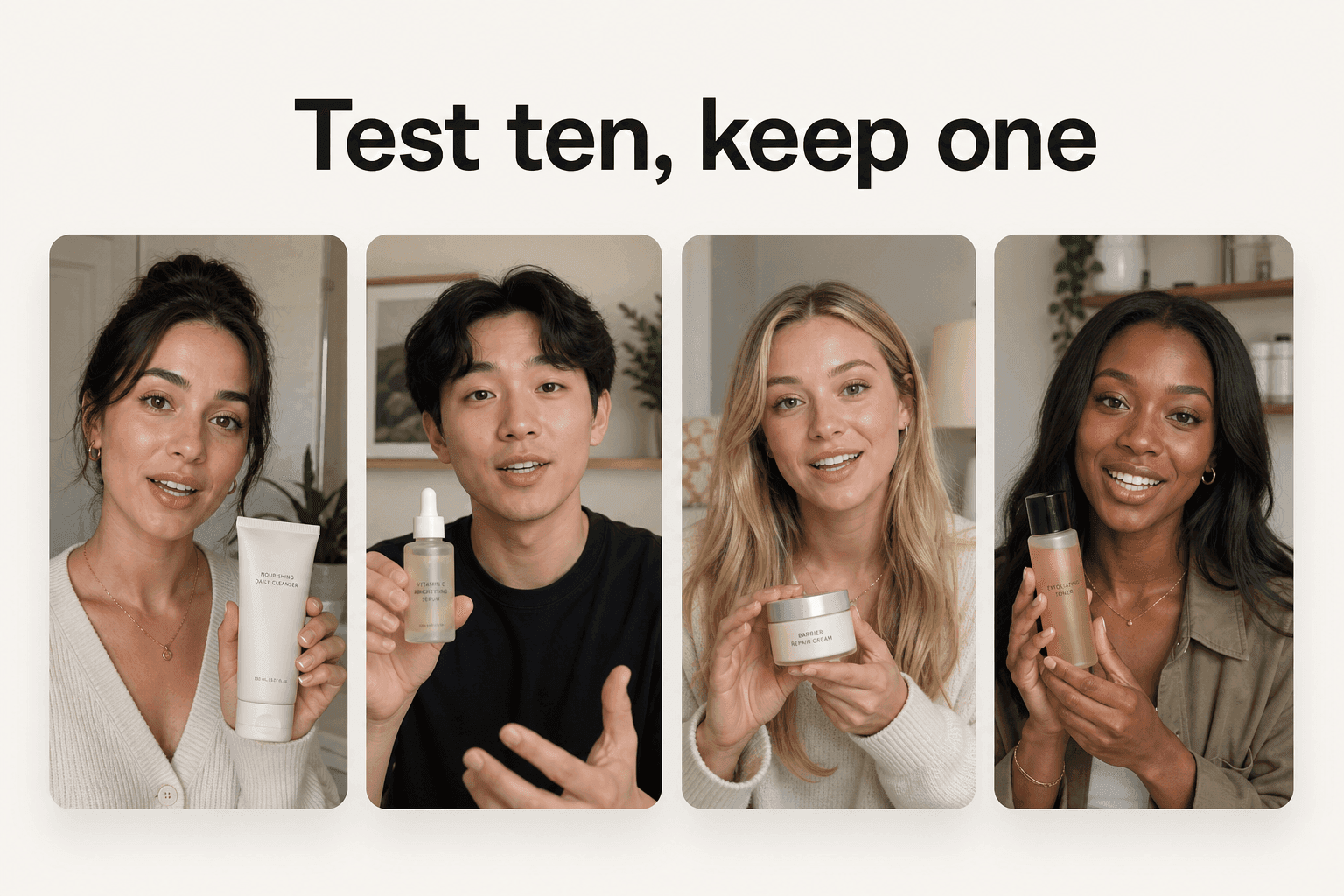
What Novoads does run is a product-to-ad flow you upload a real product photo into, which generates the ad image on GPT Image 2 at medium quality for 0.3 credits per image. The wider image stack adds Nano Banana Pro at 0.5 credits, Seedream 5 Lite at 0.4 credits and Seedream 5 Pro at 0.6 credits, so the static layer and the UGC video layer come out of one brief instead of two tools. If you want to see the flow rather than read about it, you can start a project in Novoads. Access is $49/month. Cancel whenever you want.
The reason that pairing matters is the one thing no image model solves: a clean poster is an ingredient, not an argument. Somebody still has to say why the product is worth buying, in a voice a buyer believes, which is why product video and static creative keep getting made together.
Test It. Do Not Plan Around It.
There is a version of Qwen Image 3 that deserves the attention it got. If a model really does hold legible type at ten pixels across twelve languages, a whole category of design work gets cheaper this quarter, and the teams who noticed first will have a month of advantage.
There is also the version in front of us: an endpoint that takes 800 characters, a rewriter on by default, an editing path with a lower resolution ceiling than the generation path, one independent test that found garbled words in a language the model claims to support, and no benchmark, weights, or report to settle any of it.
Both versions are compatible with the evidence, which is exactly the problem. So run it, but run it the way you would run any unproven supplier. Before a generated static goes anywhere near spend:
- Open the asset at full size and read every word, including the disclaimer line, not the thumbnail.
- Check the brand name and the product name character by character, since those are the two strings a distorted glyph destroys.
- If you generated in a language other than English or Chinese, have a native speaker read it before it ships.
- Turn off automatic prompt rewriting on anything where the copy is the deliverable.
The demo is not the deliverable, and right now the demo is all there is.
Frequently Asked Questions
What is Qwen Image 3?
Qwen-Image-3.0 is the third generation of the image-generation model built by Alibaba's Qwen team, announced on July 21, 2026. Alibaba positions it for information-dense visual work such as newspaper layouts, infographics, exam sheets and UI mockups rather than purely decorative images. According to the announcement it takes prompts of up to 4,500 tokens, renders text as small as ten pixels legibly, and writes in twelve languages, all in a single generation pass. Those capability figures are the vendor's own and have not been independently verified.
Did Alibaba publish benchmarks for Qwen Image 3?
No. The launch shipped with no benchmark table, no parameter count, no license, no downloadable weights and no technical report describing how the model was trained or tested. That is a break from how the series shipped before: the original Qwen-Image model card on Hugging Face is licensed under Apache 2.0 and cites its own technical report. Without an evaluation set or weights, the only evidence available is the set of example images Alibaba chose to publish.
How much does Qwen Image 3 cost on fal?
fal lists it as a partner API at $0.075 per image, billed per image, on both of its endpoints: alibaba/qwen-image-3/text-to-image for generation and alibaba/qwen-image-3/edit for reference-image editing. That is the raw model call. It does not include the offer, the angle, the layout judgment or the testing volume a real static-ad campaign needs.
Can Qwen Image 3 edit a photo of my product?
That workflow lives on the separate edit endpoint, not the generation one. fal's schema for alibaba/qwen-image-3/edit requires one to three reference images, states that their order is meaningful (you refer to them as image 1, image 2 and image 3 inside the prompt), and constrains each to 384-2048px per dimension and 10MB. The text-to-image endpoint exposes no reference-image field at all, so sending product photos there will not work.
Can I really send a 4,500-token prompt?
Not through fal. Both the text-to-image and the edit schemas cap the prompt at 800 characters. The 4,500-token figure describes Alibaba's native surface, where the launch demos were made, not the endpoint most teams would actually buy. Both endpoints also enable automatic LLM prompt rewriting by default, so if an exact headline string matters to you, turn that setting off.
Is Qwen Image 3 available inside Novoads?
No. Qwen Image 3 is not one of the models Novoads offers. Novoads' product-to-ad flow runs on GPT Image 2 at medium quality for 0.3 credits per image, and its image stack also includes Nano Banana Pro, Seedream 5 Lite and Seedream 5 Pro. New models get evaluated as they earn their place, and a model with no published evaluation has not earned it yet.
Key Takeaways
- Alibaba's Qwen team announced Qwen-Image-3.0 on July 21, 2026, saying it accepts prompts of up to 4,500 tokens and renders legible text as small as ten pixels in a single pass. Both figures come from Alibaba's own launch post and no outside party has verified them.
- The release carried no benchmark table, no parameter count, no license, no downloadable weights and no technical report, breaking the precedent of Qwen-Image 1.0, which shipped under Apache 2.0 with a technical report.
- The one published independent hands-on test found the small screenshot-style text broadly held, but words came out distorted ("Quest" rendered as "Keesuto") and Japanese text was awkward enough that the tester called it an unsolved challenge.
- On fal the model is two separate endpoints at $0.075 per image: alibaba/qwen-image-3/text-to-image generates and accepts no reference images, while alibaba/qwen-image-3/edit requires one to three reference images and treats their order as meaningful.
- Both fal endpoints cap the prompt at 800 characters, so the 4,500-token prompt that produced the launch demos is not the prompt you can send through the API today.