HeyGen Avatar 6 for Ads: What It Costs a Second, What It Needs, and When It Fits
HeyGen's Avatar 6 is billed by the second on fal and by the minute in HeyGen credits. What does a 30-second ad cost, which modes work with your own face, and what does HeyGen's 84.4% measure?

Mauricio Valdivia
·11 min
HeyGen's newest avatar arrived with a realism score of its own
HeyGen released Avatar 6, the newest version of its talking-avatar model, with a technical report dated November 17, 2026, and fal lists Avatar 6 too. HeyGen's model page opens with a score from the company's own tests. Side by side with real footage, it says, Avatar 6 is 84.4% indistinguishable, up from 44.4% for Avatar V. If you make presenter ads, three plainer questions probably matter more. What does one finished ad cost? Which mode works with your own face? And when is a different presenter tool the better buy?
On November 19, 2026, we read HeyGen's own pages (its model page, its research pages and the two technical reports behind them, its pricing page, its help center and its developer docs), along with fal's Avatar 6 pages and the top Google results for "heygen avatar 6". We didn't render Avatar 6, so we don't judge how its videos look. The Novoads side comes from our own prices that day and two renders we made in July.
What Avatar 6 is, in HeyGen's words
This section is HeyGen's description of its own model, from its model page, its research pages and its developer docs, plus what fal's Avatar 6 pages add. Where a line is our own reading, it says so.
Native 2K, with 1080p as the default
HeyGen's model page says every Avatar 6 frame is native 2K. That's HeyGen's label, but it doesn't mean every video you download comes out in 2K. The FAQ on the same page says you can export in 1080p or 2K. HeyGen's developer docs list 1080p as the default on both of its Avatar 6 endpoints, so a video comes out in 2K only when you ask for it. The docs also say 720p and 4K aren't supported there. On fal, 2K costs $0.145 a second. At 1080p it's $0.10.
HeyGen's 2K isn't one fixed size, either. For a landscape video, its docs give 2880 × 1620 on the model endpoint and 2560 × 1440 on the video endpoint, the one that takes a script and a HeyGen voice. Vertical videos follow the same split, 1620 × 2880 against 1440 × 2560.
Two HeyGen tests behind 84.4% and 44.4%
Both numbers are HeyGen's own, and they come from two separate tests.
In the Avatar 6 test, raters saw a real recording and an Avatar 6 clip of the same person saying the same sentence over the same audio, then picked the one they thought was real. They picked the Avatar 6 clip in 42.2% of their choices. That's 114 of 270 answers. HeyGen doubles that share and calls it an indistinguishability rate, so a 50% pick rate, the point where raters can't tell the two apart, would score 100%. So the 84.4% is a doubled pick rate, and it doesn't mean 84.4% of viewers were fooled.
HeyGen's technical report says the test used real recordings of HeyGen employees. The side-by-side part covered 76 people, judged by 20 external raters. Another 11.2% of the side-by-side answers were "can't tell" responses, which the count of 270 leaves out. HeyGen ran the test on the setting its report calls Avatar 6 Quality, at 2K output.
The 44.4% for Avatar V comes from a different study. HeyGen's Avatar 6 report says Avatar V was measured the same way in its own technical report, which HeyGen's research page dates April 8, 2026. In that test, three annotators each judged 18 pairs. They mistook Avatar V for the real video in 22.2% of their 54 judgments. Double that and you get the 44.4%.
So HeyGen's "up from 44.4%" compares a figure from one test with a figure from another. The Avatar 6 figure rests on 270 answers from 20 external raters. The Avatar V figure rests on 54 judgments from three annotators. We found no test outside HeyGen that repeats either number.
Turbo and Pro
HeyGen sells Avatar 6 in two modes, Turbo and Pro. Its help center says the Creator plan includes only Turbo, while the Pro plan includes both. HeyGen's technical report describes Turbo as a lower-latency variant, and the realism test ran on the setting the report calls Quality. So don't read HeyGen's 84.4% as a score for Turbo, the mode on the $29 Creator plan.
fal sells the two tiers as separate endpoints, Avatar 6 and Avatar 6 Turbo, and calls Turbo the lower-cost tier.
Which modes work with your own face
In HeyGen's app, you can make an avatar of yourself. According to HeyGen's model page, you upload a photo, verify that it's you and record at least 15 seconds of yourself talking.
On HeyGen's API, the developer docs list three ways to put a real person on camera.
- A HeyGen avatar, meaning a public avatar or a digital twin made through HeyGen's consent flow, works in every workspace.
- A photo reference, which the docs describe as a photo of the person used with their permission, also works in every workspace.
- A video reference, for the highest likeness, is for Enterprise customers.
fal splits Avatar 6 into three endpoints by what you feed it.
- Identity mode has a stock HeyGen avatar read your written script in a HeyGen voice, or lip-sync to audio you upload.
- Image mode animates a photo of a person, lip-synced to a speech track you supply, and the video runs as long as the audio.
- Reference-video mode is for animated or illustrated characters, and fal says that mode doesn't support videos of real people.
So you can get your own face into a video through HeyGen's app, through a digital twin or a photo reference on HeyGen's API, or through fal's image mode with your own audio. Identity mode on fal gives you a stock face.
Sizes, shapes and length
fal lists five shapes for identity mode, vertical 9:16 among them. A video on fal runs as long as your audio or the speech generated from your script, and HeyGen's docs say the same about the audio on its model endpoint. HeyGen's research page says the model works up to 2K, with no length limit. But HeyGen's pricing page lists a cap of 30 minutes per Avatar 6 video on the Creator and Pro plans.
What one 30-second Avatar 6 ad costs
Prices as of November 19, 2026.
On fal, by the second
fal bills Avatar 6 by the second of video it generates, so a 30-second presenter ad costs 30 times the rate. The 30-second columns are our arithmetic, from fal's per-second prices.
| fal endpoint | 1080p, a second | 1080p, 30 seconds | 2K, a second | 2K, 30 seconds |
|---|---|---|---|---|
| Avatar 6 | $0.10 | $3.00 | $0.145 | $4.35 |
| Avatar 6 Turbo | $0.05 | $1.50 | $0.0875 | about $2.63 |
On each tier, fal's image mode costs the same as its identity mode, so the table holds whether the face is a stock avatar or your photo. A 15-second hook costs half as much as a 30-second take, so billing by the second helps when you're testing short openings.
On HeyGen's own plans, by the minute
HeyGen's help center lists Avatar 6's prices in HeyGen credits by the minute, and at 1080p, Pro mode costs twice as much as Turbo. The last column is our arithmetic, half the per-minute rate. HeyGen's help article on credits shows a 30-second scene billed at half a per-minute rate only in its example for another feature, Custom Expressive Motion. So we've assumed HeyGen bills Avatar 6 the same way. If HeyGen rounds a partial minute up to a whole one, each 30-second price below doubles.
| HeyGen mode | Credits a minute, 720p or 1080p | Credits a minute, 2K | One 30-second ad, 1080p |
|---|---|---|---|
| Avatar 6 Turbo | 20 | 35 | 10 credits |
| Avatar 6 Pro | 40 | 58 | 20 credits |
What a credit costs in dollars depends on your plan.
| HeyGen plan | Price a month | Credits a month | Avatar 6 modes | Export | One 30-second ad at 1080p |
|---|---|---|---|---|---|
| Creator | $29 | 600 | Turbo only | 1080p | 10 credits, about 48 cents |
| Pro | $49 | 1,000 | Turbo and Pro | 4K | 20 credits in Pro mode, about 98 cents |
On Creator, a month's credits cover 60 of those Turbo ads if you don't spend them on anything else. At 2K, a Pro-mode ad of the same length costs 29 credits. That's about $1.42 on the Pro plan. The dollar figures are each plan's price per credit times the credits, so they assume you spend the whole month's credits. Our HeyGen pricing guide covers every HeyGen plan and what its credits buy across HeyGen's other models.
fal or HeyGen for one ad
For a 30-second presenter ad at 1080p, HeyGen's own plans cost less per ad than fal's per-second price, as long as you use the month's credits. fal suits a team that makes a handful of presenter videos through an API and would rather pay by the second than subscribe to a HeyGen plan. That's our reading of the two price lists. If you're weighing HeyGen as a whole against other tools, our comparisons of HeyGen and Higgsfield and HeyGen and InVideo go beyond Avatar 6.
When Avatar 6 fits an ad, and what to check before you pay
This part is our reading of HeyGen's and fal's pages. We haven't made an ad with Avatar 6.
A presenter reading your script
Every route into Avatar 6 that we read about takes a script or a speech track and gives you back a talking presenter. So it fits ads where a presenter carries the message, such as a product explainer, an offer read to camera or a short how-it-works video. You'll usually test those scripts in a few versions, and that's where the price of each take adds up. For ads built around the product itself rather than a presenter, our ecommerce video ad examples are a better place to start.
What HeyGen's video endpoint won't do with Avatar 6
If you plan to make Avatar 6 videos through HeyGen's API, its docs say the video endpoint doesn't support Avatar 6 for raw-image requests, studio scenes, batch creation or scene editing. The same docs say the engine setting still defaults to Avatar IV when you leave it out, so each request has to name Avatar 6 to get it.
A stock face can turn up in other ads
Identity mode on fal uses a stock HeyGen avatar, one of HeyGen's public avatars. HeyGen's docs list public avatars as open to every workspace, so the presenter in your ad can also turn up in someone else's. Whatever face you use, we'd write the script for a presenter. An AI presenter shouldn't pose as a customer giving a review or as one of your staff.
Four checks before you pay
- Which mode your plan includes. Creator has Turbo only, and HeyGen's realism test ran on the setting its report calls Quality.
- The export size. On Creator, you export in 1080p, and 2K costs more on fal and in HeyGen credits.
- The audio. On fal, image mode needs your own speech track, while identity mode can work from a script and a HeyGen voice.
- Whose face it is. A photo reference on HeyGen's API needs the person's permission, and a video reference is for Enterprise customers.
Making a presenter ad in Novoads with a talking AI actor
Novoads doesn't sell or run Avatar 6. Our talking AI actor is a separate product, priced on our own plans, and we don't compare the two on realism. It reads your script with a face from our actor library or one you make from a written description, and the take comes back with voice and lip-sync. Its voices cover 32 languages.
Make one in five steps
- In the editor, pick Talking Actors.
- Type your script in the box that says "Write what the actor will say...".
- Click Add actors and pick a face from the library. To make a new face, click Create Actor, choose Generate and describe the person in a sentence. You'll get three faces back. Pick one, then choose a voice under Select Actor Voice.
- On the price line, choose 480p or 720p. The default is 720p.
- Click the round arrow button to send it.
We made the faces below in July for our guide to AI actors, from one loose, misspelled prompt for a blonde woman in her twenties. She's made up, so she has no name and no job. That run used Nano Banana Pro and cost 6 credits for the three faces. Today, Generate in Create Actor makes its three faces with GPT Image 2.6 Sunburst at high quality, and it still costs 6 credits.
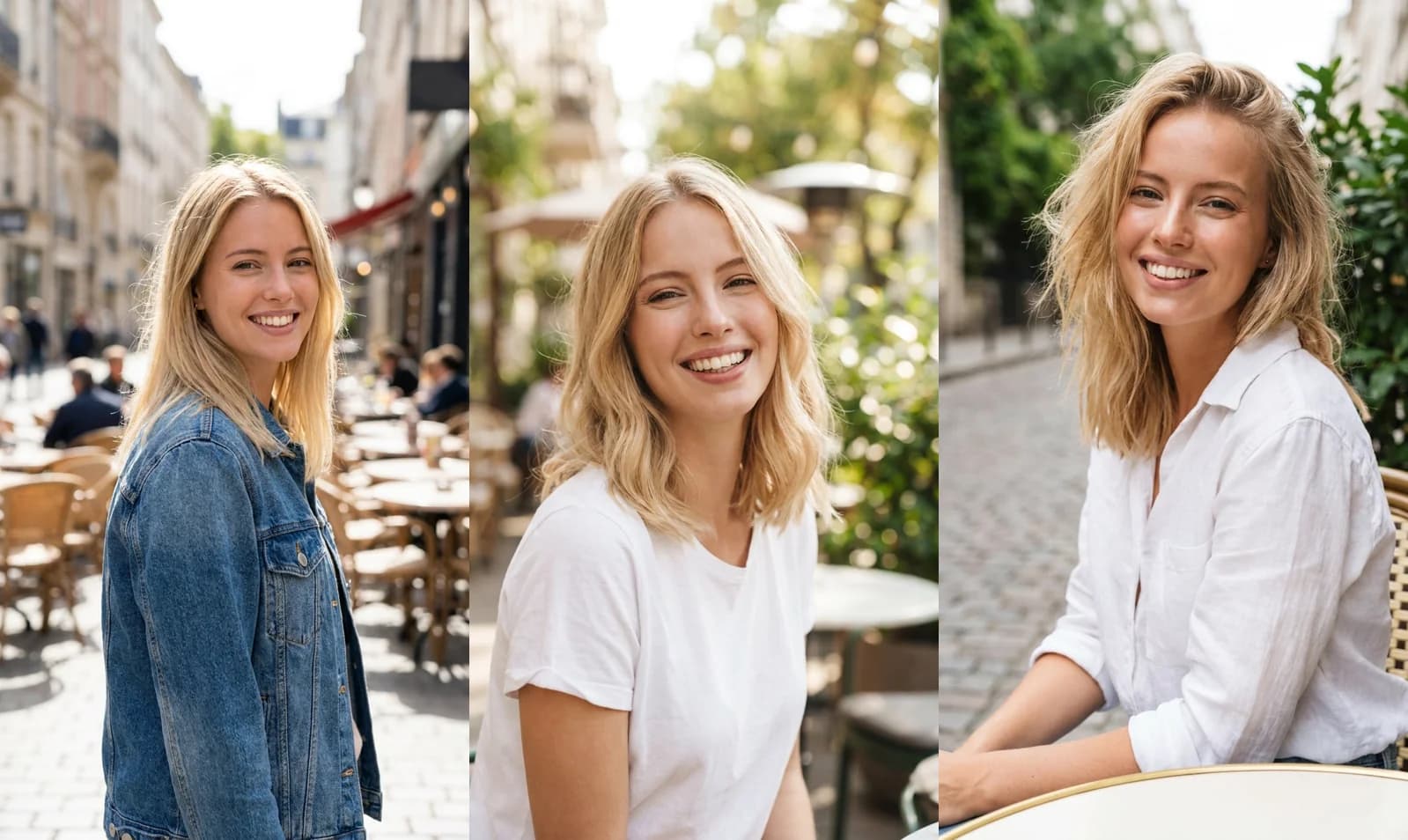 Made in Novoads with Nano Banana Pro · three candidate faces from one loose prompt in Create Actor, made for our AI actors guide · 6 credits · 2026-07-28
We saved the denim-jacket face as an actor, gave her a voice from our library and had her read a 5.8-second welcome line for Novoads. We made the take at 720p, which costs 200 credits at today's price. Across the frames, her mouth changes shape with the words, and in the last one she gestures with an open hand.
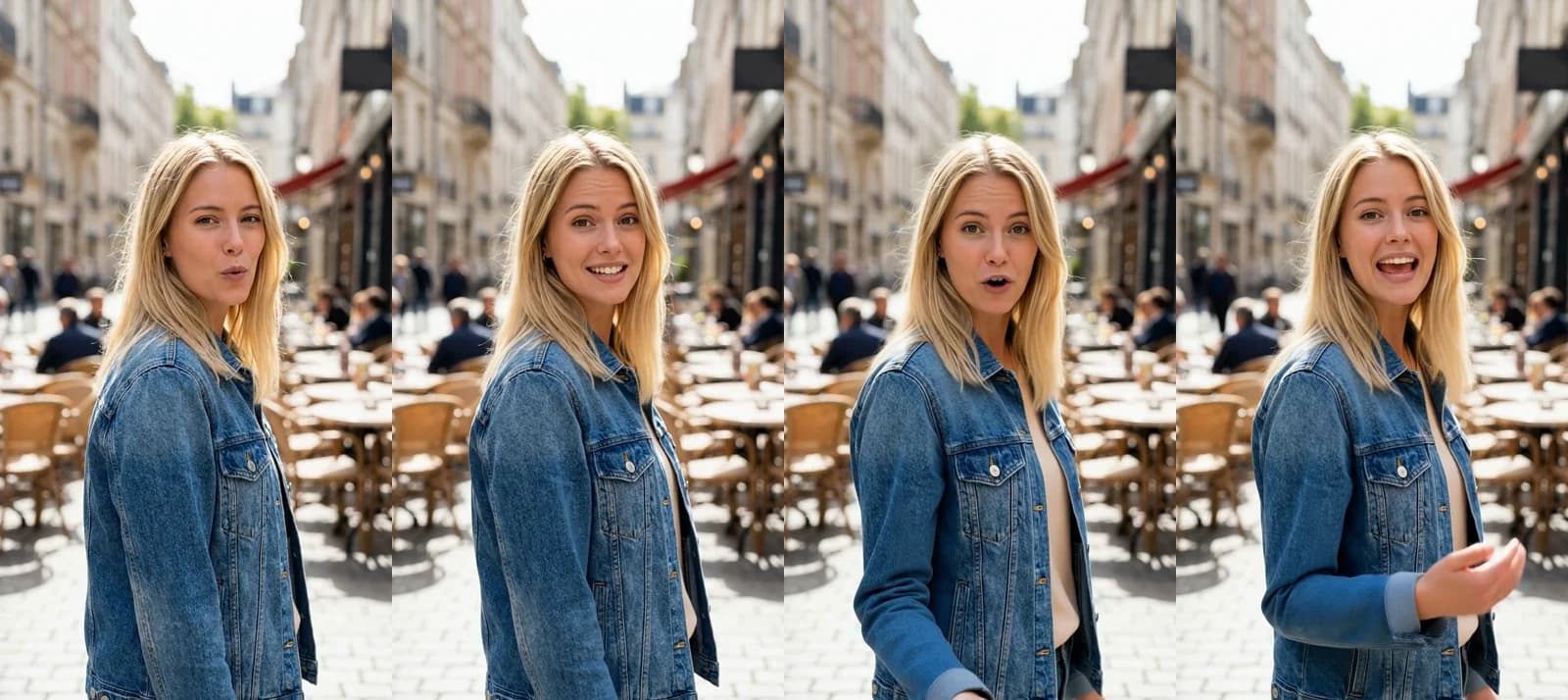 Made in Novoads with Talking actor · the denim-jacket face, saved as an actor with a library voice, reading a 5.8-second welcome line, made for our AI actors guide · 720p, 200 credits at today's price · 2026-07-28
What a take costs
Our prices as of November 19, 2026. We bill the talking actor by the started minute, for each actor in the video, so every take of up to a minute costs the same.
| Talking actor take, one actor | 480p | 720p |
|---|---|---|
| Up to 60 seconds (one started minute) | 100 credits | 200 credits |
| 61 seconds (two started minutes) | 200 credits | 400 credits |
| One started minute on Starter ($15 for 200 credits) | $7.50 | $15.00 |
| One started minute on Plus ($49 for 1,000 credits) | about $4.90 | about $9.80 |
A face you make from a description adds 6 credits for its three candidates, and a library actor adds nothing. At 480p, a Starter month covers two takes. A Plus month covers ten. Because we bill by the started minute, a 15-second hook costs as much as a full-minute script at the same size. We charge from the first month, and every plan is on our pricing page.
When our talking actor fits instead
This is our reading too. By the prices above, a presenter-only take costs less on HeyGen's own plans than our 480p take. We'd pick our talking actor in two cases.
- The presenter is one part of an ad you're making in Novoads. The same credits pay for the actor, the product pictures and clips from our video models (Seedance 2.5, Seedance 2.0, Seedance 2.0 Mini, Kling 3.0, Kling 4.0, Google Veo 3.1, Omni Flash and Wan 3.0). Our guide to making product videos with AI covers the product clips.
- You want a face you describe in words for this ad, rather than a stock avatar from a shared library or your own face on camera.
We'd pick Avatar 6 when the ad needs 1080p or 2K, or your own face. For a fuller side-by-side of the two tools for UGC-style ads, see HeyGen vs Novoads.
Before you pick a presenter tool
Price one finished take on each tool, at the length and size you'll actually run, before you weigh a realism score. HeyGen's 84.4% is its own measurement, on the setting its report calls Quality, at 2K, and Turbo is a separate, lower-latency variant.
Compare HeyGen and Novoads for presenter ads
See what each tool makes, what each costs and when to pick each for UGC-style ads. Novoads plans start at $15 a month.
See HeyGen vs NovoadsIf you try ours, start with one 480p take of your real script and move to 720p once the script and the face are right. For all the steps of making a complete AI ad, see our five-step guide to AI ads.
Frequently Asked Questions
What does HeyGen's 84.4% for Avatar 6 measure?
It's HeyGen's own score, from its own test. Side by side with real recordings, raters picked the Avatar 6 clip as the real one in 42.2% of their choices. HeyGen doubles that share, so a 50% pick rate would score 100%. The 44.4% for Avatar V comes from a separate, smaller test in Avatar V's own report from April 2026. As of November 19, 2026, we found no outside test that repeats either number.
Key Takeaways
- HeyGen released Avatar 6 with a technical report dated November 17, 2026. Its model page calls every frame native 2K, but its API docs list 1080p as the default.
- HeyGen's 84.4% for Avatar 6 and 44.4% for Avatar V come from two separate HeyGen tests. The 84.4% is a doubled pick rate, so a coin flip would score 100%.
- On fal, Avatar 6 costs $0.10 a second at 1080p. One 30-second ad there is $3.00, and fal's Turbo tier halves that.
- You can use your own face through HeyGen's app or a photo reference on its API. On fal, identity mode gives you a stock HeyGen avatar, and image mode needs your own audio.
- Novoads doesn't sell Avatar 6. Our talking AI actor costs 100 credits for a take of up to a minute at 480p with a library actor, and a face you describe in words adds 6 credits for its three candidates.