Junk Removal Ads: Before-and-After Video Ideas, What Each Costs With AI, and Washington's Ad Rule
Junk removal ad ideas built from your crew's own before-and-after photos, what each one costs to make with AI in Novoads, and the Washington statute under which advertising to haul solid waste for pay counts as operating, so the company needs its state certificate before the ad runs.

Mauricio Valdivia
·12 min
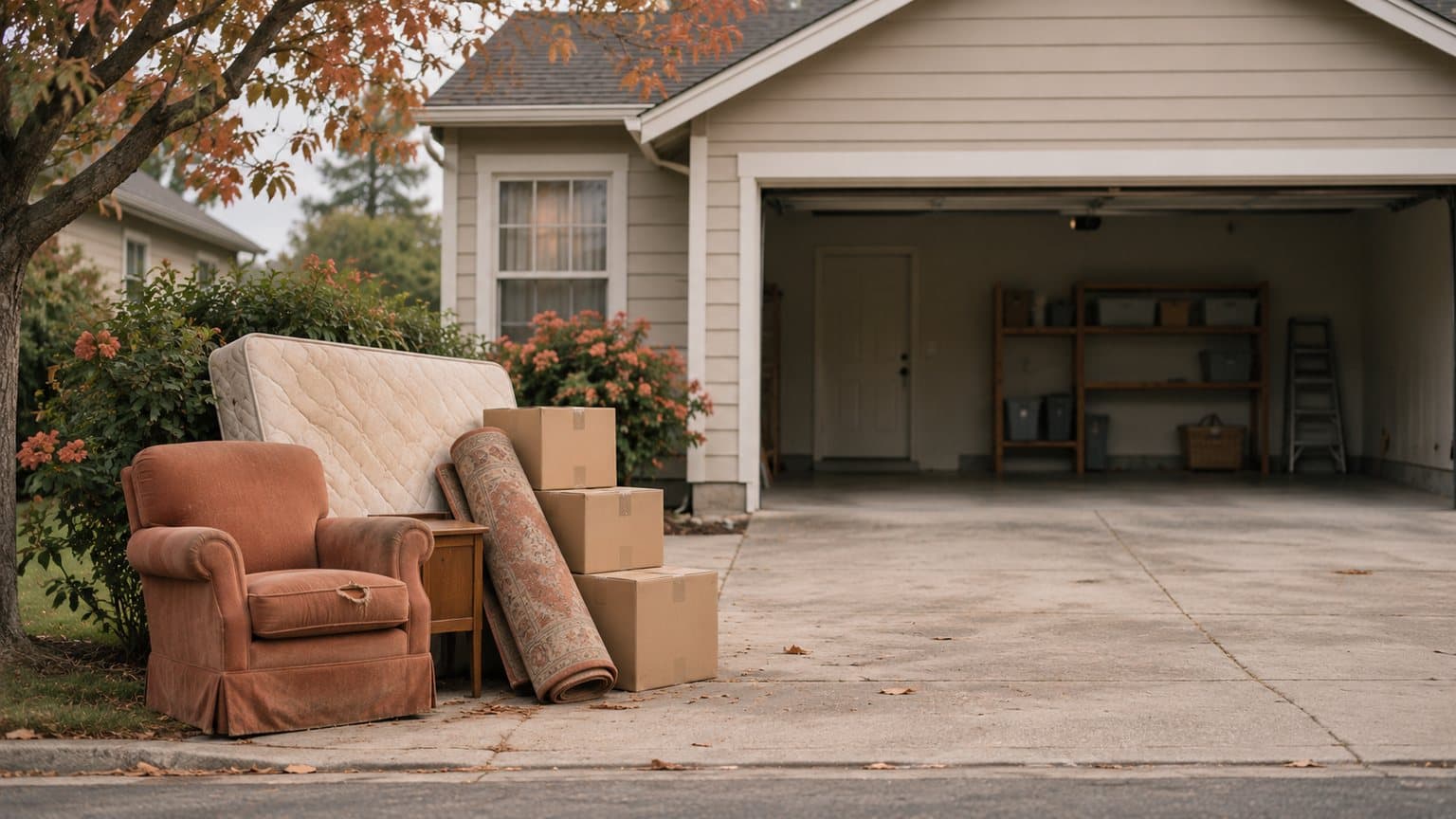
Nobody hauled a thing out of this garage
The garage in the first picture below was empty from the start. We made it for this post with GPT Image 2.6 Sunburst, as a stand-in for the photo your crew takes from the driveway once the last load is strapped down, then turned it into a four-second Seedance 2.0 Mini clip of the camera moving in. Together they cost 3 credits. Your own ad should start from a garage your crew actually emptied.
Most of what you need for a month of ads is already on your phone. There's the before shot of a garage stacked to the rafters, the after shot of the same floor swept bare, the estate cleanout booked for Saturday where the family wants every room empty before the listing photos, and the truck that leaves Tuesday morning with room for one more pickup. What you don't have is a spare hour between the first load and the transfer station's closing time to turn any of it into an ad.
On November 17, 2026, we read six of the first-page results for "junk removal ads", Washington's statute and rules, case pages from its Utilities and Transportation Commission, and our own price list. We made both pictures in this post in Novoads (the clip through our own connector), and we didn't run any ads. Washington is the only state whose rules we checked.
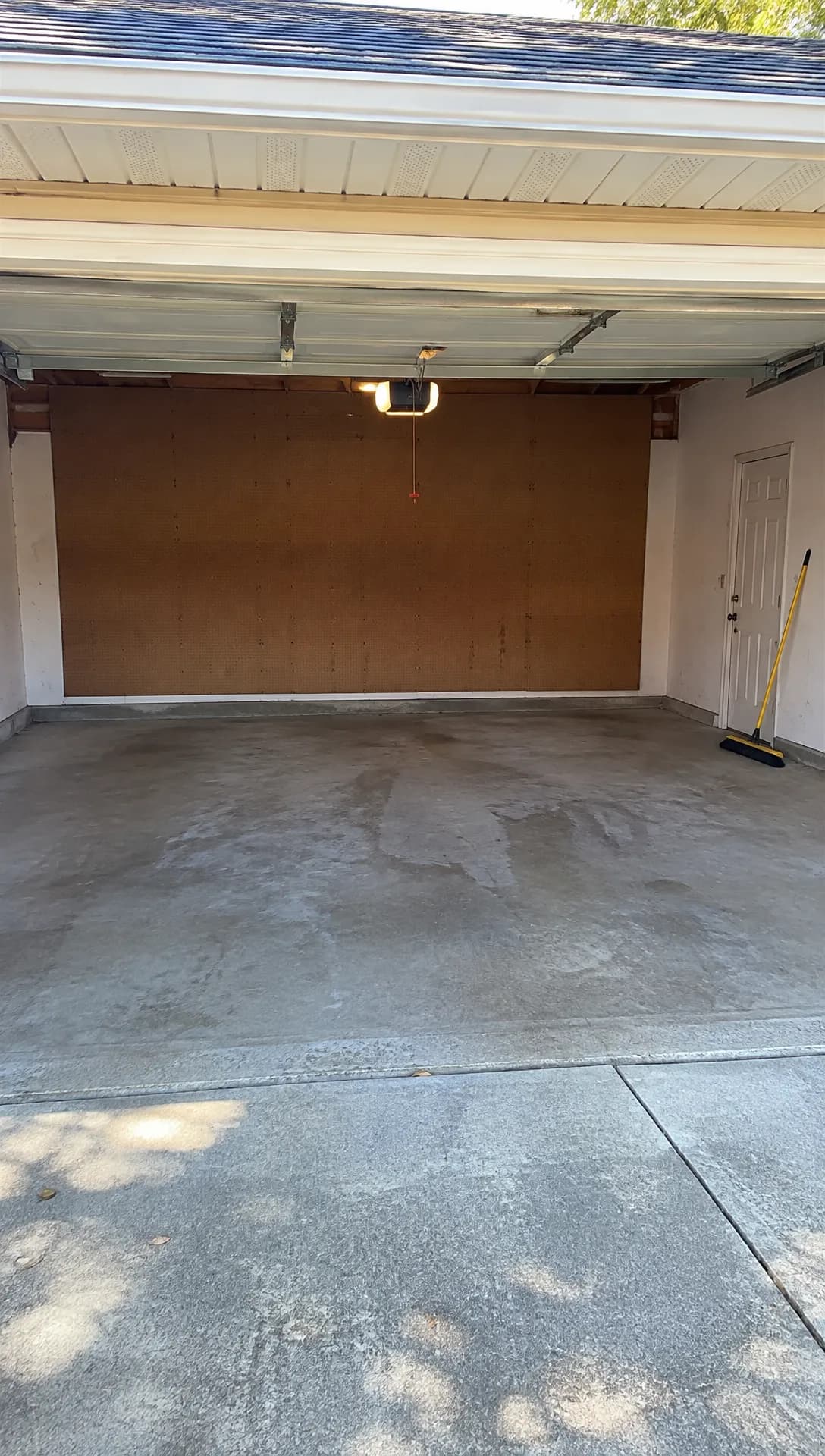
Made in Novoads with GPT Image 2.6 Sunburst · a swept, empty garage after a haul, framed like a crew's phone photo; it stands in for your own photo · 1 credit · 2026-11-17
Five ads a junk removal crew can pull from one week of jobs
Nextdoor's and Housecall Pro's guides, both on the first page of results for "junk removal ads", tell you what to film. Nextdoor's guide for junk removal advertisers, dated April 23, 2025, says "time-lapse or side-by-side comparison videos can be very compelling", and its video ideas include your removal process, customer testimonials and how you donate and dispose of each load. Housecall Pro's guide says "quick walkthroughs, customer testimonials, and cleanup footage can help customers get to know your crew". None of the six pages we opened says what one of those videos costs to make, shows how to make one with AI, or mentions Washington's certificate.
The before and after of one real cleanout
This is the ad that sells the job, because the after photo shows what your customer is paying for. A garage, a basement, a storage unit or a whole estate will do, as long as both photos show the same room on the same job, taken from the same spot.
AI helps with the motion. You can make a clip that opens on the before photo and ends on the after photo, or a slow push into the finished room. But AI must never make the after for you. The clean room in the ad has to be a photo your crew took when the job was done, or the ad isn't true.
One offer, said out loud
An offer gives people a reason to book this week instead of next month. It can be a dollar amount off a half load, a same-week slot or an on-site estimate, as long as it's one you'll honor at the door.
An AI presenter suits this ad. It reads the offer, the towns you serve and how to book, and when the offer changes, you change one line and make the video again. It must never claim what you don't have, whether that's a price, a same-day promise or "licensed and insured". The presenter is an AI actor speaking for the company. It isn't you, a driver or a customer, so it never says "I" about your business. If your company hauls in Washington, read the section on the state's statute below before this ad runs.
What a pickup includes, shown with your own truck
Customers who've never hired a hauler want to know who shows up, what goes on the truck, and whether they have to drag anything to the curb. Housecall Pro's guide recommends video for this, saying walkthroughs and cleanup footage help customers understand what a pickup includes.
For this one, start a clip on a real photo of your truck and move the camera slowly along its side. The list of what you take (furniture, appliances, mattresses, yard debris) goes in the captions or the presenter's script. The clip must never show a truck, a uniform or a crew that isn't yours.
A real review, quoted word for word
Nextdoor's guide recommends customer testimonials on video and says "genuine, unscripted testimonials build trust". If a customer will film one for you, that's your ad, and it doesn't need AI at all.
If they won't, put the review they actually left, word for word, in the text that runs with the ad, and use the after clip from their own job as the video if they're happy for you to show it. Use AI for the clip only. It must never write the review, tidy up its grammar or hand the words to an AI actor playing the customer.
Where the load goes after it leaves
On an estate job, the family may ask whether the furniture goes to a donation center or the dump. If you donate or recycle part of each load, an ad can say which items go where, and Nextdoor's guide suggests showing your company's "commitment to eco-friendly junk disposal and donations".
An AI presenter can explain it in plain words, next to a clip of your truck at the drop-off. The ad must never show a donation center, a recycling plant or a recycled share that isn't real, and a percentage belongs in it only if your own records back it up.
Making each ad in Novoads from your crew's photos
Every clip in this section starts on a photo your crew took, so the job in the ad is the job you did. Before you open the app, get a before and an after from the same spot, one clear photo of your truck, and the wording of one offer. If AI ads are new to you, our guide to making AI ads covers the basics, so start there.
Before and after in one clip
We'd use Wan 3.0 for this one, because it takes your before photo as the first frame and your after photo as the last.
- Take the before photo from the doorway before the first item comes out, and the after photo from the same spot once the floor is swept. Hold the phone upright both times.
- In Novoads, open Video, pick Wan 3.0, and switch the picture box from "Reference" to "Start / End Frames".
- Drop the before photo where it says "Drop a start frame or click to upload". Once it's in, a second slot asks for the after photo with "Drop an end frame or click to upload".
- Describe the motion in one line, such as a slow push in from the doorway, and ask for no people and no vehicles, because any person or truck the model draws won't be your crew or your truck.
- Pick 5 seconds and 720p, then send it with the round up-arrow button.
You get back a five-second clip that starts on your before photo and ends on your after photo. The frames in between are the model's guess at how the room emptied, so watch them before you post. If they show something your crew didn't do, make it again (a second take costs as many credits as the first) or post the two photos as separate clips.
Omni Flash takes the same pair of photos on "Start / End Frames". Kling 3.0, Kling 4.0 and Google Veo 3.1 start a clip on one photo dropped in their start-frame box, which works for a clip of the after photo on its own. For more on turning a single photo into a clip, see our guide to product videos from one photo.
The offer, read by an AI presenter
- Open Talking Actors and click "Add actors" to choose an AI actor.
- Type the offer where it says "Write what the actor will say...". Name the company, what you haul, the towns you serve and how to book, and keep it under a minute.
- Choose 480p. It costs 100 credits a started minute, half the 720p rate.
- Send it.
The result is a video of the AI actor saying your script, with voice and lip-sync. We'd write the script in the third person, along the lines of "[Company] clears garages, basements and whole houses in [three towns]. Send a photo of the pile and [Company] texts back a price." Nobody watching should take the presenter for the owner or a customer, and writing in the third person keeps it that way.
Captions are a separate step you run on the finished video. The Captions tool opens on the "TikTok, no box" look, which costs 3 credits a started minute. If the ad is headed for TikTok, our TikTok ads guide covers what's specific to that platform.
Your truck, your reviews and your donation runs
The other three ads use the same tools.
- For the truck, drop your truck photo in Kling 3.0's start-frame box and ask for a slow move along the side with nobody in the shot.
- For the review, make the after clip from that customer's job and put their words, exactly as they wrote them, in the text that runs with the ad.
- For the donation run, have the presenter from the offer ad explain what you donate and recycle, then follow it with a clip of your truck at the drop-off in the same ad.
What our own test clip shows
We made the proof for this post the cheap way. The garage still cost 1 credit with GPT Image 2.6 Sunburst. We turned it into a Seedance 2.0 Mini clip through our own connector, starting on the still, for 2 more credits. The clip runs four seconds at 480p. The strip below shows four of its frames.
The camera moves forward from the driveway toward the brown board wall at the back. The broom by the side door slides out of frame, and in the last two frames the door opener's bulb blooms into a starburst, the kind of flare you'd cut or make again.
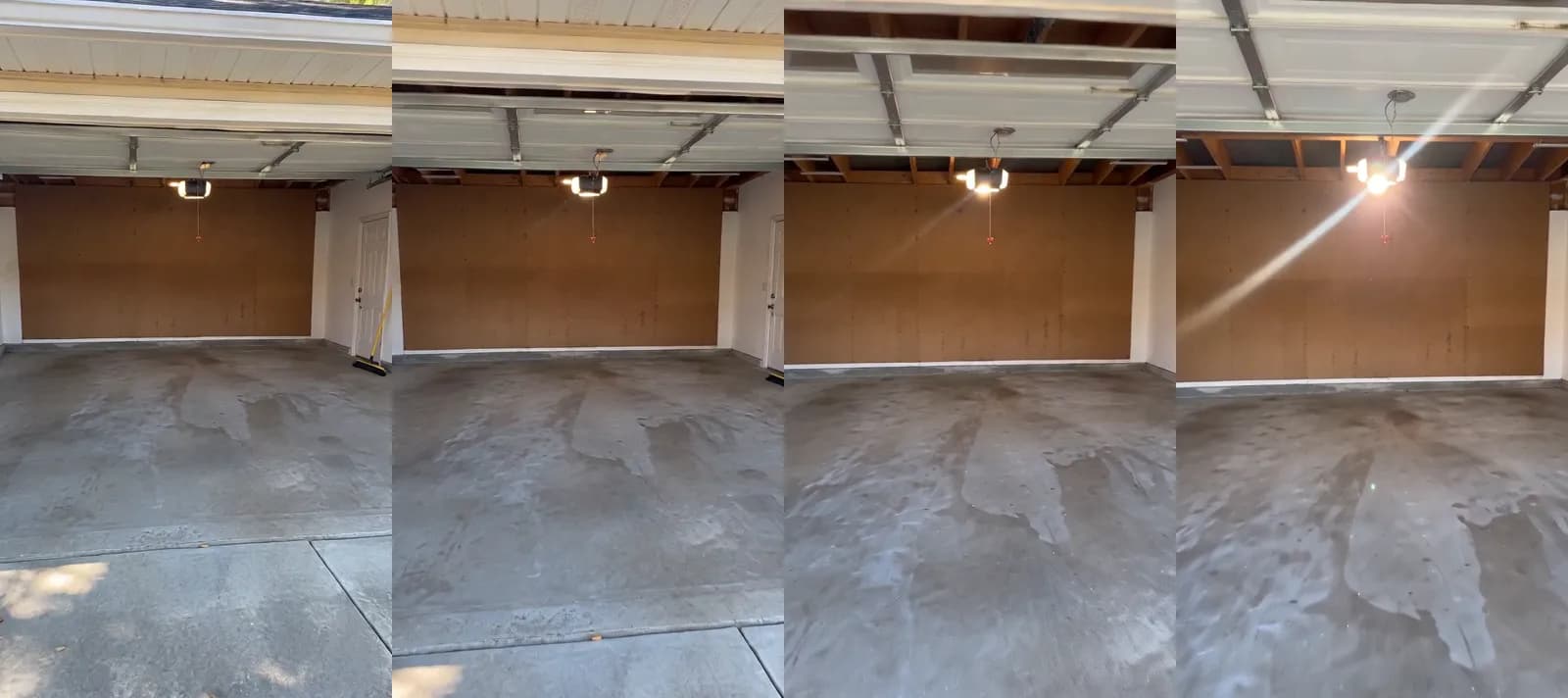
Made in Novoads with Seedance 2.0 Mini through our own connector · the camera moves into the empty garage toward the back wall, sound off, 4 seconds at 480p · 2 credits · 2026-11-17
In the editor, Seedance takes a photo only as a reference that you name @Image1 in the prompt, so the clip isn't set to start on your photo there. For the ad you post, use Wan 3.0 at 720p or Kling 3.0, as described above. Our 480p clip was a small, cheap test of the motion, and you wouldn't post at that size.
What these ads cost in credits and dollars
Prices are as of November 17, 2026. Every credit figure below comes from our price list, and every dollar figure is the plan's price per credit times the number of credits. You pay for Novoads from the first month, on one of these plans.
- Starter, $15 a month for 200 credits, so $0.075 a credit (monthly only)
- Plus, $49 a month for 1,000 credits, so $0.049 a credit ($39 a month billed yearly)
- Ultra 3,000, $129 a month for 3,000 credits, so $0.043 a credit ($99 a month billed yearly)
| Piece of the ad | Model and setting | Credits | Starter | Plus | Ultra 3,000 |
|---|---|---|---|---|---|
| One job, before to after | Wan 3.0, 5 s, 720p | 9 | about 68 cents | about 44 cents | about 39 cents |
| Truck clip from one photo | Kling 3.0, 5 s | 10 | 75 cents | 49 cents | 43 cents |
| The offer, read by a presenter | Talking actor, 480p, up to 1 min | 100 | $7.50 | $4.90 | $4.30 |
| Captions on that video | TikTok, no box, up to 1 min | 3 | about 23 cents | about 15 cents | about 13 cents |
| Two jobs and one offer | rows 1 (twice) and 3 | 118 | $8.85 | about $5.78 | about $5.07 |
What a month of these ads looks like
On Starter, you could split a month's 200 credits three ways.
- Four cleanout clips at 9 credits each come to 36 credits.
- One presenter video with its captions comes to 103 credits.
- The 61 credits left over cover second takes, which cost the same as first takes.
A Plus month covers eight of the 118-credit sets in the table. Since a clip from your own photos is the cheap part, you can make two versions of the same job with different camera moves and keep whichever one brings in calls. Our ecommerce video ads post makes the case for volume over one perfect ad. Our pricing page lists every plan with its yearly price.
These sums leave out four things.
- Joining the clips into one ad
- What you pay Facebook, Google or Nextdoor to run the ads
- Music
- The time it takes you to check every clip against the real job
How that compares with a filmed promo
Beverly Boy, a video production company, updated its guide to business promo video prices on March 5, 2026. It says to expect around $3,000 to $7,500 per finished minute. That price is for a crew that films and edits for you, which is a different job from adding motion to photos you've already taken, so read it as the price of the other kind of video. If you want a full spot made with AI instead, our post on AI commercials prices a 30-second one.
The Washington statute that puts the certificate before the ad
The six pages we opened never mention this statute. Under Washington law, the state's Utilities and Transportation Commission certifies solid waste collection companies, and advertising counts as part of operating one.
What RCW 81.77.040 says
The statute's first sentence reads, "A solid waste collection company shall not operate for the hauling of solid waste for compensation without first having obtained from the commission a certificate declaring that public convenience and necessity require such operation." The next sentence is the one that matters for ads. It reads, "Operating for the hauling of solid waste for compensation includes advertising, soliciting, offering, or entering into an agreement to provide that service."
That second sentence has been in the statute since July 2010. The Legislature's final report on the 2010 bill says a solid waste collection company "must be certified for operation by the UTC before it may engage in, or advertise to engage in, solid waste collection." Put loosely, in Washington the ad itself needs the certificate, though that's shorthand for the statute's second sentence. The certificate belongs to the company, and you need it before you run the ad.
Getting one can take more than an application. Where a certificate holder already serves the territory, the statute lets the commission issue a new certificate only if the existing company "will not provide service to the satisfaction of the commission" or doesn't object.
Each ad in each medium is its own violation
RCW 81.77.090 says a person who violates the chapter "is guilty of a gross misdemeanor", and its second subsection reads, "Each advertisement reproduced, broadcast, or displayed via a particular medium constitutes a separate violation under this chapter." By our reading, the same offer running as a Facebook video and printed on a door hanger would count as two advertisements in two media.
The commission has opened investigations over ads. In each of these three dockets, it opened one into a junk removal or junk hauling company "to determine if" the company is in violation of RCW 81.77.040 "for advertising and offering solid waste services".
- TG-230053, filed in 2023
- TG-230258, filed in 2023
- TG-240599, filed in 2024
An investigation isn't a finding, and the case pages we read don't say what any of the three found.
Who the statute leaves out
Not every haul is covered.
- Among the operations the commission doesn't regulate, its rules list a company's work "under a contract for solid waste collection service with a city or town".
- The same list also names private carriers who haul solid waste in their own vehicles "purely as an incidental adjunct to some other established private business". In the commission's guide for haulers, a licensed contractor hauling debris from its own project in its own equipment counts as private carriage, which needs no solid waste certificate.
- That private-carrier exemption doesn't cover hauling solid waste from residential sources, such as apartment houses, in vehicles designed or used mainly for solid waste.
- The statute's definitions leave recyclable materials out of solid waste, except "source separated recyclable materials collected from residences". A business's recyclables hauled to a recycler fall under a different chapter, 81.80.
If you remodel and haul your own demo debris, our contractor ads post is the closer fit. For everyone else, the commission can tell you which side of these lines your work falls on.
What it means for the five ads above
Each of the five ads above offers your hauling to people who'd pay for it. As we read it, if your company hauls solid waste for pay in Washington and none of the exemptions fits, you need the certificate before you run any of them.
The commission's rules, in the Legislature's 2024 edition, require a company to conduct all operations, advertising included, under the company name or a registered trade name. They also call for the certificate holder's name and certificate number on each side of each vehicle, which is one more reason the truck in your ad should be your own. We found no rule requiring the certificate number in the ad itself, so ask the commission if you're unsure. This covers Washington's statute only (we haven't checked any other state), and none of it is legal advice.
Before the first box leaves Saturday's estate job
On your next estate job, get these shots.
- The before, from each doorway, before anything moves
- The after, from the same doorways, once the floors are swept
- The loaded truck from the street, with your company name showing
- The drop-off, if part of the load goes to a donation center
Ask the family whether you can use the photos, and keep faces and the house number out of the frame.
In Novoads, you can turn those photos into short clips that start on your own pictures, and have an AI presenter read your offer when nobody on the crew wants to be on camera. You pay from the first month, and plans start at $15 a month (Starter, 200 credits a month).
Price your first cleanout ad
See what 200 credits a month covers on Starter, and what Plus and Ultra add, before you make the first clip.
See the plansTwo photos from the same doorway on Saturday's job are all you need for the first ad.
Frequently Asked Questions
What should a junk removal company's first video ad show?
One real job from start to finish. Take the before photo from the doorway before anything comes out and the after photo from the same spot once the floor is swept, then turn the pair into one short clip. Nextdoor's guide for junk removal advertisers points the same way, suggesting you show 'cluttered spaces transformed into clean, usable areas'. Every frame should come from your own job, with no made-up after room and no truck or crew that isn't yours.
How much does a junk removal video ad cost to make with AI?
Prices are as of November 17, 2026. In Novoads, a Wan 3.0 clip that runs from your before photo to your after photo costs 9 credits for five seconds. That's about 44 cents on the Plus plan. An AI presenter reading your offer costs 100 credits a started minute at 480p. That's $4.90 on Plus. Two cleanout clips and a presenter video come to 118 credits, about $5.78 on Plus. Whatever you pay to run the ad comes on top of that.
Do junk removal companies in Washington need a certificate to advertise?
Washington's RCW 81.77.040 says a solid waste collection company shall not operate for the hauling of solid waste for compensation without first having a certificate from the Utilities and Transportation Commission, and that operating 'includes advertising, soliciting, offering, or entering into an agreement to provide that service.' So a company the statute covers needs the certificate before it runs the ad. Some hauling falls outside the statute, such as work done under a contract with a city or town, and the commission can tell you which side of that line yours falls on. This covers Washington's statute only, and it isn't legal advice.
Can the AI presenter play the owner or a happy customer?
We'd never script it that way. The presenter in Novoads is an AI actor, so write its lines in the third person, speaking for the company, and save customers' words for real reviews, quoted exactly as they wrote them. If you want the owner or a customer on screen, film the real person.
Key Takeaways
- Your first junk removal ad should be one real job's before and after, shot from the same spot, because the after photo shows what your customer is paying for.
- With Wan 3.0's Start / End Frames, you can turn that before and after into a five-second clip for 9 credits.
- An AI presenter can read your offer for 100 credits a started minute at 480p, speaking for the company and never as the owner, the crew or a customer.
- A presenter video and two cleanout clips come to 118 credits, about $5.78 on Plus.
- In Washington, RCW 81.77.040 says operating for the hauling of solid waste for compensation includes advertising, so a solid waste collection company needs its certificate from the Utilities and Transportation Commission before it runs the ad.