Locksmith Ads: Video Ideas, What Each Costs With AI, and Google's Verification Rule for Locksmiths
The ads US locksmiths run for lockouts, rekeys and smart locks, how to make each one with AI from your own van photos or with an AI presenter, what each costs in credits, and the verification Google requires of US locksmiths before their ads can run.

Mauricio Valdivia
·11 min
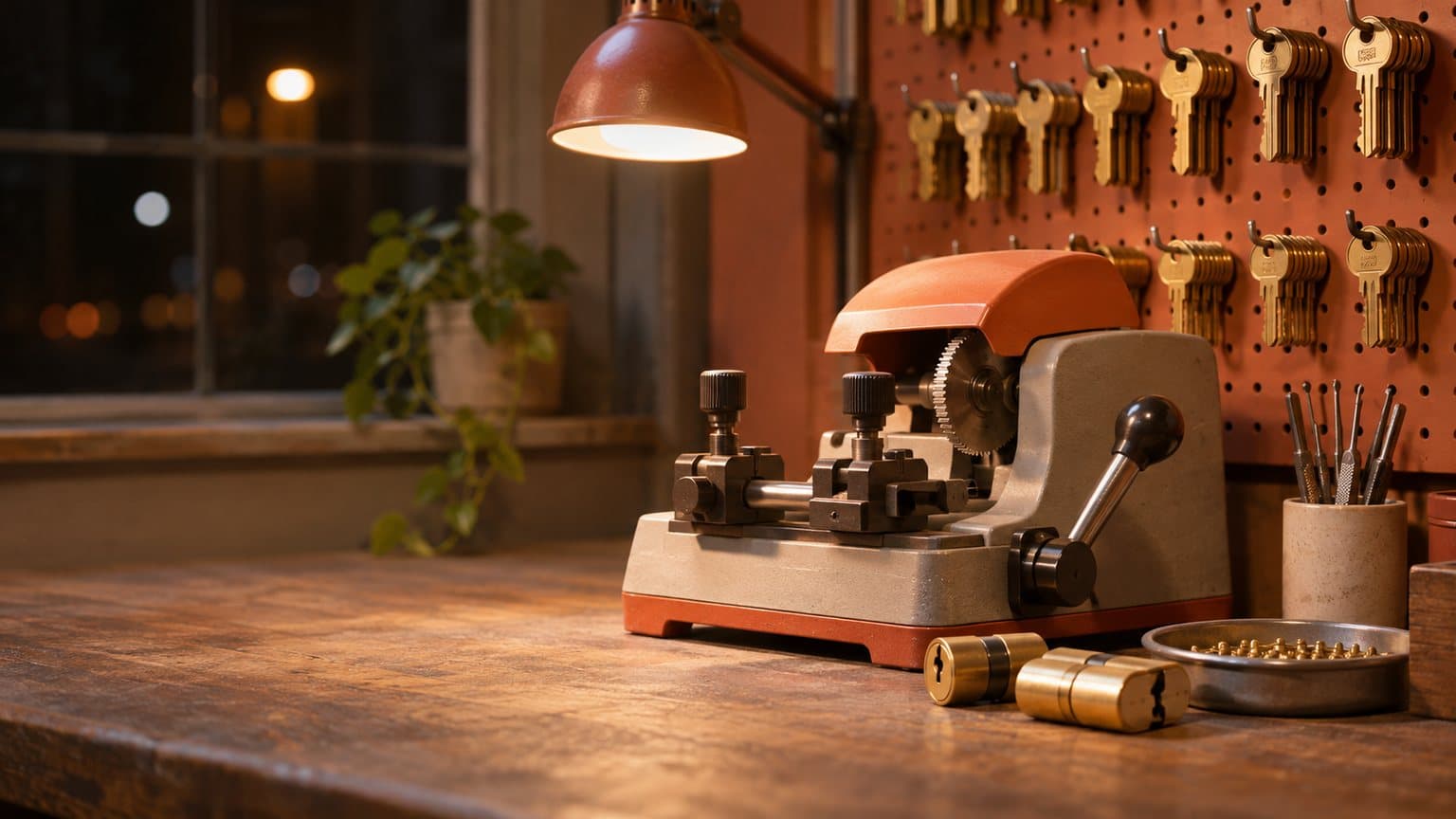
Four seconds closing in on a work van's key rack
Lockout calls rarely come at a good hour. Someone's keys are on the seat of a locked car, or a renter is standing on a porch in front of a door that won't open, and they're on their phone looking for a locksmith they've never met. Whoever they pick is about to open up their car or their home, so a locksmith's ad has to look like a real local business before it says anything else.
For this post, we used GPT Image 2.6 to make a picture that stands in for the phone photo an owner would take. It shows a plain white work van at a quiet curb at dusk, its side door slid open on a lit wall of key blanks, with a red key-cutting machine on a wooden bench and clear bins of parts below. Then we animated it with Seedance 2.0 Mini through our connector. Over four seconds, the camera pushes toward the open door, the rack and the bench grow in the frame, and the street slides out of view. The picture and the clip cost 3 credits together. The van has no name or number on it because it isn't anybody's.
On November 17, 2026, we read the top-ranking pages for "locksmith ads", Google's own help pages on its locksmith rules and the credit tables we bill from. None of the top-ranking pages puts a price on making a single ad or walks through making one with AI, and none names Advanced Verification, the check US locksmiths have to pass before Google will run their ads. We haven't run a locksmith ad anywhere, so there's no click or call count here.
What locksmiths advertise, from lockouts to smart locks
The top-ranking pages split a locksmith's advertising the way the work itself splits, into urgent calls and planned jobs. SmartSites' tips for locksmith search campaigns sort keywords into emergency searches and planned ones such as "rekey locks". HeyLead, an agency with a page for residential locksmiths, says lockouts are urgent while rekeys, smart locks and landlord changeovers are planned, and adds, "We build separate marketing for each".
Lockout ads for the call after dark
This is the ad for someone stuck outside a locked car or house with nothing but a phone. SmartSites says that person searches on their phone and will "call the first locksmith that looks trustworthy". Its sample search ad opens with "Locked Out Of Your Car?" and follows the question with round-the-clock hours and a call to action.
An AI presenter can read a short lockout script for Reels or a TikTok ad, in Spanish as easily as in English, since the voice list covers 32 languages.
Leave out any promise you can't keep on every call. That means no arrival time you can't always meet, no AI presenter introduced as the technician who'll show up, and no van, uniform or storefront that isn't yours.
Trust ads that show the van, the team and the paperwork
Before a stranger gives you their address, they want signs that you're a real shop. HeyLead's list of what should shape every page and ad includes your "registration and insurance details", how you check that the caller lives at the property, and "photos of your van and team".
A clip that starts on a photo of your actual van, crew or shop counter keeps everything in the frame true while still playing as video in a feed. Never let it show anything you don't have, such as an invented van, badge, license, certificate or technician.
Rekeys, tenant changeovers and smart lock installs
Planned jobs run on the calendar rather than on someone's emergency. HeyLead counts landlords and property managers "booking lock changes between tenancies" among the buyers, and says the busy times for this work are "month-ends for landlord changeovers and moving seasons for rekeys".
In under a minute, an AI presenter can explain the difference between rekeying and replacing, and anything up to 60 seconds is billed as one minute. A smart lock you actually install can go from its product photo to a short clip, the same way any product video can start from one photo. But don't show a lock brand you don't install, or a home or a customer that isn't real. If you also wire access control or alarms, the electrician ads post reads Florida's license number rule.
Security tips and before-and-after installs
For social posts, Comrade's locksmith marketing ideas include "Before-and-after photos of lock installations" and "Short educational videos demonstrating locksmith techniques". Both give people a reason to follow a locksmith while they aren't locked out, which is most days.
An AI presenter can read a quick security tip, and a clip can start on your real "before" photo of a door. We'd keep technique demonstrations to your own footage, though, because AI hands working a lock aren't your crew's hands. And never show an install you didn't do.
Offers for a first job
SmartSites suggests giving people a reason to choose you, "such as a special offer, a first-time customer deal or a promise you can keep", and adds, "Make sure every claim in your ad is one your team can honor." A presenter reading the offer, with its terms spelled out in the captions, gives people that reason in a few seconds.
What an offer ad can't show is a bait price. In an update posted September 23, 2025, Google's Misrepresentation policy uses a locksmith as its example of price exploitation, one "threatening to leave the customer unless a cost above what was quoted is paid on the spot". And for US locksmiths, Google's Advanced Verification policies say coupons, discounts and flat-rate offers in your ads or on your website "must have a corresponding description of what the offer includes and excludes".
Making each one in Novoads
There are two ways to make these ads. A clip built on your own photo shows the van, the shop or the lock, and an AI presenter reads the script. For the basics of AI video, see our guide to AI ads, and for what a full commercial costs, see our post on AI commercials.
From a photo of your van, your shop or a lock you install
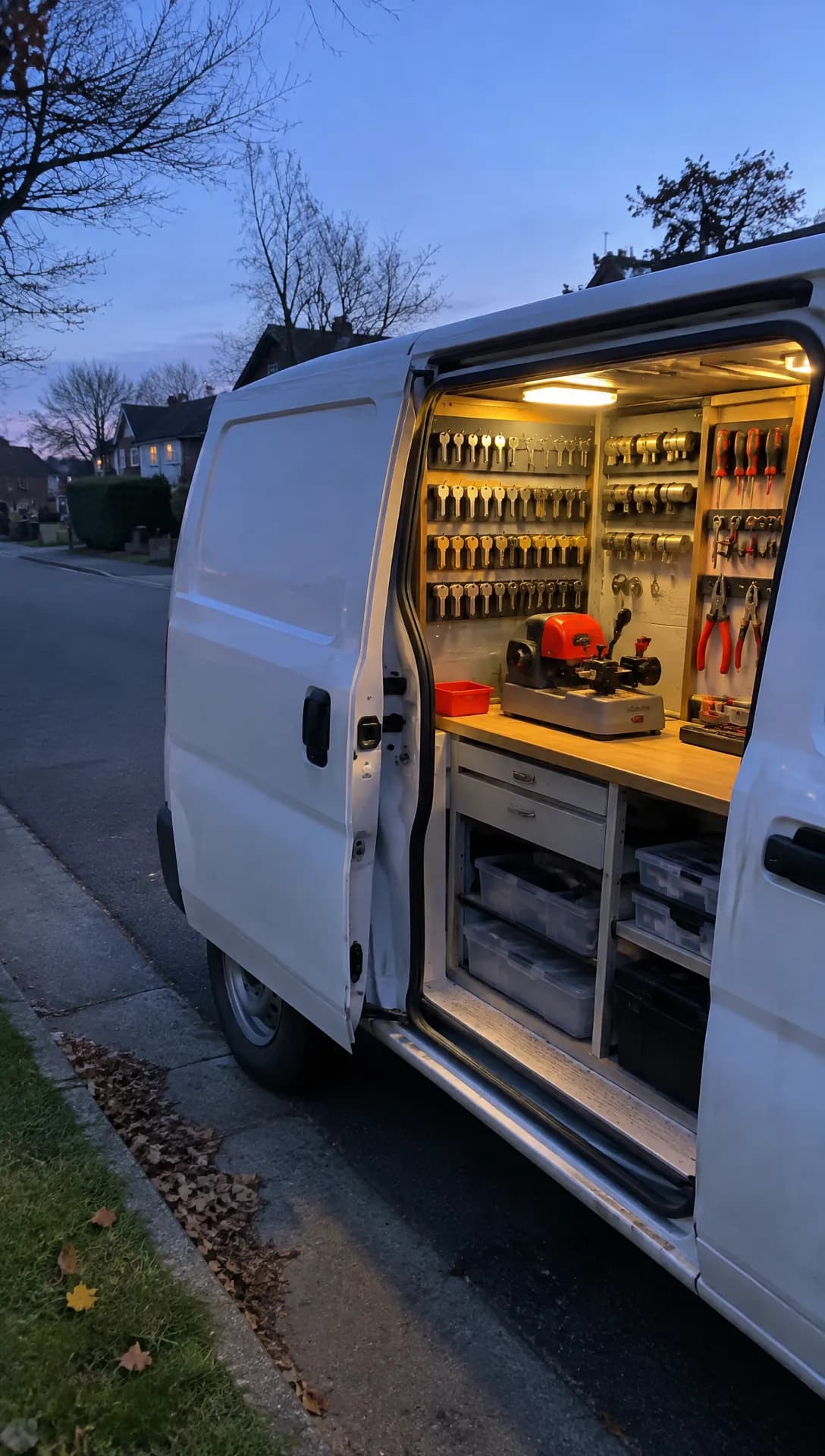 Made in Novoads with GPT Image 2.6 Sunburst · a work van at dusk with its side door open on a lit key rack, standing in for your own photo · 1 credit · 2026-11-17
We didn't have a real locksmith's photo, so the picture above stands in for yours. You'd use a phone photo of your own van with the side door open, your shop counter or a smart lock you install.
In the editor, your photo becomes the clip's start frame.
- Open the Video tab in a project and pick Kling 3.0 from the model menu.
- Drop your photo where it says "Drop a start frame or click to upload". The editor then shows "The video starts on this picture."
- Write one line describing the motion, such as a gentle push-in on the open side door with the work light on and nothing added to the van.
- Choose 5 seconds, then press the round up-arrow button to send.
You get back a 5-second clip that starts on your photo, for 10 credits. Check it against the real van before you post it, and redo it if any lettering, badge or number shows up that your van doesn't carry.
Kling 4.0 takes your photo in the same box and adds sound to its clips, but it costs more credits than Kling 3.0 at the same length. Omni Flash and Wan 3.0 start on your photo once you switch the upload from "Reference" to "Start / End Frames". On Seedance, the editor treats a photo only as a reference, so the clip doesn't start on it.
Our test clip took a different route. Our connector can start a Seedance 2.0 Mini clip on a picture, so we used it to make a 4-second clip from the stand-in photo, for 2 credits.
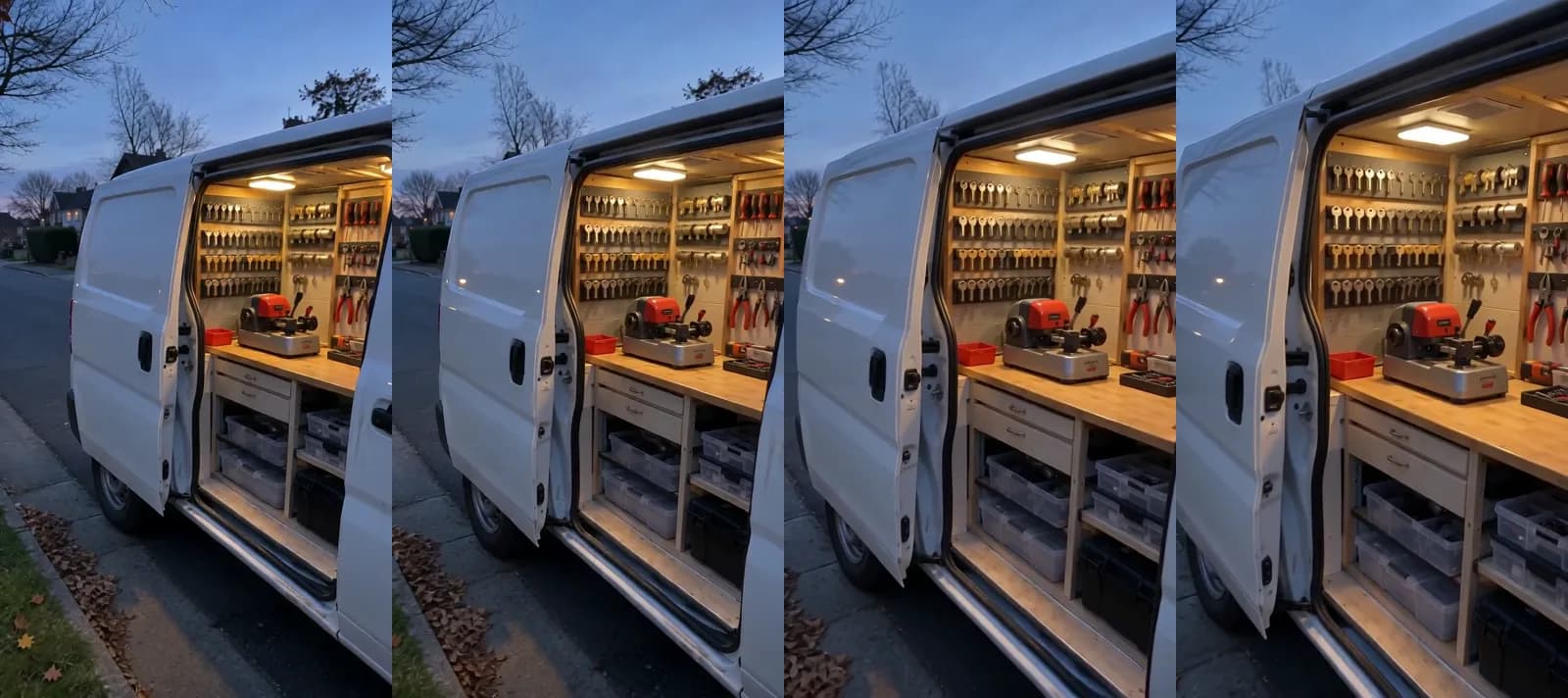 Made in Novoads with Seedance 2.0 Mini · four frames of a 4-second clip made through our connector from the stand-in van photo, the camera pushing toward the open side door, no sound · 2 credits · 2026-11-17
Across the four frames, the camera closes in on the rack, the cutting machine and the bins while the houses and the street slide out of the frame. We kept it at 480p, small and cheap, just to test the motion, and we wouldn't run the ad at that size.
With an AI presenter for the lockout, rekey, tip and offer ads
- Open Talking Actors, press "Add actors" and pick an AI actor.
- Type the script where it says "Write what the actor will say...".
- On the price line, pick 720p or 480p, each priced per started minute. 720p is the default, at 200 credits a started minute. 480p costs 100.
- Press the arrow to make it.
You get back the presenter saying your lines on video, with voice and lip-sync. Captions come afterward, as a separate step on the finished video. The Captions tool opens on "TikTok, no box", one of six caption looks, each priced at 3 credits a started minute.
Write the script about the business, never in the voice of someone who works there. A few lines are enough for a lockout ad.
Locked out of your car or your home in [your town]? [Business name] is a local locksmith, licensed in [your state]. Call [your number] and say where you are.
Keep "licensed" only if you hold the license your state requires, and leave out any arrival time and any fee. The presenter never gives a name or promises to come out, so nobody watching mistakes them for the technician who'll knock.
What each locksmith ad costs to make
Prices as of November 17, 2026. Each row is one piece of an ad, priced from our credit tables. The dollar figures are our own math at each plan's rate per credit, rounded to the cent.
- Starter, $15 a month for 200 credits, or 7.5 cents a credit
- Plus, $49 a month for 1,000 credits, or 4.9 cents a credit
- Ultra 3,000, $129 a month for 3,000 credits, or 4.3 cents a credit
| Piece | Length and size | Credits | Starter | Plus | Ultra 3,000 |
|---|---|---|---|---|---|
| AI presenter | up to 60 seconds, 480p | 100 | $7.50 | $4.90 | $4.30 |
| AI presenter | up to 60 seconds, 720p | 200 | $15.00 | $9.80 | $8.60 |
| Kling 3.0 from your photo | 5 seconds | 10 | 75 cents | 49 cents | 43 cents |
| Kling 3.0 from your photo | 10 seconds | 20 | $1.50 | 98 cents | 86 cents |
| Kling 4.0 from your photo | 5 seconds, 720p, sound | 18 | $1.35 | 88 cents | 77 cents |
| Wan 3.0 on Start / End Frames | 5 seconds, 720p | 9 | 68 cents | 44 cents | 39 cents |
| Captions, one of six looks | per started minute | 3 | 23 cents | 15 cents | 13 cents |
The pair we'd start with is one lockout video read by an AI presenter at 480p and one 5-second Kling 3.0 clip of the van. That comes to 110 credits.
- On Starter, the pair costs $8.25. A month's credits cover one pair, with 90 credits left over.
- On Plus, it's $5.39, and a month's credits cover nine pairs.
- On Ultra 3,000, it's $4.73, and a month's credits cover 27 pairs.
Some costs aren't in that total. Each re-roll costs its full price again. A voice-over and assembling the pieces into one ad have no listed price, so we left them out. Ad spend goes to Google, Meta or TikTok, and checking every clip against your real van takes your own time. Every plan, the larger Ultra ones included, is listed on our pricing page.
For an outside comparison, HeyLead's residential locksmith page lists "Marketing from $500 USD a month". That's a monthly service covering pages, search and ad work, and tracking, so it isn't the price of one ad. HeyLead also says "Ad spend is separate and stays in your own accounts".
Google's verification rule for US locksmith ads
Google restricts US locksmith ads to businesses that pass its Advanced Verification, according to its own pages, which we read on November 17, 2026. No top-ranking page we read mentions it. Only SmartSites brings up Google checking locksmiths, and that's for Google's Local Services Ads. Google's policy change log traces the checks back to a November 2016 beta for locksmith and plumber ads aimed at San Diego, and more US states were added in 2017.
Who has to verify, and what Google looks at
For the United States, Google's Local services policy says "Ads for locksmith services and garage door repair services are restricted. To advertise, you must apply for advanced verification." Its Advanced Verification policies list locksmith services in the United States and Canada, and say the process combines three things.
- "a review of your Google Ads account (if applicable)"
- "publicly available data such as state registrations and professional licenses"
- "video interviews conducted by Google", and you "must agree to participate in a video interview and to have that video recorded"
Google's help page on the process says Google Ads and Local Services advertisers who are required to verify "won't be eligible to have their ads appear on searches related to these services until the verification process is successfully completed". It says verification typically takes around 6 to 8 weeks, and that where licenses are required by law, "you must hold all required licenses in order for your business to get verified." For the call itself, it asks you to be at your business location and adds, "If you operate your business out of a vehicle, have the vehicle nearby during the call."
The same pages make a few smaller points.
- After you pass, Google "may ask you to comply with re-verification procedures once every 12 months".
- Its terms say you "may be charged a fee to verify your business".
- All locksmith businesses in the US and Canada "must pass Advanced Verification in order to serve in the Local Services unit", even after passing Local Services background and license checks. The badges on those ads have their own history, which our plumbing ads post traces.
What the program's policies bar
The policies list prohibited practices for the program's advertisers (locksmiths in the US and Canada and garage door services in the US). These are among them.
- "Service call fees and minimum or starting prices must not be included in any text ads."
- "Discounts and coupons must not be included in text ads that promote emergency or repair services."
- "Claims of rapid response times that are unlikely to always be true and cannot be guaranteed must not be included in text ads or on landing pages."
- "Making false claims related to accreditation, organizational membership, insurance, or licensing status" is listed as misrepresentation.
On prices, the same page says "Any prices that are presented to customers must be inclusive of all applicable fees, delivery charges, surcharges, and taxes." For services that vary in price, "a range of typical prices must be displayed", one that "should represent both the minimum and maximum total costs that customers can expect to pay". A business that breaks the policies may lose its verification status for a time or for good, which "will result in a partial or complete inability to advertise on Google".
What that means for the ads above
The price line names text ads, and only text ads. It doesn't say a video can't show a price. But given the price rules quoted above, we wouldn't read it as room for a service call fee or a "from" price in a video either. That's why our lockout script has no fee and no "from" figure. And none of your text ads for an emergency or repair job should carry a discount or coupon.
The response-time line covers text ads and landing pages. In a video, we'd still promise only an arrival time you meet every time, or none at all. Treat both as our reading of Google's pages rather than legal advice, and read the Advanced Verification policies yourself before you apply.
While your Google Ads application is pending, Google's page on the process tells you to make sure your website and keywords don't contain phrases like "emergency" or "lockout", which it calls "prohibited phrases" that "might trigger automated flags".
Which locksmith ad to make first
Start with the van. Photograph your own van with the side door open and turn it into a 5-second Kling 3.0 clip for 10 credits, so a stranger sees your business before they call. Then write a short lockout script for an AI presenter, with no fee and no arrival time in it, and run the two wherever your calls come from.
In Novoads you make both pieces (clips built on your own photos and AI presenters that read your script) in one place, and add captions as a further step. Each piece is priced on its own. You pay from the first month, and Starter is $15 a month for 200 credits. The finished ads are yours to run.
Price your first locksmith ad
A van clip from your own photo is 10 credits. A lockout video read by an AI presenter is 100 at 480p. See what each plan covers before you make either.
See the plansTake the van photo tonight with the side door open and the work light on, and you'll have the start frame for your first clip.
Frequently Asked Questions
Does a locksmith in the US need Google's Advanced Verification to advertise?
On Google, yes. Its Local services policy says ads for locksmith services in the United States are restricted and that 'To advertise, you must apply for advanced verification.' Its help page on the process says Google Ads and Local Services advertisers who are required to verify 'won't be eligible to have their ads appear on searches related to these services until the verification process is successfully completed'. The same page says verification typically takes around 6 to 8 weeks. That's the rule as Google's pages stated it when we read them on November 17, 2026, so read the Advanced Verification policies yourself before you apply.
What happens in Google's video interview for locksmiths?
Google says its check combines a review of your Google Ads account (if applicable), publicly available data such as state registrations and professional licenses, and video interviews it conducts. You also have to agree to the interview being recorded. Its help page says the call is there 'to visually confirm the existence of the business as well as its location and other details'. It asks you to be at your business location and, if you work out of a vehicle, to have the vehicle nearby. On the call, an agent asks your name, your relationship to the business and other questions that vary with your application.
Can a locksmith put a service call fee or a 'from' price in a Google ad?
Not in a text ad. Google's Advanced Verification policies, which cover locksmiths in the US and Canada and garage door services in the US, say 'Service call fees and minimum or starting prices must not be included in any text ads.' That line names text ads only. We still wouldn't read it as room for a service call fee or a 'from' price in a video, because the same policies say any price shown to customers must include all applicable fees, and a service whose price varies must show a range of typical prices. Treat that as our reading of Google's page rather than legal advice.
What does a locksmith video ad cost to make with AI in Novoads?
Prices as of November 17, 2026. A lockout video read by an AI presenter costs 100 credits at 480p, for any length up to a minute. A 5-second Kling 3.0 clip that starts on your van photo costs 10 more. Together they come to 110 credits. That's $8.25 at Starter's rate and $5.39 on Plus. Re-rolls, ad spend and the time you spend checking each clip come on top of that.
Key Takeaways
- Locksmith ads split the way the work does, into lockout ads for urgent calls and planned-job ads for rekeys, tenant changeovers and smart lock installs. Trust, tip and offer ads fill in around them.
- Start every trust clip on a photo of your own van, team or shop. In Novoads, a 5-second Kling 3.0 clip that starts on your photo costs 10 credits.
- A lockout video read by an AI presenter at 480p plus one van clip comes to 110 credits. That's $8.25 at Starter's rate and $5.39 on Plus.
- Google restricts US locksmith ads to businesses that pass Advanced Verification, which combines a review of the Google Ads account, publicly available data such as state registrations and professional licenses, and a recorded video interview.
- The program bars service call fees and minimum or starting prices from its advertisers' text ads. The rule names text ads only, but we wouldn't read it as room for a fee in a video.