Roofing Ads: Video Ideas From Your Own Jobs, and the Insurance Promise Texas Bans
Five roofing ads worth running on Facebook, how to make each one in Novoads from the roofs you've already finished or with an AI presenter, what each costs in credits, and the insurance promise Texas doesn't let roofers make.

Mauricio Valdivia
·12 min
The roof you finished Tuesday is next week's ad
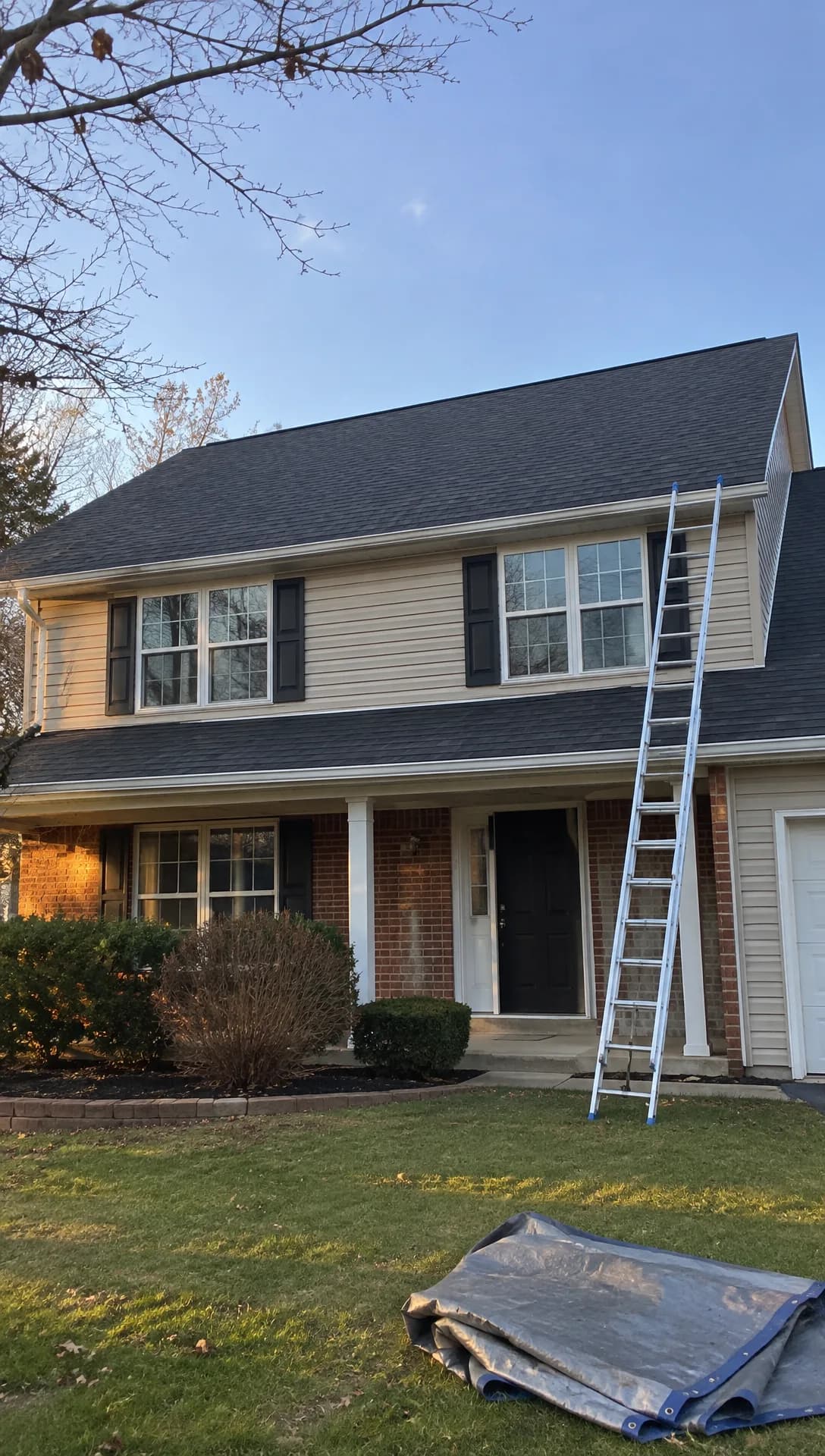
The week after a hailstorm, the phone rings before the coffee's done, the crew is booked three streets deep, and the ads you meant to make in the spring still don't exist. Meanwhile, your camera roll is full of finished jobs, like a new roof on a two-story with the ladder still at the gutter, shot from the yard on the walk back to the truck.
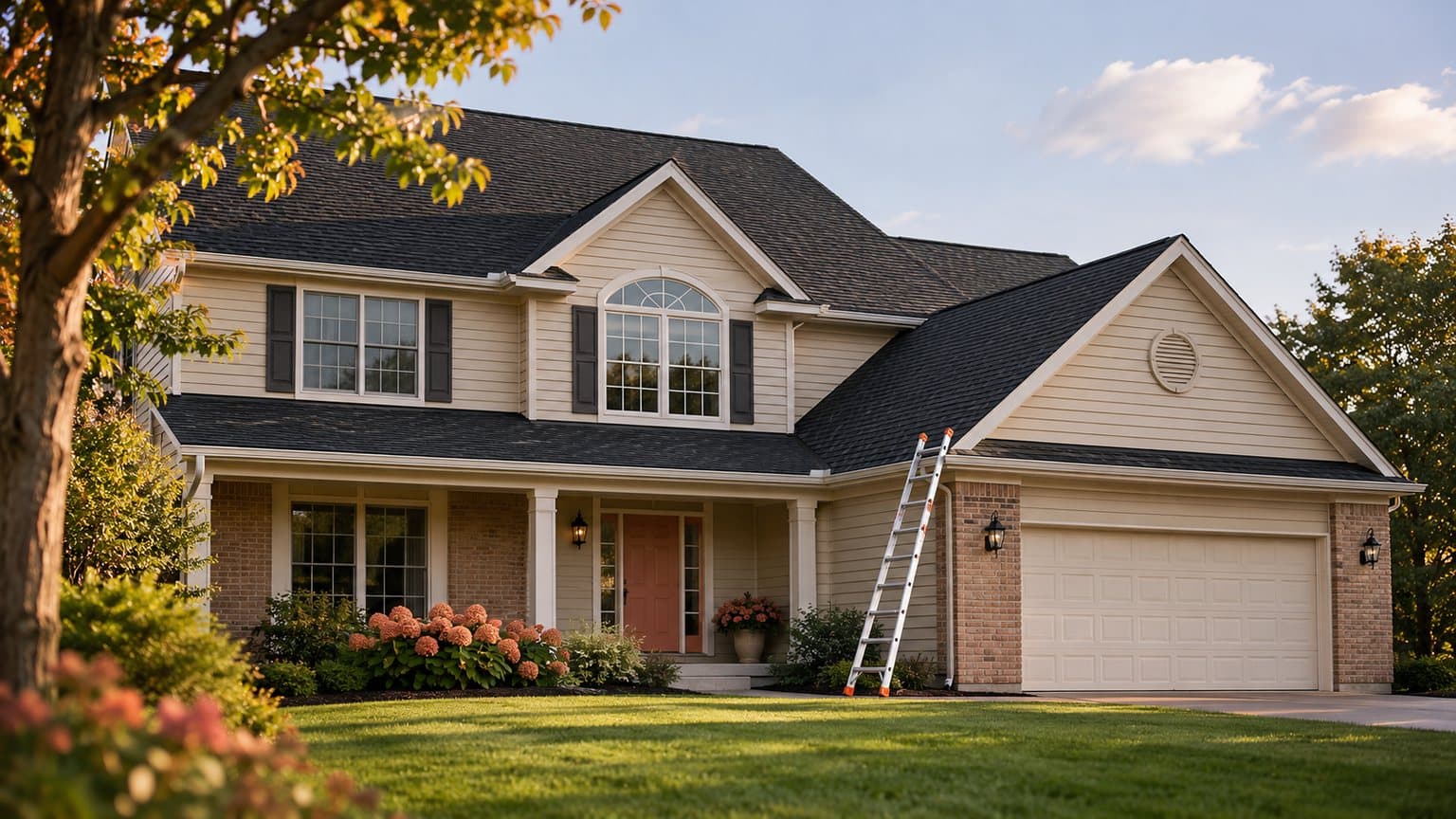
That photo is most of an ad. The picture below stands in for it, since we don't have a roofer's camera roll to borrow from.
We made it in Novoads with GPT Image 2.6 for 1 credit. It shows a two-story with tan siding, a brick front, black shutters and a dark gray shingle roof in low afternoon sun, with an extension ladder against the gutter and a blue-gray tarp folded on the lawn. Then we turned it into a 5-second clip for 5 more credits, and it came back as a slow tilt from the lawn up to the roof.
 Made in Novoads with GPT Image 2.6 Sunburst · prompt: a finished shingle roof on a two-story house with a ladder at the gutter, as a roofer's own phone photo from the yard · 1 credit · 2026-11-15 · a made-up house, standing in for your own photo
On November 15, 2026, we read the pages ranking for "roofing facebook ads" and three of the Texas Department of Insurance's own pages, priced each ad at what Novoads charges today, and made that picture and its clip in our own workspace. We haven't run a roofing ad or measured what one brings in, so nothing in this post promises calls or leads.
None of the five guides we opened for that search mentions an adjuster or a deductible. That gap matters in Texas, where the Department of Insurance tells roofers to make sure their websites and ads don't "say or imply that you will act as both a contractor and adjuster on a project."
Five roofing ads, and what each one should leave out
The pages that rank for this search keep pointing to the same handful of ads. BestPPC's comparison of Facebook and Google for roofers, dated February 6, 2026, outlines a storm damage campaign with "Storm-specific messaging, free inspection offer" as its creative. Its cold-prospecting campaign for roof replacements runs on "Before/after photos, video testimonials, financing offers." LSP Leads, a lead generation agency, adds "Drone footage of completed projects."
The storm inspection ad
Run it in the days after hail or high wind, aimed at the streets that got hit. It names the towns, the inspection you're offering and how to book it, and it runs while people are still talking about the storm over the fence. BestPPC files it under "Campaign 2: Storm Damage (Seasonal)", which fits, since it's the one ad on this list that goes stale within a few weeks.
An AI presenter does this one well. It reads the offer, the towns and the phone number in a short take, with captions for anyone scrolling on mute. And you can make a fresh one the morning after the storm, for the towns it actually hit.
It shouldn't show anything that didn't come from one of your jobs, and in Texas it should leave the claim alone.
- No hail dents the model drew, and no torn shingles that never existed.
- No roof you didn't work on, however close it is to the street you're targeting.
- No line about filing or negotiating the homeowner's claim.
The job-site clip
This one shows your actual work to the street, from a finished roof shot from the yard to a tear-off in progress, so the neighbors who watched your trucks all week can put a name to them. LSP Leads lists "Photos of your team at work." beside the drone footage, and a clip of your crew on a roof down the street is probably what gets a neighbor to stop scrolling.
AI is good at the motion here. A still you shot on the job comes back as a short, slow camera move you can post to the feed.
It shouldn't show a crew, a roof or an aerial shot that isn't yours, and it shouldn't add people. Ask for "no new people" in the prompt, because anyone the model adds to that roof would read as your crew.
The before and after
BestPPC's guide says "Before/after photos and videos stop the scroll", and you probably already have the pair, one photo from the day you measured and one from the day you cleaned up. The ad says what changed, in which town and how many days it took.
AI can animate the two real photos into one clip that opens on the before and ends on the after, with a caption for the town, the shingle and how long the job took. When remodels fill the gaps between roofs, our ad ideas for remodelers and general contractors are made the same way.
What it shouldn't do is make up either photo.
- A generated "after" isn't your work.
- A "before" pushed darker or more damaged than it was isn't your customer's roof.
- The frames between the two photos are the model's own, so the clip isn't footage of the job, and the caption should call it a before and after.
The review, read aloud
BestPPC lists "Testimonials, urgency messaging, seasonal offers" as the creative for its retargeting campaign, the ads that go back to people who've visited your site or watched your videos. For a roofer, the best testimonial is a written review a homeowner already left you.
An AI presenter can read that review on camera, with the words on screen as captions, as long as the ad says plainly that it's a reading. Open with a line like "A homeowner in [town] left this review for [company]," then read the review word for word.
Never cast the presenter as that homeowner, and never use a review nobody wrote or a star rating you don't have. If your truck or yard signs still say Google Guaranteed, what Google replaced that badge with is in our plumbing post.
The offer and financing follow-up
The last ad goes to people who looked and didn't call. It makes one offer, with one next step and a reason to book this month. BestPPC puts "financing offers" in its cold-prospecting creative and "seasonal offers" in its retargeting creative, and a short presenter take is the quickest way to say either.
AI makes it cheap to try a few versions of the same offer, each with a different first line.
Keep two things out of it.
- A discount, a monthly payment or financing terms you don't actually offer.
- In Texas, any offer to waive, rebate or absorb the homeowner's deductible, which the state's insurance department calls illegal for a contractor.
Making each ad in Novoads, from your photos or with an AI presenter
Everything here happens in the Novoads editor. Your own photos go through its Video tab, and the presenter ads go through Talking Actors.
A clip that starts on your own job photo
- Open Video and pick Kling 3.0 in the model list.
- Drag the job photo onto the zone marked "Drop a start frame or click to upload." Once the photo is in place, the editor shows "The video starts on this picture."
- Describe the camera move rather than the roof, for example "slow tilt up from the lawn to the roof, steady camera, no new people, no text."
- Press the round up-arrow button to start the render.
A 5-second Kling 3.0 clip whose first frame is your photo costs 10 credits. Wan 3.0 does the same for 9 credits at 720p once you switch the photo from "Reference" to "Start / End Frames" under the prompt box. Omni Flash takes a start frame the same way. Our guide to making product videos with AI walks through the same photo-to-clip steps for a product.
A before and after from two photos
- Pick Wan 3.0 in Video and switch the photo from "Reference" to "Start / End Frames."
- Drop the before photo first ("Drop a start frame or click to upload"), then the after photo ("Drop an end frame or click to upload").
- Ask for a camera that doesn't move while the old roof gives way to the new one, then press the up-arrow button.
Shoot both photos from the same spot in the yard, so the only thing the model has to change is the roof. A 5-second Wan 3.0 clip costs 9 credits at the default resolution. Sound is on by default, and a silent clip costs the same.
The storm ad, the review and the offer, with an AI presenter
- Open Talking Actors and press "Add actors."
- In the "Select actors" window, pick one presenter and press "Add actors" at the bottom.
- Paste the script. The storm ad names the company, the towns and the inspection, and the review ad opens by saying it's a homeowner's review, read aloud.
- Pick 480p or 720p on the price line, which shows the credits before you send. The default is 720p.
- Start it with the round button that shows an up arrow.
You get a video of the AI presenter speaking your lines, lip-synced to its own voice. You're billed for each minute you start, so any take up to 60 seconds is a single charge. At 480p that's 100 credits. At 720p it's 200.
For captions, open the finished video and press "Add Captions." The Karaoke style costs 0 credits in the app. Our voice list covers 32 languages, so you can put out a Spanish version of the storm script the same day.
Keep the presenter a presenter.
- Skip any actor dressed for a job site.
- Leave out any story about a day on a customer's roof.
- Never have it claim to be an adjuster or a homeowner.
It's an AI presenter, and nothing in the ad should let anyone take it for your roofer.
How we made the clip in this post
The clip in this post came from our own Claude connector, which can render a Seedance 2.0 Mini clip that opens on a picture you give it. Five silent seconds cost 5 credits. The editor handles Seedance differently. There, your photo is a reference the prompt calls @Image1, and the clip won't open on it. If you want the first frame to be your own photo, pick Kling 3.0, or pick Wan 3.0 or Omni Flash and set it to "Start / End Frames."
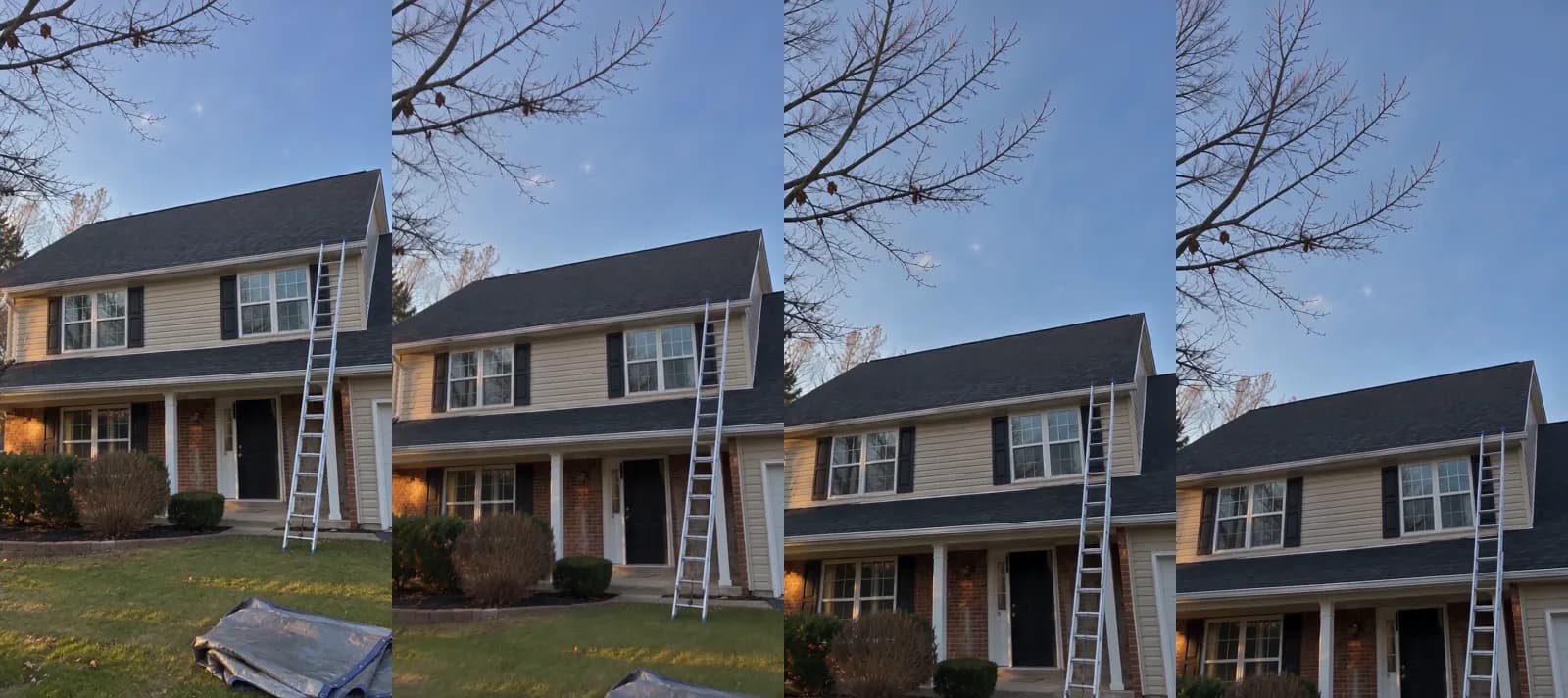 Made in Novoads with Seedance 2.0 Mini · prompt: the camera tilts up from the lawn to the roof and the sky, sound off · 5 seconds at 720p · 5 credits · 2026-11-15 · made from the stand-in photo above, through our own connector
The camera tilts up and back from the tarp, which slides out of the frame early, until the roof sits in the lower half of the picture under the sky and the bare branches. The frames show no person, no sign and no readable text, which is what we asked for.
What each roofing ad costs in credits and dollars
Prices are what Novoads charges as of November 15, 2026. You pay for Novoads from your first month.
- Starter is $15 a month for 200 credits. That's about 7.5 cents a credit.
- Plus is $49 a month for 1,000 credits, or $39 a month billed annually. At the monthly price, that's about 4.9 cents a credit.
- Ultra 3,000 is $129 a month for 3,000 credits, or $99 a month billed annually. At the monthly price, that's about 4.3 cents a credit.
To get the dollar figures, we multiplied the credits by each plan's per-credit rate at the monthly price and rounded to the cent.
| Ad | What you make | Credits | Starter | Plus | Ultra 3,000 |
|---|---|---|---|---|---|
| Job-site clip | Kling 3.0, 5 seconds | 10 | 75 cents | 49 cents | 43 cents |
| Job-site clip, before and after | Wan 3.0, 5 seconds, 720p | 9 | about 68 cents | about 44 cents | about 39 cents |
| The clip in this post | Seedance 2.0 Mini, 5 seconds, 720p | 5 | about 38 cents | about 25 cents | about 22 cents |
| Storm, review or offer ad | AI presenter, up to a minute, 480p | 100 | $7.50 | $4.90 | $4.30 |
| The same, sharper | AI presenter, up to a minute, 720p | 200 | $15.00 | $9.80 | $8.60 |
Karaoke captions add 0 credits in the app. If you redo a take, you pay for it again at the same price, so leave room for a second try on the presenter ad.
What a storm week costs
For a storm week, we'd make one presenter ad at 480p and three Wan 3.0 clips from your job photos. At 5 seconds a clip, that's 127 credits.
- On Starter, it's about $9.53. The month's 200 credits cover one storm week, with 73 left over.
- On Plus, it's about $6.22. The month's 1,000 credits cover seven storm weeks, with 111 left.
- On Ultra 3,000, it's about $5.46. The month's credits cover 23 storm weeks, with 79 left.
What a drone pilot charges for the same roof
The other way to get footage of a finished roof is to pay someone to shoot it. Drone U, which runs courses for drone pilots, publishes a pricing guide written by its co-founder Paul Aitken and dated May 30, 2026. It lists aerial photography at "$150 to $400 per hour" and adds "These are typical ranges." That rate covers a pilot and a drone at your job site, which is a different job from turning a photo you already took into a clip.
What a Texas roofing ad can't promise about the claim
On a page for roofers called "Roofing and insurance: Know the law," the Texas Department of Insurance (TDI) says "Texas doesn't allow a roofer or contractor to act as a public insurance adjuster on insurance claims if they're also doing the work." The next sentence reads "You can't advertise that you would do so, either."
Then the page addresses ads directly. It tells roofers to make sure their "websites, ads, and other materials" don't "say or imply that you will act as both a contractor and adjuster on a project," and it gives four examples of improper language or conduct.
- "Offering to negotiate claim settlements or file a claim for the policyholder."
- Promising to recover "every dime you are owed" from an insurer.
- Advertising to help homeowners avoid "incorrect settlement pricing."
- "Telling others, including insurance companies, that you represent the policyholder or can speak for them on coverage issues."
Who the rule applies to, and since when
The rule applies to the roofer doing the work, on any property that roofer works on or may work on. A TDI bulletin from July 8, 2024, sent to insurers, adjusters and contractors after Hurricane Beryl, says "A roofing contractor may not act as an adjuster or advertise to adjust claims for any property that the contractor is providing or may provide roofing services to." TDI's 2014 bulletin on the law says the same holds "regardless of whether the contractor holds a license under this chapter," meaning the chapter that licenses adjusters. So a roofer with an adjuster's license is still covered.
The rule isn't new. The 2014 bulletin says the Legislature "enacted House Bill 1183, effective September 1, 2013." The roofers' page we quote was last updated March 24, 2025, long after the rule took effect.
What's still allowed, and the deductible
The 2024 bulletin also says "Contractors may provide estimates and discuss those estimates and other technical information with an insurer or its adjuster." So a Texas roofer can still give an estimate and go over it with the adjuster. What crosses the line is an ad that says or implies the roofer will be the adjuster too.
The deductible gets a line of its own. TDI's page says "It's also illegal in Texas for a contractor to offer to waive, rebate, or absorb a property policyholder's deductible." It adds that state law requires contracts for $1,000 or more that involve an insurance settlement to include a notice that the policyholder must pay the deductible.
One of the guides we read, LSP Leads, suggests the headline "Storm-Damaged Roof? Insurance Covers the Repair!" That headline isn't one of the examples on TDI's page. Those examples are about the claim itself (filing it, negotiating it, recovering "every dime") and about speaking for the homeowner.
What this means for the five ads
This part is our reading of TDI's pages, and it isn't legal advice.
- The storm inspection ad offers the inspection and the estimate, and it leaves out any line about filing the claim, negotiating it or recovering every dime from the insurer.
- The offer ad leaves the deductible out of every offer, however it's worded.
- The review ad uses a review about the roof and the crew rather than one that thanks you for handling the claim, because the presenter reads it out as your ad.
- No ad introduces the presenter as an adjuster, a claims expert or someone who'll deal with the insurer for the homeowner.
- The job-site clip and the before and after are about the work itself, so they rarely come near the rule.
We only read Texas's pages. Other states write their own rules, and this post doesn't cover them. Before a Texas ad goes out, check TDI's own page.
Your next roofing ad is already on your phone
In Novoads, you turn the job photos you already have into short clips and hand your storm, review and offer scripts to an AI presenter. Then you post the finished ads from your own Facebook page. Our page on UGC-style ads with AI actors shows the presenter side in more detail, and our guide to making ads with AI covers the basics if this is your first one.
Turn this week's jobs into ads
Three clips from your own roof photos and one AI presenter storm ad come to 127 credits, inside a month of Starter.
See AI presenter adsStart with the best roof you finished this month and a storm ad for the towns you work in, then add the before and after.
Frequently Asked Questions
What does a Texas roofing contract have to say about the deductible?
The Texas Department of Insurance's page for roofers says state law requires any contract for $1,000 or more that involves an insurance settlement to include a notice that the policyholder must pay the deductible. The same page says state law lets insurance companies ask the policyholder for proof that the deductible was paid, and that it's illegal for a contractor to offer to waive, rebate or absorb the deductible. That's TDI's summary of the law. It isn't legal advice from us, so check TDI's page before you write the quote.
Can a Texas roofer still talk to the homeowner's insurance adjuster?
Yes. A TDI bulletin from July 2024 says contractors may provide estimates and discuss them, along with other technical information, with an insurer or its adjuster. What Texas rules out is a roofer acting as the adjuster on a property it works on or may work on, or advertising that it will.
How many credits does a roofing video ad take in Novoads?
A 5-second clip that starts on your own photo costs 10 credits on Kling 3.0. On Wan 3.0 it's 9 credits at 720p. An AI presenter video up to a minute long costs 100 credits at 480p. At 720p it's 200. Karaoke captions in the app add 0 credits. Starter is $15 a month for 200 credits. These prices are as of November 15, 2026.
Can an AI presenter play the homeowner in a roofing testimonial?
No. Have the presenter read a real review a homeowner left you, and say on screen that it's a reading. The presenter is an AI actor. It isn't your customer, your crew or an adjuster, and the ad shouldn't suggest it is.
Key Takeaways
- Search 'roofing facebook ads' and the ranking guides we opened keep coming back to the same five ads. They're the storm inspection ad, the job-site clip, the before and after, the testimonial and the offer follow-up.
- In the Novoads editor, a 5-second Kling 3.0 clip that starts on your own job photo costs 10 credits, and Wan 3.0 set to "Start / End Frames" turns a before photo and an after photo into one clip.
- An AI presenter video up to a minute long costs 100 credits at 480p. The presenter reads your script, and the ad should never pass it off as your roofer, your crew, an adjuster or a homeowner.
- In Texas, the Department of Insurance tells roofers to make sure their websites and ads don't say or imply they'll act as both the contractor and the adjuster on a project. The law behind that rule took effect on September 1, 2013.
- Texas roofers can still give estimates and go over them with the insurer or its adjuster. TDI's page calls it illegal for a contractor to offer to waive, rebate or absorb a deductible, so keep that out of every offer ad.
Sources
- •Texas Department of Insurance: Roofing and insurance: Know the law
- •Texas Department of Insurance: Commissioner's Bulletin B-0008-24, Hurricane Beryl, adjusters and repairs (July 8, 2024)
- •Texas Department of Insurance: Bulletin B-0014-14, House Bill 1183 (May 23, 2014)
- •Drone U: Drone Service Pricing Guide, by Paul Aitken (May 30, 2026)
- •BestPPC: Roofing Facebook Ads vs Google Ads, ROI Comparison (February 6, 2026)