Towing Ads: Ideas That Bring Calls, What Each Costs With AI, and Washington's Police Look-Alike Rule for State Patrol Tow Operators
Four towing ads built to get the phone ringing, how to make each one with AI from your own truck photos, what each costs in credits on every plan, and Washington's ad rule for the tow companies its State Patrol appoints.

Mauricio Valdivia
·12 min
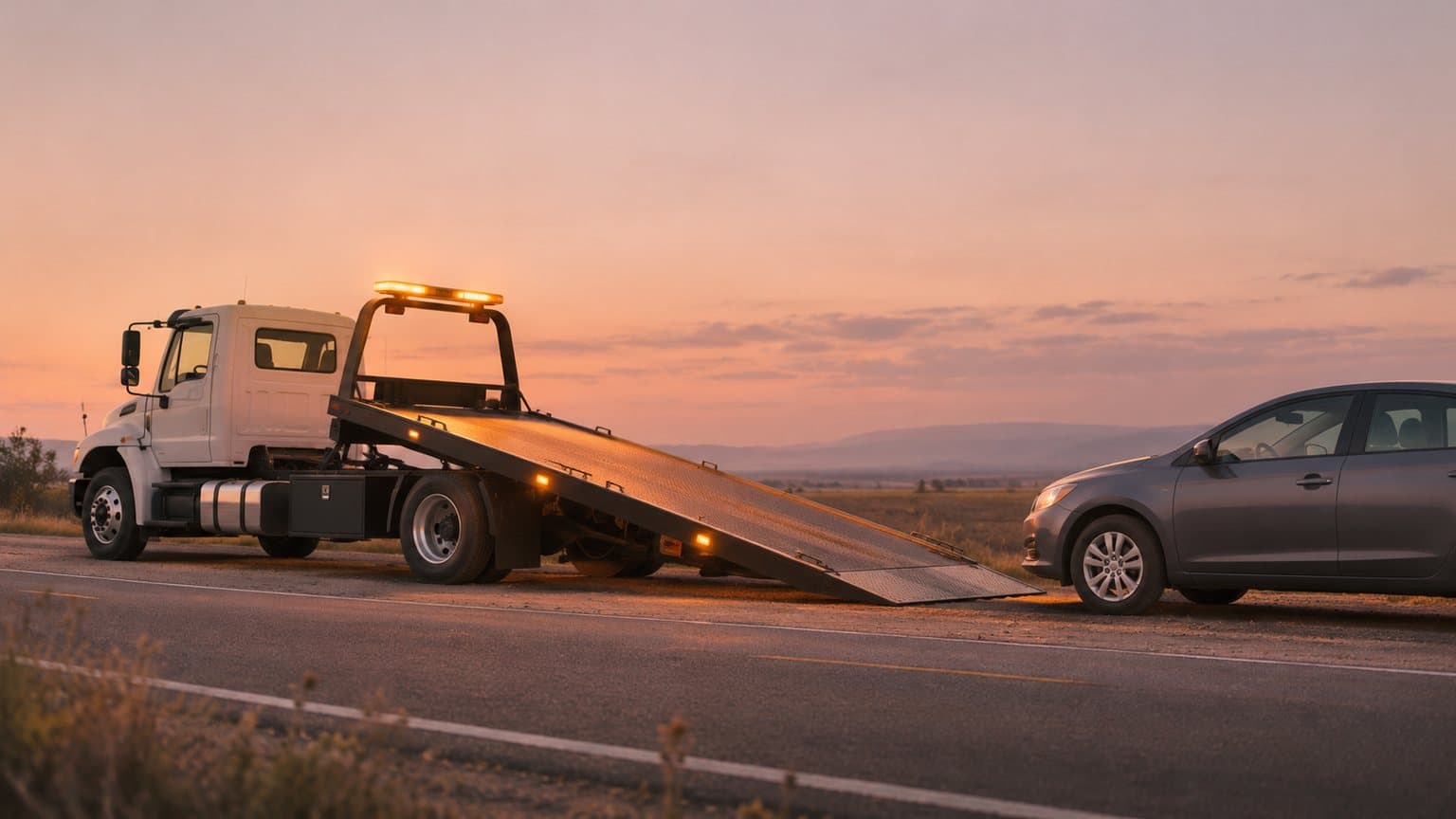
Your next caller is on a shoulder with the hazards on
The driver who calls you tonight is standing next to a car that won't start, hazards blinking, picking a tow company from whatever came up on their phone. They won't read your About page. In our view, the ad that gets that call shows a real truck, says you're open 24/7, names the towns you cover and puts your number one tap away.
Between them, the towing marketing agencies whose guides rank in Google's top ten results for "towing ads" cover the same ground. They want a call-now line, action shots of your own trucks, a page for each service and the roads you cover. None of the five pages we opened says what it costs to make an ad (the one that mentions money puts figures on clicks and a monthly budget), and none walks you through making one with AI. So we priced each ad from our own price list, and we made one picture and one short clip ourselves.
The picture stands in for a snapshot of your own truck. It's a plain white flatbed parked on a gravel shoulder early in the morning with its bed tilted down, and it cost 1 credit with GPT Image 2.6 Sunburst. Through our own connector, we turned it into a 4-second clip for 2 more credits, and both came back clean on the first try. Everything else here comes from our own price list and from pages we read on November 19, 2026. Those were the results page and the five agency guides on it, Washington's rule and three of the State Patrol's rule filings as the state's Code Reviser publishes them, the patrol's tow page and one production company's cost guide. We didn't run any of these ads for a tow company, and we didn't call one.
One thing none of the five mentions is a state rule on what a towing ad may say. Washington has one, and it binds only the tow companies that hold a letter of appointment from the State Patrol (over 400 businesses, the patrol says). Those companies must not engage in any advertisement indicating an official connection with the patrol or other law enforcement agency, and must not put police-like signs, shields, markings, accessories or insignia on their trucks or uniforms.
Four towing ads worth making, and what AI has to leave out
A 24/7 call-now ad with your towns and your number
This is the ad for the driver on the shoulder. Roadside & Towing Marketing's Google Ads tips sum it up in one line of sample copy, "Need a tow? Fast, affordable towing available 24/7." In a video, that's a talking AI actor saying your version of it, with your number in the script so the captions show it to everyone watching with the sound off. Lift Marketing Group's guide asks the other question this ad should answer, "What major roads and intersections do you service?" So put the highways, towns and counties you cover in the script and the captions.
AI does the cheap, repetitive part well. You can try three opening lines ("Stuck on the interstate?", "Locked out?", "Dead battery?") and keep the one that brings calls. What it must not do is pretend, so keep these out of the ad.
- An AI actor introduced as your dispatcher or one of your drivers. Let it speak for the company, as an AI presenter.
- An AI-made trooper or badge on screen, or any wording that hints at an official tie to the patrol or the police.
- An arrival time your trucks can't keep.
Your own trucks at real jobs
Lift Marketing Group's guide has a step called "Advertise with Action Shots", and it makes the case for "Original images of your towing company". This is where AI helps most, because you already have the pictures, like the flatbed loading a car in a parking garage, the wrecker at a ditch recovery or the rotator on a rollover you cleared. Use one of those photos as the opening frame of a 5-second clip. The model adds a slow camera move and some light, and your prompt asks it to keep the truck and the job as they were. Lift also wants equipment detail in your service descriptions. Its example is a "75-ton rotator" with "360 degrees of rotation", and an ad caption can carry the same detail as long as those are your truck's real numbers.
A model can draw things that weren't in your photo, so throw out any take that shows one of these.
- A truck or a rotator you didn't have, or a recovery or a wreck you didn't handle.
- Lettering, lights or markings your truck doesn't carry.
- Police-like markings of any kind. In Washington, the rule for appointed operators names markings like these.
One service per ad, from heavy towing to lockouts
Lift's guide tells owners to "promote each additional tow capability with its own page", and the same split works for ads. A heavy-duty ad shows your heavy wrecker on a real job, a motorcycle ad shows a bike strapped down on your own flatbed, and a lockout or jump-start ad can be a short AI presenter take that names the service and your number. Each ad has one thing to say, so it's easy to see which service brings calls. Our locksmith ads guide has lockout ads of its own, along with Google's verification rule for locksmiths.
What AI must not show here is a service, a vehicle class or a piece of equipment you don't offer. If you don't tow semis, no clip should hint that you do.
Real reviews over your own photos
A review ad puts the words of people who already called you in front of the next driver. Use a real customer's written words, copied exactly, over your own photo of the job or the truck, with the star rating as they left it. Let AI handle the motion, the layout and the captions, and keep two things out of the ad.
- A review read aloud by an AI actor as if a customer were speaking.
- A review, a rating or a badge you haven't earned. We explain Google Verified, the badge that replaced Google Guaranteed, in our plumbing ads guide.
Building each towing ad in Novoads from your truck photos
You make the clip, the presenter take or the picture in Novoads, and you run it wherever you already advertise. The four ads above come from three tools in the app. If you've never made an AI ad, start with our guide on how to make video and image ads with AI.
A clip that starts on your own photo
We'd use Wan 3.0 for these clips. The 5-second clip in the steps below costs 9 credits.
- In the editor, open Video and pick Wan 3.0, the last row of the model menu.
- Under the prompt, pick "Start / End Frames" instead of "Reference", and drop your photo where it says "Drop a start frame or click to upload". The editor then shows "The video starts on this picture."
- Write what should move and what shouldn't, for example, "slow push toward the truck, the truck and the car stay exactly as they are, no people, no new lettering".
- Set 5 seconds at 720p and press the round button with the up arrow.
On Kling 3.0, there's no switch to pick. Your photo goes straight into its start frame, and a 5-second clip costs 10 credits.
You get back 5 seconds of video whose first frame is your photo. Wan 3.0 clips come with sound unless you turn it off, and a silent clip costs the same. Check the clip against the real truck before it goes anywhere. Our walk-through of turning one photo into a finished ad goes deeper into choosing a model for the motion, and our car dealership ads guide builds its video ideas from a dealer's own lot.
For this guide, we made a stand-in for your own photo with GPT Image 2.6 Sunburst.
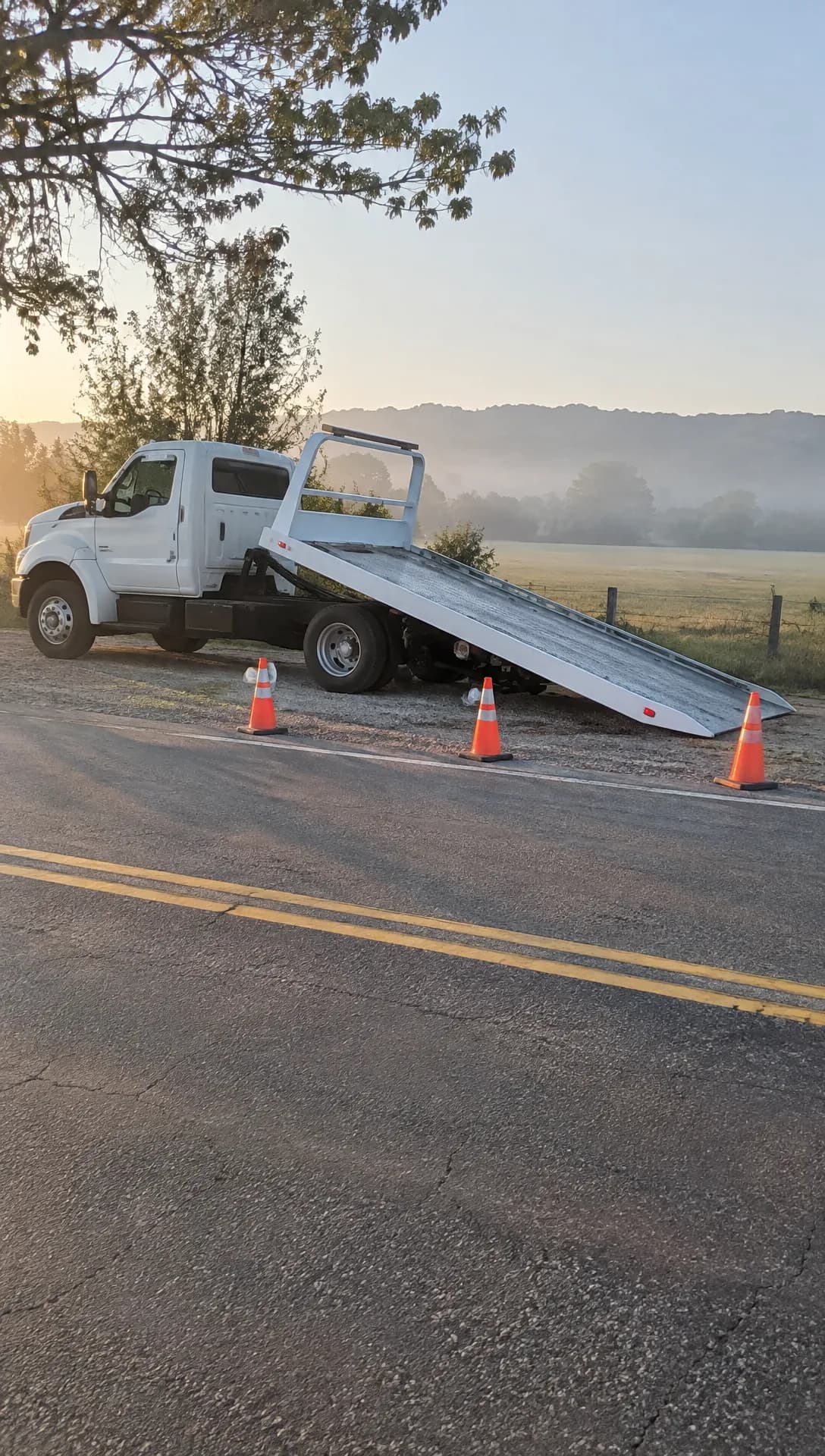 Made in Novoads with GPT Image 2.6 Sunburst · a phone-style photo of a white flatbed on a country road's shoulder early in the morning, bed tilted down and empty, cones beside it · stands in for your own photo · 1 credit · 2026-11-19
Then we gave that still to Seedance 2.0 Mini through our own connector as the clip's start picture, and asked for 4 seconds with the sound off. At 480p, it cost 2 credits. In the editor, though, Seedance takes your photo as a reference and never starts the clip from it, which is why the steps above use Wan 3.0 or Kling 3.0. We kept this one at 480p to try the camera move cheaply, and we'd make the clip you run at 720p.
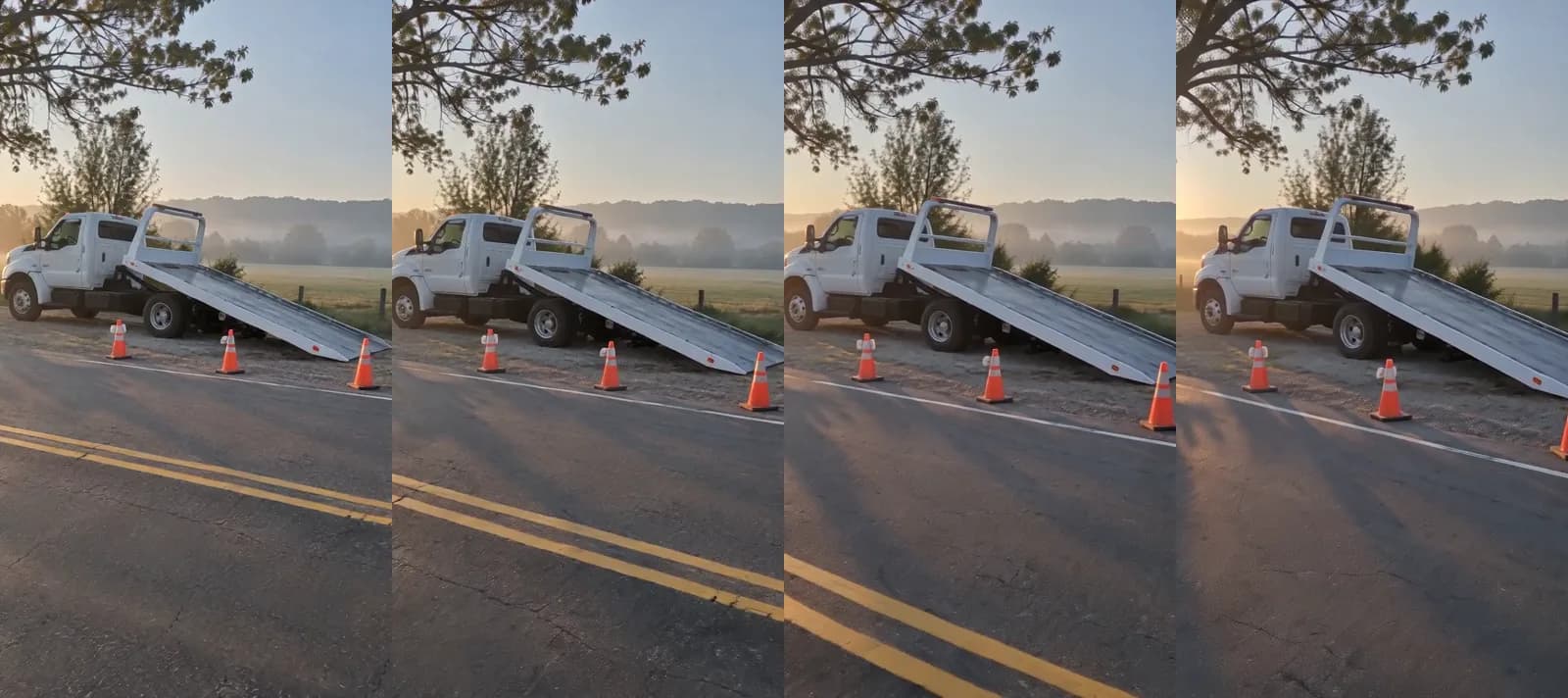 Made in Novoads with Seedance 2.0 Mini through our own connector · 4 seconds at 480p from the still above, sound off, a slow push toward the parked truck · 2 credits · 2026-11-19
Across the four frames, the camera pushes slowly forward and a little to the right, the double yellow line slides out of the bottom of the picture, and a low sun from the left throws long tree shadows across the road. The truck, its tilted bed and the cones stay where they were.
A talking AI actor reading your 24/7 line
- Open Talking Actors, press Add actors, pick one AI actor and confirm. Choose one in everyday clothes, since anything that reads as a uniform or a badge is wrong for this ad.
- In the box marked "Write what the actor will say...", type the script in your company's voice and never as a dispatcher or a driver. For example, "Stuck on the side of the road? [Your company] tows around the clock across [your towns]. Call [your number] now."
- On the price line, switch from 720p (the default) to 480p. That line shows credits per started minute, per actor. The price halves, and a take of up to a minute comes to 100 credits.
- Press the round up-arrow button.
What comes back is the AI actor reading your script with voice and lip-sync. Adding captions is one more step, in the Captions tool, which opens on the "TikTok, no box" look. That look and the other five each cost 3 credits per started minute.
Review and service pictures from the Image tool
- Open Image, press Reference and upload your photo as a JPG, PNG or WebP.
- Type what the picture should show and say, including the review's exact words if you want them on it.
- Under Settings, set Model to GPT Image 2 and switch Quality from High to Medium.
- Leave Images at 3, and the run costs 3 credits.
GPT Image 2 offers square, tall and wide shapes. For a 4:5 feed ad, you'll need Nano Banana Pro, at 2 credits a picture. Read every word on the picture against the review before you post it.
What a week of towing ads costs on each plan
Prices as of November 19, 2026. Novoads is paid from the first month, and the dollar figures in these tables are our own math at each plan's rate.
| Plan | Price a month | Credits a month | Each credit |
|---|---|---|---|
| Starter | $15 | 200 | 7.5 cents |
| Plus | $49 | 1,000 | 4.9 cents |
| Ultra 3,000 | $129 | 3,000 | 4.3 cents |
What each piece costs
| What you make | Setting | Credits | Starter | Plus | Ultra 3,000 |
|---|---|---|---|---|---|
| Clip from your photo, Wan 3.0 | 5 s, 720p | 9 | about 68 cents | about 44 cents | about 39 cents |
| Clip from your photo, Kling 3.0 | 5 s | 10 | 75 cents | 49 cents | 43 cents |
| Talking AI actor, up to 60 s | 480p | 100 | $7.50 | $4.90 | $4.30 |
| Talking AI actor, up to 60 s | 720p, the default | 200 | $15.00 | $9.80 | $8.60 |
| Three pictures, GPT Image 2 | Medium | 3 | about 23 cents | about 15 cents | about 13 cents |
| Captions on one take | up to a minute | 3 | about 23 cents | about 15 cents | about 13 cents |
One week's set, added up
Our set for a first week is three pieces. Two are 5-second Wan 3.0 clips made from your own flatbed photos. The third is a 480p take of a talking AI actor reading your call-now line, your towns and your number. The clips come to 18 credits and the take to 100. That's 118 credits for the set.
At Starter's rate the set comes to about $8.85, and at Plus's to about $5.78. On Ultra 3,000, it's about $5.07. A Starter month covers one set with 82 credits to spare. A Plus month covers eight sets, and an Ultra 3,000 month covers 25. Review pictures and captions on the presenter take add 3 credits each, which brings the week to 124.
We'd make the 24/7 presenter take first, since it's the ad that does the most work for the driver on the shoulder. The credit totals leave out four things.
- Re-rolls. Every new try costs the same credits again.
- Joining the clips into a single ad, and a separate voice-over. Neither has a set price on our list, so we left both out of the total.
- Your ad spend on Google, Facebook or anywhere else you run the ads.
- The minutes you spend comparing every clip with the truck in your yard. Those matter most, because a model can add a detail your truck doesn't have.
How that compares with a filmed local commercial
C&I Studios, a video production company, gives "$8,000" as a representative budget for a "Local Service Business Commercial" in a cost guide it first published on March 24, 2026. The example is "A plumber, dentist, or local retailer producing a 30-second spot for local cable and social media." Its breakdown includes a "Half-day studio shoot, 3-person crew: $3,000". That's one studio's figure for a filmed spot, and it doesn't compare like for like with ours. Their budget pays for a crew and a shoot, while our credits pay to move photos you already took or to put an AI presenter on your script. Our breakdown of what a 30-second AI commercial costs prices that longer format in credits too.
Washington's ad rule for State Patrol tow operators
The two sentences in subsection (29)
The rule is WAC 204-91A-180, a section of the State Patrol's towing rules that the Legislature's Code Reviser publishes. Its subsection (29) has two sentences.
Tow operators must not display any sign, shield, marking, accessory, or insignia on uniforms or vehicles indicating the equipment or vehicle marking are similar to or belong to any public law enforcement agency. Tow operators must not engage in any advertisement indicating an official connection with the patrol or other law enforcement agency.
Both sentences have read this way since May 27, 2017, the date the section's history gives for its latest change. The 2017 order only dropped the word "truck" from "Tow truck operators" in both of them. The patrol's 2016 proposal already shows them in the text, so the ban is older than that.
Which tow companies it binds
The section opens by naming the companies it covers, "registered tow truck operators appointed pursuant to this chapter". In plain English, that's a tow company holding the State Patrol's letter of appointment, which the chapter defines as the patrol's document letting the operator "tow and store vehicles for the patrol on a rotational or contractual basis in a specified area". The patrol's tow page says it has a letter of appointment with over 400 registered tow truck operator businesses that do law enforcement impounds for it.
So the rule binds only those appointed companies. It doesn't bind every tow company in Washington, and it isn't a national rule. Some of the section's other items apply only on patrol calls, such as the one on drivers' clothing, which starts "When responding to a patrol call". Subsection (29) has no such words, and as we read it, it covers an appointed company's ads whenever they run. If you tow outside Washington, read your own state's towing rules before you write the ad.
What it means for an AI-made towing ad
Nothing in subsection (29) mentions AI, video or presenters, so what follows is our reading and isn't legal advice. An AI presenter dressed in a police-like uniform, or a clip in which the model paints police-like markings onto your truck, is our example of what the first sentence names. A caption that calls you the State Patrol's official tow company is our example of what the second one names. The second sentence's words reach an advertisement indicating an official connection with the patrol or other law enforcement agency, and they say nothing against mentioning police work. Before an ad runs, read any line that names the patrol or the police against that sentence.
Lights come up elsewhere in the patrol's rules. An order effective August 29, 2024, amended WAC 204-91A-170, the section on minimum tow truck equipment standards, to match a change in state law that permits rear-facing blue lights on emergency tow trucks. It didn't change section 180. Even so, keep flashing lights out of your AI clips, because the model would be drawing equipment your photo doesn't show.
A first week of towing ads from your camera roll
With Novoads, you can turn the truck photos already on your phone into short ad clips and hand your 24/7 script to an AI presenter. Each plan's credits and price are on our pricing page.
See what a month of towing ads costs
Every plan's credits and monthly price, from Starter up, on one page.
Compare the plansStart with the two flatbed clips and the 24/7 take, check each one against your real truck, and add the one-service ads once those bring calls.
Frequently Asked Questions
Does Washington's rule on police look-alike ads apply to every tow company in the state?
No. WAC 204-91A-180 covers registered tow truck operators appointed under the State Patrol's towing rules, meaning the companies that hold the patrol's letter of appointment to tow and store vehicles for it on a rotational or contractual basis. The patrol says over 400 businesses hold one. For those companies, subsection (29) bars police-like signs, shields, markings, accessories or insignia on uniforms or vehicles, and any advertisement indicating an official connection with the patrol or other law enforcement agency. That section doesn't cover tow companies without the appointment. Outside Washington, read your own state's towing rules.
Key Takeaways
- Four ads cover what your tow company has to say: a 24/7 call-now ad with your towns and number, your own trucks at real jobs, one service per ad, and real customers' reviews over your own photos.
- AI earns its place by moving photos you already have and reading your script, and it must never show a truck, a job, a review or a person that isn't yours.
- In Novoads, a first week's set of two clips from your truck photos and one take from a talking AI actor comes to 118 credits. That's about $5.78 at the Plus rate and about $8.85 at Starter's.
- C&I Studios, a video production company, gives $8,000 as a representative budget for a filmed local service commercial in a cost guide it first published on March 24, 2026.
- In Washington, a tow company holding the State Patrol's letter of appointment must not engage in any advertisement indicating an official connection with the patrol or other law enforcement agency (WAC 204-91A-180, subsection 29). The rule binds only those appointed companies.
Sources
- •Washington State Legislature, WAC 204-91A-180 (Code Reviser)
- •Washington State Register, WSR 16-21-032 (Washington State Patrol, proposed rules, 2016)
- •Washington State Register, WSR 17-10-029 (Washington State Patrol, permanent rules, 2017)
- •Washington State Register, WSR 24-16-032 (Washington State Patrol, permanent rules, 2024)
- •Washington State Patrol, Tow & Wrecking
- •C&I Studios, 30 Second Commercial Cost in 2026: Complete Pricing Guide
- •Lift Marketing Group, How to Advertise Towing Business
- •Roadside & Towing Marketing, Best Google Ads for Towing & Roadside Assistance Business