Urgent Care Ads: Ideas for Clinics, What Each Costs With AI, and Florida's Line on Hospital Prices
Five urgent care ads (from an open-now map ad to a flu-shot price read by an AI presenter), the clicks and credits each one takes in Novoads, and the Florida statute that puts a sentence about hospital charges in a hospital-affiliated center's ads.

Mauricio Valdivia
·11 min
Start with your own front door
Someone with a sprained wrist or a feverish kid doesn't study an urgent care ad. They glance at it to see whether you're open, whether they can walk in, how close you are and, if they're paying out of pocket, what the visit will cost.
You probably have most of that ad already. There's a phone photo of the entrance, the hours are on the door, and the front desk knows the self-pay price of a flu shot or a school physical. What's hard is turning all that into new ads every flu season while the waiting room is full, without a film crew or an actor in a white coat.
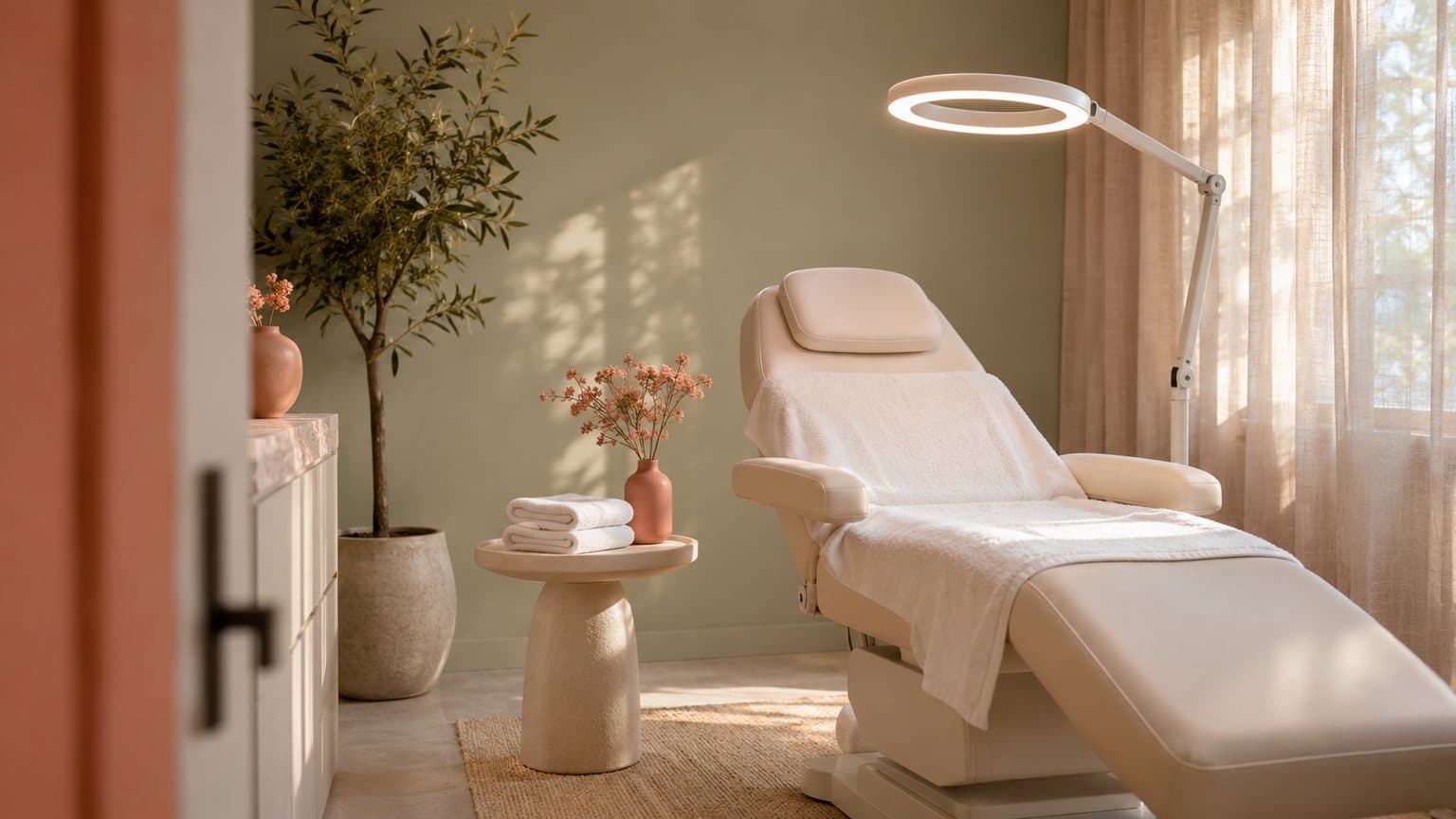
We've already tested the photo-first half of this. On November 15, for our med spa guide, we spent 1 credit on a still of an empty treatment room, lit like a snapshot from the owner's phone. It has a cream reclining chair under a ring light, a steel cart of folded towels and a potted olive tree. Our Claude connector then turned that still into a five-second clip for 5 credits. Frame by frame, the camera drifts toward the chair, while the light, the towels and the tree stay where the photo put them. It's a med spa room, so here it only stands in for a photo of a room in your clinic.
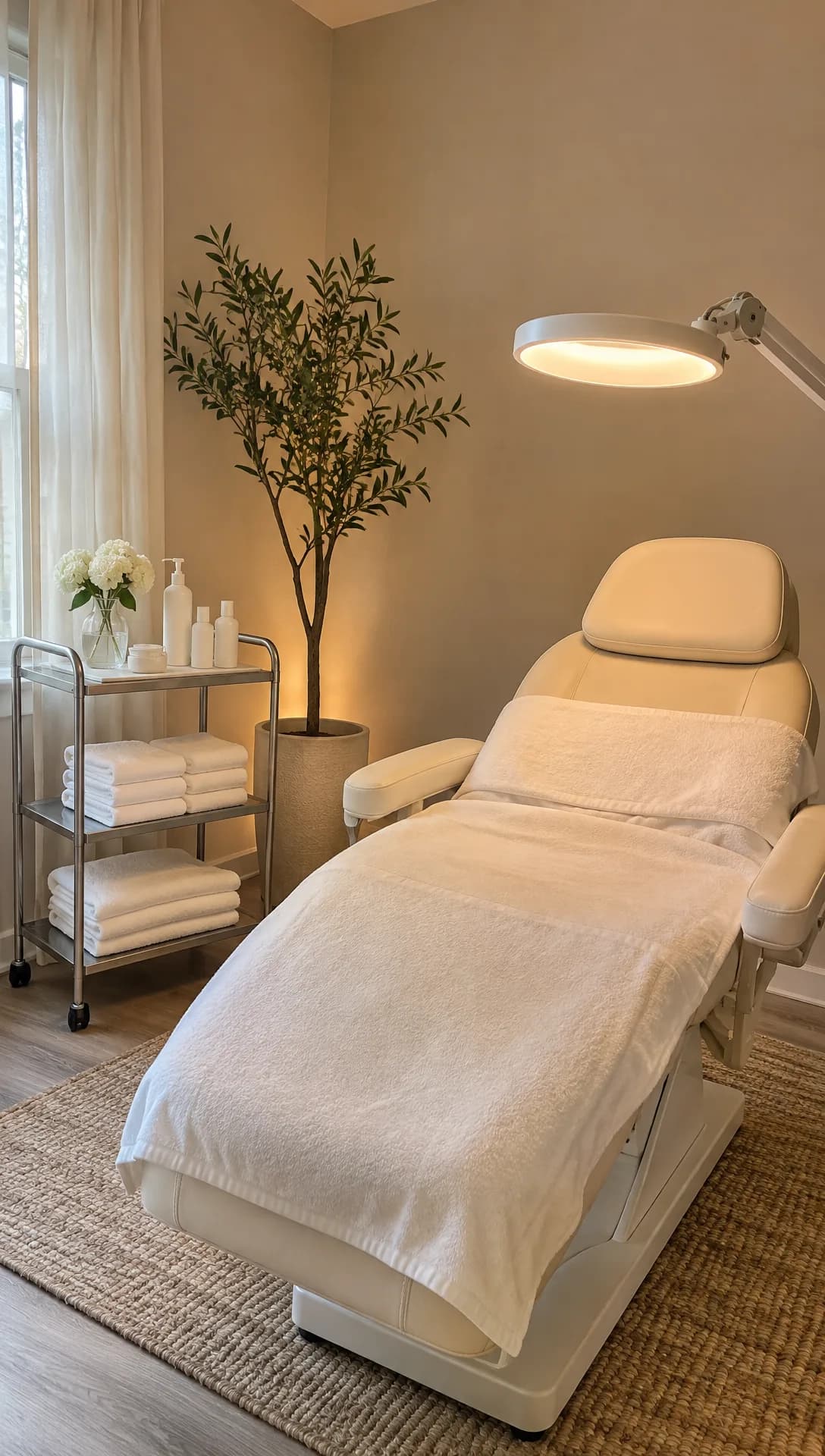 Made in Novoads with GPT Image 2.6 Sunburst · an empty treatment room for our med spa guide, made to look like a phone snapshot · a stand-in for a photo of your own room · 1 credit · 2026-11-15
On November 19, 2026, we went through four pages that rank high for "urgent care ads", read the Florida statute this guide ends on and priced each Novoads step in credits. Both pictures here come from the med spa run. We didn't make a new clip, run any clinic's ads or film anyone.
Five kinds of urgent care ad, and where AI fits in each
Most of the guides ranking for this search come from marketing firms, and they keep recommending the same short list of ads. One says you're open, one shows the inside, one carries a price for the season, one explains what you treat and one lets a patient talk. AI helps with some of them more than others, and each has something it must never show, whether that's a room, a person or a service that isn't really yours.
The "open now, walk right in" ad
Someone with a sore throat types "urgent care near me" after dinner, and this ad is what they should find. It carries your hours, your town and the services that decide whether they make the trip (walk-ins, and X-rays on site if you have them). On a results page, it's text you write in the ad platform. Where a placement takes a picture, as social feeds and display banners do, the same words go over a picture of your real entrance. Who sees the feed version is up to the audience you choose, and our chiropractor ads guide goes into the health-condition audiences Meta flags.
AI earns its keep on that picture, since one photo of your front door can be redrawn for every shape a placement asks for. It shouldn't add a door, a sign or a service you don't have. We'd also keep "emergency" and "ER" out of the copy, so nobody with chest pain picks you over calling 911. In Florida, a center affiliated with a licensed hospital has one more line to carry, which we get to in the Florida section below.
A short tour of the building
A first-time patient, or a parent bringing a child, wants to see the place before walking in. A tour is a few seconds each of your entrance, the waiting room and an exam room, cut together into one short video.
AI does well here as long as every clip starts on a photo you took, because then the first frame is the real room a patient will walk into. Don't let it pass off a room, an X-ray machine or a lab the model invented as yours. If a take adds equipment you don't have, throw it out and run it again.
A seasonal price for flu shots and school or sports physicals
In the fall, people look for flu shots, and in late summer, parents need school and sports physicals before the first practice. For a patient paying out of pocket, the price is what decides it, so the ad gives the price, what it includes and when you're open.
An AI presenter can say all that on camera. It's a talking AI actor reading your script, and when the price or the hours change, you edit the words and make it again. Nobody should take it for your doctor, a nurse, one of your staff or a patient. The price it reads is the self-pay price you actually charge, and if that price covers the shot or the exam but leaves out an X-ray or a lab test, the script says so plainly.
What you treat, and when to call 911 instead
This one helps someone decide where to go before they get in the car. It lists what you treat in plain words (colds, flu, sore throats, sprains, minor cuts) and says when to call 911 instead.
A presenter reading that list, with the words on screen, is easy to make and easy to change when you add a service. Don't show any patient, symptom or treatment as if it were a real case, and don't present the actor as a clinician.
A real patient's review
This ad borrows a real patient's own words, shared with their consent. It's the one kind where we'd keep AI away from the person entirely, because the review is theirs, word for word.
AI can still make the picture around it, setting their sentence beside a photo of your entrance or your waiting room. An invented patient, an invented review, or an AI actor playing a patient or an employee has no place in it.
What to click in Novoads for each ad
Three routes in Novoads cover all five ads. One turns your photo into the first frame of a clip, one has a talking AI actor read your script, and one uses your photo as the reference for a picture ad in the Image tool. If this is your first time, our guide to making video and image ads with AI starts from zero.
Tour clips that open on your photos
- In a new project, choose Video and pick Kling 3.0 from the model menu.
- Put your entrance photo in the start-frame box, the one labeled "Drop a start frame or click to upload". Once it uploads, the editor says "The video starts on this picture."
- In the prompt, describe only the camera move (a gentle glide through the front doors, for instance), and ask that no people appear and that nothing new be added.
- Leave the length at five seconds, the default, then press the round button with the up arrow.
A five-second Kling 3.0 clip costs 10 credits. Do the same with the waiting room and an exam room, then compare each clip with your photo before you use it.
We priced Kling 3.0 because its first frame is your photo. Kling 4.0 and Veo 3.1 work the same way, and so do Omni Flash and Wan 3.0 once you switch from "Reference" to "Start / End Frames". Seedance works differently in the editor. Your photo becomes a reference that the prompt refers to as @Image1, and the clip may begin on a different frame.
Our proof clip came about another way, through our Claude connector, which opens a Seedance 2.0 Mini clip on a picture you give it. It began on the treatment-room still shown earlier.
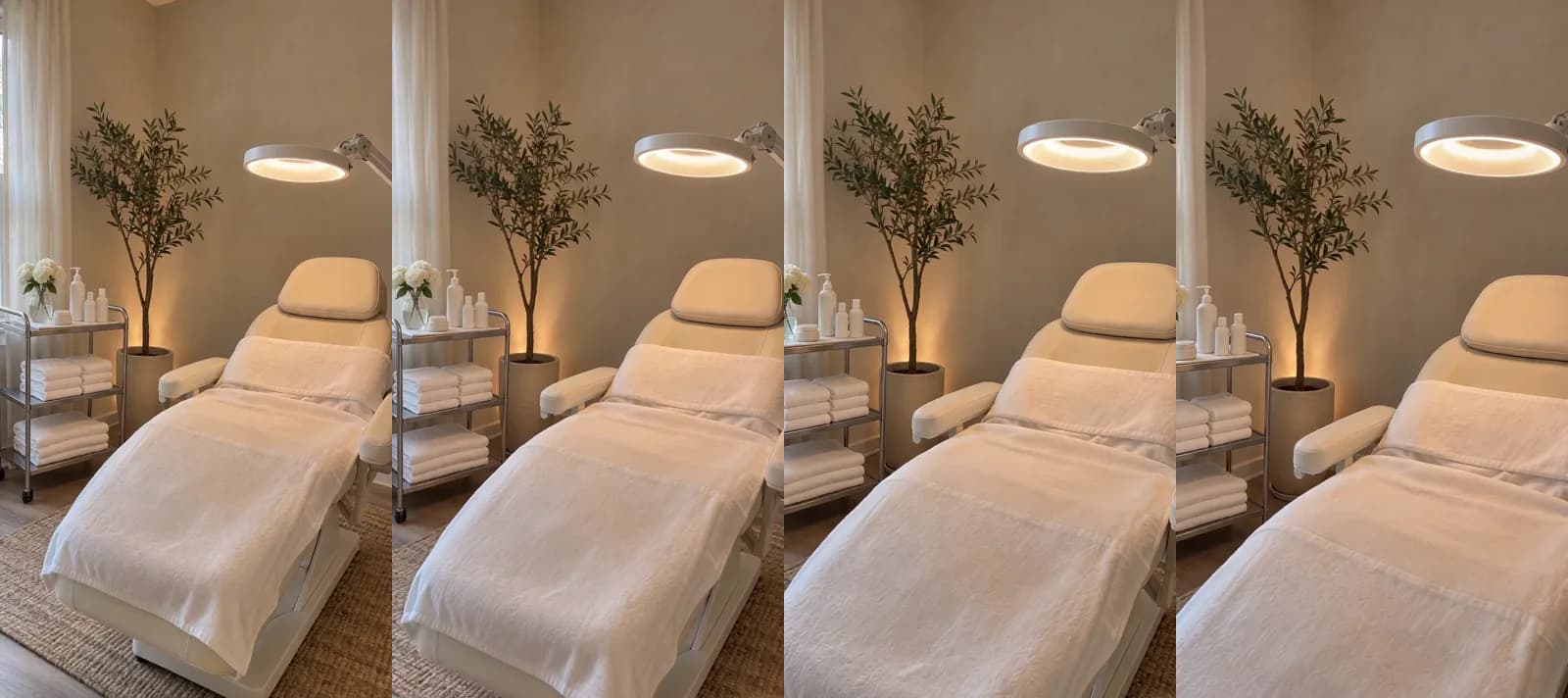 Made in Novoads with Seedance 2.0 Mini · the camera moves in on the chair from the still above, made through our Claude connector for our med spa guide · 720p, sound off · 5 credits · 2026-11-15
For a longer walk-through of one-photo clips, see how we turn a single product photo into a video.
The presenter ad for your price or your "where to go" list
- Choose Talking Actors, click "Add actors" and pick an AI actor in everyday clothes, with no scrubs, white coat or stethoscope.
- Write the script in the box marked "Write what the actor will say...". Give the clinic's name, street and hours, then the self-pay price word for word from your posted list, along with what that price includes and leaves out.
- On the price line, switch from 720p to 480p, then send it.
You get back the actor speaking your script, lip-synced to it. Captions are a separate pass you run on that video afterward.
You're billed by the started minute, so any script of 60 seconds or less is a single charge. At 480p, the setting we priced, that's 100 credits. The 720p default costs 200. Have the presenter name the clinic rather than say it works there, and never give it a doctor's or a nurse's title. A presenter like this is closer to a spokesperson than to a scripted AI commercial, and that's the right tone for a price ad.
Picture ads from your entrance photo, including the review card
- Choose Image, click Reference and upload your entrance photo as a JPG, PNG or WebP.
- In the prompt, lay out the hours, two or three services, the town and where each line of text goes. For the review card, paste the patient's sentence exactly as they wrote it.
- Under Settings, pick GPT Image 2, set Quality to Medium and leave Images at 3.
- Pick a shape (square, wide or one of two tall ones) and send it.
You get three pictures for 3 credits, and the reference photo doesn't add to that. Quality starts on High, which costs 4 credits a picture on GPT Image 2, so change it before you send. Read all the text on every picture before you put it in an ad. A picture model can still get a letter or a number wrong, and on a clinic ad, that slip tends to land in the street name or the hours.
What one clinic's set of ads costs on each plan
Prices in this section are as of November 19, 2026. Each Novoads plan comes with a monthly allowance of credits, and our pricing page lists every plan.
- Starter, $15 a month for 200 credits
- Plus, $49 a month for 1,000 credits
- Ultra 3,000, $129 a month for 3,000 credits
Per credit, that works out to 7.5 cents on Starter and 4.9 cents on Plus. Ultra 3,000 brings it down to 4.3 cents. The set below has a tour clip of your entrance and one of an exam room (each starting on your photo), a presenter video with the flu-season price and the hours, and three picture ads made from the entrance photo.
| Piece of the set | Model and setting | Credits | Starter | Plus | Ultra 3,000 |
|---|---|---|---|---|---|
| Entrance clip, 5 seconds | Kling 3.0 | 10 | 75 cents | 49 cents | 43 cents |
| Exam room clip, 5 seconds | Kling 3.0 | 10 | 75 cents | 49 cents | 43 cents |
| Presenter, up to 60 seconds | Talking actor, 480p | 100 | $7.50 | $4.90 | $4.30 |
| Three picture ads | GPT Image 2, Medium | 3 | about 23 cents | about 15 cents | about 13 cents |
| The whole set | 123 | about $9.23 | about $6.03 | about $5.29 |
Starter's 200 credits pay for the set with 77 to spare. A month of Plus pays for it eight times over. Ultra 3,000 covers it 24 times.
Leave the presenter at its 720p default and the set comes to 223 credits. Four other costs aren't in the table.
- Editing the tour clips together, and any voice-over, aren't in the set.
- Captions on the presenter video cost 3 credits a started minute in "TikTok, no box", the first look in the captions tool.
- A take you throw away costs the same as the one you keep.
- Whatever you spend on Google or Meta to show the ads is a separate bill.
For a sense of what outside help costs, Patient Care Marketing Pros, an agency for urgent and primary care clinics, publishes "Transparent public pricing from $995/mo" on its pricing page. Its entry plan adds a $1,500 setup fee, and the ad budget itself is extra, with a $1,000 minimum. That plan lists Google search ads and display remarketing ads, so the fee pays for running campaigns, and making the ads themselves is a separate job. Our therapist ads guide sets out Google's health audience rule, worth a look before any remarketing starts.
Florida's line on hospital charges, and the price list behind it
None of the four pages we opened from the top of this search mentions the line on hospital charges. Florida's statutes have carried it for years, though, and a hospital-affiliated center should know about it before it runs a single ad from the list above.
What section 395.107 says
Section 395.107 of the Florida Statutes covers prices at urgent care centers, and it opens with a plain duty. "A facility must publish and post a schedule of charges for the medical services offered to patients." The rest of the rules for the price list follow from there.
- The schedule lists the prices an uninsured person pays by cash, check, credit card or debit card.
- It hangs "in a conspicuous place in the reception area", and it "must include, but is not limited to, the 50 services most frequently provided".
- It may group services into three price levels, so a center can post price bands.
For a center tied to a hospital, the section adds one more line. If a facility "is affiliated with a licensed hospital under this chapter", its schedule must tell insured patients "whether the charges for medical services received at the center will be the same as, or more than, charges for medical services received at the affiliated hospital". That text, the section says, "shall be included in all media and Internet advertisements for the center and in language comprehensible to a layperson."
Who it applies to, and since when
The two duties reach different centers.
- The ad line is written for Florida urgent care centers affiliated with a licensed hospital, and for no others.
- The self-pay price list applies to every urgent care center in Florida that's open to the public. The section exempts a facility "operated and used exclusively for employees and the dependents of employees of the business that owns or contracts for the facility".
Section 395.002 says what counts as an urgent care center, calling it "a facility or clinic that provides immediate but not emergent ambulatory medical care to patients". The examples it gives include a hospital's off-site facility that takes patients without an appointment, and a licensed clinic group that "maintains three or more locations using the same or a similar name".
None of this is new.
- The self-pay price list is already in the 2011 edition of the statutes.
- The ad line has been in the section since the 2012 edition.
- The section was last amended in 2016, which gave it its current wording. The text quoted here is from the 2026 edition on the Florida Senate's site.
What it means for the five ads
The section never mentions video or AI. It says "all media and Internet advertisements", and we read that as covering a tour clip, a presenter video, a search ad and a picture ad on social media, since each one is an Internet ad for the center. So for a Florida center affiliated with a licensed hospital, we'd put a plain sentence in every one of them telling insured patients whether their charges will be the same as, or more than, at the hospital. By our reading, the sentence fits into each ad a little differently.
- The search or map ad carries it in its own text.
- The presenter reads it aloud, and it also appears on screen.
- A tour clip has no voice, so the sentence is written over the picture and repeated in the ad's text.
- The review card and the other picture ads carry it on the picture itself.
- The explainer says it along with the list of what you treat.
If your center isn't affiliated with a hospital, that ad line isn't written for you. If it's in Florida and open to the public, though, the self-pay schedule still is, and we'd make the price your presenter reads match the one posted in your reception area. In another state, Florida's section doesn't apply, so check your own state's rules before you put a price in an ad. Take all of this as our reading of the statute rather than legal advice, and read the section itself on the Florida Senate's site.
Which ad to make first this flu season
We'd start with the presenter ad for the self-pay price you're asked about most. Of the five, it's the one you can redo fastest when a price or your hours change, and it gives someone without insurance a number before they drive over. Next come the tour clips, from the entrance and exam room photos on your phone, and then the picture ads, from that same entrance photo.
You can make every piece of this in Novoads (the photo-first clips, the AI presenter reading your script and the picture ads built from a reference) and see what each one costs in credits before you make it.
Price your clinic's first set of ads
The set of ads in this guide came to 123 credits. See what each plan's month of credits covers.
See the plansThis week, pick the self-pay price people ask you about most, write it into a script with your hours and what the price leaves out, and send it.
Frequently Asked Questions
Does every Florida urgent care ad need the line about hospital charges?
No. The line comes from section 395.107(3) of the Florida Statutes, and it's written for a center affiliated with a licensed hospital. That center's schedule must tell insured patients whether their charges at the center will be the same as, or more than, at the affiliated hospital, and that text 'shall be included in all media and Internet advertisements for the center'. What applies to every urgent care center open to the public is the self-pay schedule, which must include at least the 50 services the center provides most often. A center run only for a business's own employees and their dependents is exempt from the section. Counting a short video ad among 'all media and Internet advertisements' is our reading of the statute, so check the section on the Florida Senate's site.
Key Takeaways
- The five kinds of urgent care ad are an open-now search or map ad, a short tour of the building, a seasonal self-pay price, a video on what you treat and when to call 911, and a real patient's review.
- Tour clips should open on the clinic's own photos. In the Novoads editor, that means using Kling 3.0's start frame (10 credits for five seconds), or Omni Flash or Wan 3.0 set to Start / End Frames.
- An AI presenter can read the flu-season price and the hours for 100 credits at 480p, as long as the script runs a minute or less. Never cast it as a doctor, a nurse, one of your staff or a patient.
- The full set we priced (tour clips, a presenter video and picture ads) comes to 123 credits, about $6.03 at the Plus rate.
- In Florida, a center affiliated with a licensed hospital must say in all its media and Internet ads whether insured patients' charges will be the same as, or more than, at the hospital. That duty has been in section 395.107 since 2012. The same section has every urgent care center open to the public in Florida post self-pay prices for at least its 50 most frequent services.
Sources
- •Florida Statutes (2026), section 395.107: publishing and posting schedule of charges
- •Florida Statutes (2026), section 395.002: definitions, urgent care center
- •Florida Statutes (2012), section 395.107: the first edition with the ad line
- •Florida Statutes (2011), section 395.107: the price list before the ad line
- •Patient Care Marketing Pros, pricing