Veterinary Advertising: Video Ideas for a Clinic, What Each Costs With AI, and Minnesota's Ad Rule
Five video ads a vet clinic can make with AI from its own photos or an AI presenter, what each one costs on Novoads' plans, and Minnesota's rule on what a vet ad must include.

Mauricio Valdivia
·11 min
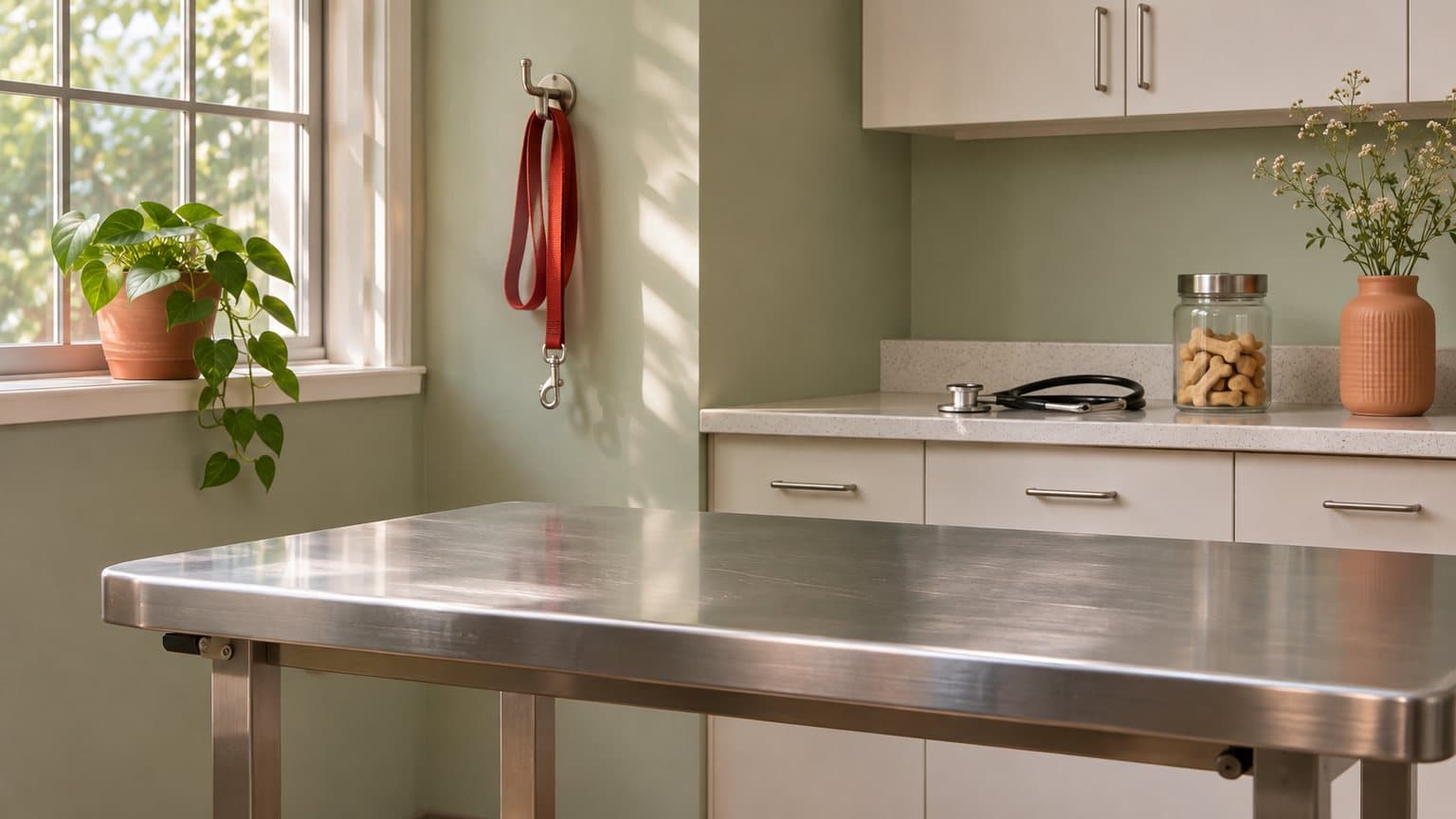
For three credits, we made a still of an exam room and set it moving
Vaccine reminders go out, a new client books a puppy's first visit for Thursday, and the after-hours line rings about a dog that got into the trash. That's an ordinary week at a small-animal clinic, and filming an ad doesn't fit anywhere in it. Nobody at the front desk has an afternoon to spend behind a camera.
So we tried the smallest version of the job. GPT Image 2.6 Sunburst drew us an empty exam room the way a clinic's phone photo would catch it, with a folded blue towel on a steel table, a big jar of dog biscuits on the counter and a window onto a hedge. That picture is our stand-in for a photo of your own exam room. Then, through our Claude connector, Seedance 2.0 Mini moved the camera slowly toward the table for four seconds. We spent 1 credit on the picture and 2 on the clip. Both came back clean on the first try, with no person or animal in the frame.
On November 17, 2026, we read the pages that rank for "veterinary advertising", Minnesota's veterinary rules on the Revisor of Statutes' site and one agency's price list. We priced every ad from our own plans. We didn't film a clinic, run an ad or ask Minnesota's board how it reads its rule, and nothing here is legal advice.
Apart from Pinterest boards, the top results are guides from two marketing agencies, a maker of client-messaging software for vets, a pet travel certificate app and a promotional-products seller. None of them prices a single ad, shows how to make one with AI or names a state board's rule on what a vet ad has to include. We kept their ideas about which ads to run and added the steps, the prices and Minnesota's rule.
Five video ads a veterinary clinic can run
Between them, the guides suggest four kinds of ad, and we've added a fifth for after hours. Each one needs something different from AI, and in all five, the pets, the people and the rooms you show come from the clinic itself.
New-client ads with a first-visit offer
Most of the guides suggest pay-per-click or social media ads, and on a social feed or YouTube, that ad can be a short video. It's for the family that just moved to town or just brought home a puppy, and it tells them you're taking new clients, what the first visit covers and where you are. If new clients book online, the hair salon ads post shows how Google's Book button gets onto a Business Profile.
AI is good at the reading and the motion here. An AI presenter gets through the first-visit deal, the hours and the street address in well under a minute. And a clip that opens on a real photo of your front door or lobby shows people the place they'll walk into. A med spa tours its own rooms the same way in med spa ads that book consults.
What it shouldn't show is anyone or anything that isn't yours. Don't let the presenter introduce itself as your veterinarian, one of your techs or a happy client, and don't let the clip show an exam room your clinic doesn't have.
Meet-the-team videos from real staff photos
Clients pick a clinic partly by who'll be in the exam room with their pet. One of the guides has a section headed "Introduce Your Team", and in a video ad, that means the doctors, the techs and the front desk.
AI can add a slow camera move to the team photo you already use on your website, plus captions with each person's name and role. If a clip changes anyone's face, throw that take away, because the person in the ad has to be the person who greets the client. And ask your staff before their photo goes into an ad.
Never use an AI-made doctor or staff member here, and never let the presenter stand in for anyone on your team. A daycare's AI presenter never plays a teacher either, as the enrollment video ideas for a daycare make clear.
Patient stories, with the client's permission
The story might be a dental cleaning, a torn ligament that healed or a senior cat's first year on a new diet. One guide suggests posting before-and-after photos of a pet's teeth cleaning. Another, writing about patient success stories, says to "be sure to get the owner's permission". Dentists who treat people run the same before and after, among new-patient ad ideas for dentists.
AI can help with everything around the real photos, like a gentle camera move on each one and captions with the pet's name and the client's own words. It shouldn't change how the patient looks. Never pass off an AI-made pet, recovery or before-and-after as a real case, because it isn't one.
Short pet-care tips
A clip on checking a dog for ticks, brushing a cat's teeth or spotting heatstroke keeps the clinic in a client's feed between visits without selling anything. One guide's own example is a short video on how to check for ticks. A tip is also the easiest ad to make again next week, so it's the one a clinic can build a habit around. Chiropractic offices post a short habit tip too, one of the video ads chiropractors run on Facebook.
An AI presenter reading one tip your doctors wrote, with captions, is the simplest ad on this list. The presenter can say the tip comes from the clinic's veterinarians, but it can't claim to be one. And the tip shouldn't promise a result.
After-hours and emergency ads
An after-hours ad is for the late call about the dog in the trash. A worried owner searches for an emergency vet on their phone, and the ad has to tell them quickly whether you're open, where you are and how to reach you.
AI can read the hours, the address and the phone number aloud over a clip of your real entrance, the door a stressed client will be looking for in the dark. What it must never do is overstate the care. If your veterinarian is on call rather than on site, don't call the practice an emergency clinic, and don't say a vet is on the premises when nobody is. In Minnesota, the board's rules spell out what an emergency facility's ad has to state, and they say an on-call practice isn't to be advertised as an emergency clinic or hospital.
How to make each one in Novoads
Every ad above is built from one or both of two pieces. One is an AI presenter reading your script, and the other is a short clip that starts on a photo you took. You add captions where they help. Novoads makes the pieces, and you run the finished video wherever you advertise.
The presenter piece
- In a new project, pick Talking Actors.
- Type the script into the box that reads "Write what the actor will say...". Start with the clinic's name and street address, then the offer and the hours.
- Press Add actors and choose one AI actor. That's your presenter, so don't write a script that has it claim to be your veterinarian or one of your clients.
- Check the price line on the toolbar. At 720p, the default, it says "200 credits per started minute · per actor".
- That line is also where you set the resolution. Pick 480p and the price drops to 100.
- Press the round up-arrow button, which has no label, to send it.
You get back the AI actor speaking your words, voice and lip-sync included. Our voice list covers 32 languages, which helps if some of your clients would rather hear the offer in Spanish. You add captions afterward as a separate step, by running the video you got back through the Captions tool. It opens on the "TikTok, no box" look, among six looks priced at 3 credits a started minute.
The clip piece
- Pick Video, open Settings and choose Kling 3.0 under Model.
- Drop your photo of the entrance, the lobby or an exam room into the box that reads "Drop a start frame or click to upload". The editor then shows "The video starts on this picture."
- Describe the move in the "Describe your video" box, for example a slow push-in on the front door.
- Press the round arrow button again to send it.
A 5-second Kling 3.0 clip costs 10 credits, and it opens on your photo. Kling 4.0 takes a start frame the same way, and so do Omni Flash and Wan 3.0 once you switch them from Reference to Start / End Frames. For more on picking a model for the motion, see our post on turning one product photo into a video.
We took another route for this post's clip. Instead of a clinic's own photo, we used the exam room picture below and started a Seedance 2.0 Mini clip on it through our Claude connector. In the editor, Seedance uses your photo only as a reference (you call it @Image1 in your prompt), so the clip doesn't open on that photo. To start on your own photo there, use Kling 3.0 or one of the models above.
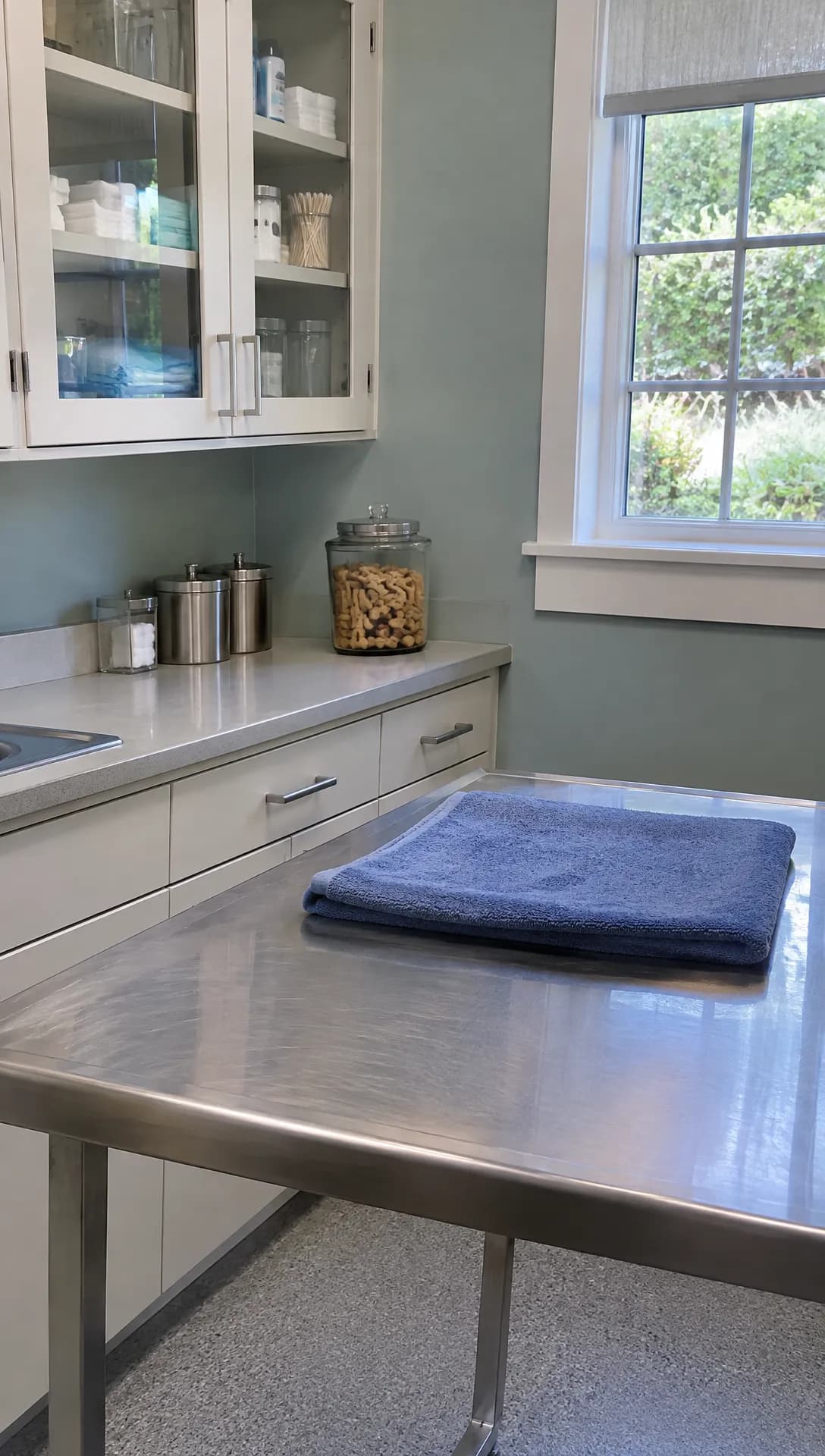
Made in Novoads with GPT Image 2.6 Sunburst · an empty clinic exam room framed like a phone photo, in place of the one you'd take of your own room · 1 credit · 2026-11-17
Which pieces each ad uses
- The new-client ad is the presenter reading the offer, the hours and the address, plus a clip of the front door.
- The meet-the-team ad is a clip from your real team photo, with captions naming each person.
- A patient story is one clip for each real photo of the patient, with captions carrying the client's own words.
- A pet-care tip is the presenter alone, with captions.
- The after-hours ad is the presenter reading the hours, the address and the phone number, plus a clip of the entrance.
What each ad costs on Starter, Plus and Ultra
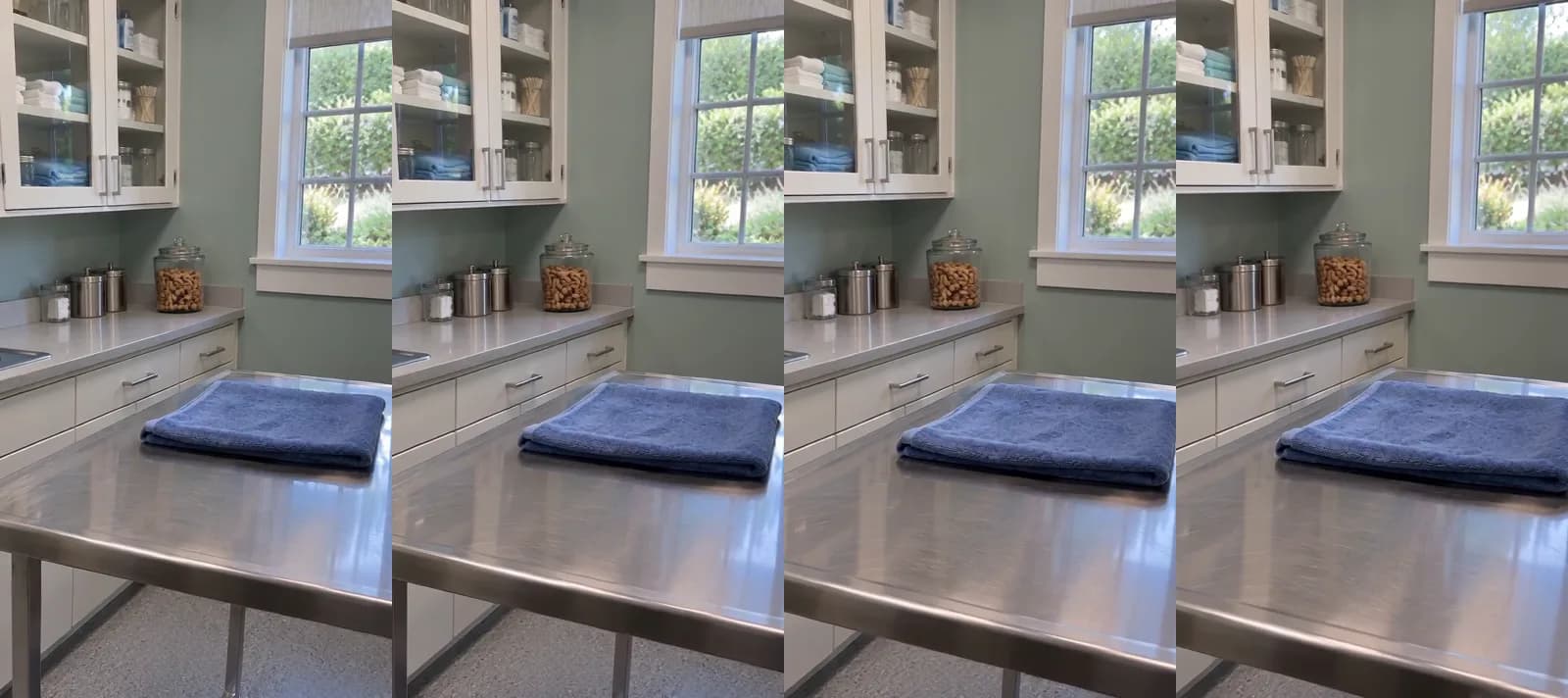
Made in Novoads with Seedance 2.0 Mini · the exam room still, the camera easing toward the table for 4 seconds at 480p, sound off, through our Claude connector · 2 credits · 2026-11-17
That clip was a cheap test of how the motion reads, so we kept it small at 480p. For a finished ad, we'd make it at 720p. At that resolution, a five-second Seedance 2.0 Mini clip costs 5 credits.
Prices as of November 17, 2026. Each plan includes a monthly allowance of credits, so a credit's price changes from plan to plan.
- Starter is $15 a month for 200 credits.
- Plus is $49 a month for 1,000 credits.
- Ultra 3,000 is $129 a month for 3,000 credits.
That puts a credit at 7.5 cents on Starter and 4.9 cents on Plus. On Ultra 3,000 it's 4.3 cents. In the table, each dollar amount is that per-credit price times the credits, rounded to the cent.
| What you make | Credits | Starter | Plus | Ultra 3,000 |
|---|---|---|---|---|
| AI presenter, up to a minute, 480p | 100 | $7.50 | $4.90 | $4.30 |
| AI presenter, up to a minute, 720p | 200 | $15.00 | $9.80 | $8.60 |
| Kling 3.0 clip, 5 seconds | 10 | 75 cents | 49 cents | 43 cents |
| Wan 3.0 clip, 5 seconds, 720p | 9 | 68 cents | 44 cents | 39 cents |
| Caption look, per started minute | 3 | 23 cents | 15 cents | 13 cents |
What one new-client ad costs on each plan
The new-client ad from the list above is a presenter at 480p plus a Kling 3.0 clip of the clinic's front door. Together they come to 110 credits.
- On Starter it's about $8.25. A month's credits cover one, with 90 to spare.
- On Plus it's about $5.39, and a month's credits cover nine.
- On Ultra 3,000 it's about $4.73, and a month's credits cover 27.
The after-hours ad costs the same as long as its script stays under a minute, because it's the same two pieces with different words.
What an agency charges
Vet Marketing by Signal, a marketing agency for veterinary clinics, lists its Accelerate package at $999 a month on its pricing page. We read that page on November 17, 2026. Of the plans on that page, it's the one that includes Google and Facebook ad campaign management. Its card adds that ad spend isn't included and recommends $500 or more.
That's a different job from ours. The agency's fee pays for managing the campaigns and the rest of its full-service marketing, while Novoads makes the video and you run it. It's still a useful number to set the per-ad prices against, because it's what one agency asks each month to take the whole job off a clinic's hands.
What the 110 credits leave out
Every price above assumes a single take per piece, and a second take costs the same credits again. Five things aren't in the sum.
- A separate voice-over.
- Joining the presenter and the clip into one video.
- Captions, if you add them.
- Your ad spend.
- The time you spend comparing every clip with your real photo.
Minnesota's rule on what a vet ad must include
Minnesota's veterinary board has a one-sentence rule on what an ad for veterinary services has to carry, and a separate one for emergency facilities. Neither turns up in the guides that rank for this search.
The address rule, in the board's words
Minnesota Rules, part 9100.0800, sets the Board of Veterinary Medicine's minimum standards of practice. Its subpart 10, headed Advertising, is a single sentence. "Print or electronic media advertisements offering professional veterinary services must include the corporation's, partnership's, and/or individual veterinarian's name and business address."
It's one of the standards Minnesota's board sets for veterinary practice in the state. If your clinic is somewhere else, look up your own state's veterinary rules, because this post covers only Minnesota's.
It isn't new. The board adopted these rules with modifications on March 1, 1993. They took effect a week later, on March 8, 1993. The line under the rule's text on the Revisor's page, "Published Electronically: October 2, 2007", only gives the date this text went online. The rule itself is older.
What the rule doesn't say
The rule says "print or electronic media" and stops there, which leaves three things open.
- It doesn't mention video or social media.
- Chapter 9100, which it's part of, defines neither "electronic media" nor "advertisement".
- It doesn't say where in the ad the name and address go, how large they appear or how long they stay on screen.
So applying it to a clinic's video ad on Facebook, Instagram, TikTok or YouTube is our own reading of its plain words. The rule itself doesn't say so.
Emergency and on-call ads
Subpart 5 of the same part covers emergency service, and its item B has a separate rule for ads. "Advertisements for emergency veterinary facilities must clearly state" three things.
- The hours the facility will provide emergency service.
- That a licensed veterinarian is on the premises during the posted emergency hours.
- The facility's address and telephone number.
Item C defines a veterinarian on call as one who isn't present at a veterinary facility but can respond within a reasonable time to requests for emergency veterinary services. Then it adds, "The facility's services are not to be considered or advertised as an emergency clinic or hospital."
What we'd do in a Minnesota clinic
This part is our own reading of the rules, so don't take it as the board's.
- We'd write the clinic's name and business address into the script of every presenter ad, so the presenter says them and the captions show them.
- We'd put the same name and address in the captions of any clip that has no presenter.
- If you run an emergency facility, we'd put all three of item B's points in the ad (the emergency hours, the licensed veterinarian on the premises during them, and the address and phone number).
- If your vet is on call instead, we'd say so plainly and wouldn't call the practice an emergency clinic or hospital anywhere in the ad.
None of this is legal advice. Read the rule on its own page, and ask Minnesota's board about your ad.
Make the new-client ad first
We'd start with the new-client ad. It's the one that brings people through the door, and all it needs is your offer, your hours, your name and address, and one photo of the entrance. The presenter can say the name and address in its first sentence.
You pay for Novoads from the first month on. The smallest plan is Starter, at $15 for 200 credits a month, and the prices page shows every plan side by side. One new-client ad, presenter and clip together, fits in a single Starter month.
Make your clinic's new-client ad
An AI presenter reading your offer, hours and address, plus a clip that starts on your own photo of the front door, comes to 110 credits.
See the plansTake a photo of your front door this week, and write a script that opens with the clinic's name and address, then the offer and the hours.
Frequently Asked Questions
Does a vet clinic's video ad have to include its address?
In Minnesota, the Board of Veterinary Medicine's rules say print or electronic media advertisements offering professional veterinary services must include the corporation's, partnership's, and/or individual veterinarian's name and business address (Minnesota Rules, part 9100.0800, subpart 10). The rule doesn't mention video, so applying it to a video ad is our reading of its plain words. It also doesn't say where in the ad the address goes. If your clinic is outside Minnesota, look up your own state's veterinary rules. This isn't legal advice.
Key Takeaways
- The video ads a clinic can run come down to new-client offers, team introductions, patient stories, short pet-care tips and after-hours ads.
- AI can supply the motion and the voice, from a clip that opens on the clinic's own photo to an AI presenter reading a script. It should never invent a patient, a recovery, a staff member or an exam room.
- An AI presenter reading the offer plus a short clip that opens on your clinic's own photo costs 110 credits in Novoads, or about $5.39 on Plus.
- Minnesota's veterinary board says print or electronic media ads offering professional veterinary services must include the corporation's, partnership's, and/or individual veterinarian's name and business address. That rule has been in effect since March 8, 1993.
- The same Minnesota rules say an emergency facility's ads must clearly state its emergency hours, that a licensed veterinarian is on the premises during them, and its address and phone number.