Mortgage Ads: Ideas for Loan Officers, What Each Costs With AI, and Regulation Z's Trigger Terms
Four mortgage ads a loan officer can make this week in Novoads with an AI presenter or a partner's listing photo, what each one costs in credits, and the extra Regulation Z disclosures a 30-year line in an ad brings with it.

Mauricio Valdivia
·11 min

Your rate video, read by a presenter who isn't you
Your rate sheet moved again this week, and it isn't the only reason to post. The agent you co-market with wants something for Saturday's open house. A past client asked whether pulling cash out for a new kitchen makes sense yet. A first-time buyer wants to know what pre-approval means before she calls anyone. Every one of those is an ad, and filming yourself for each one is the part that keeps slipping to next week.
The two strips further down show the first thing we'd try instead. We made them in July for our guide to AI actors and reused them here. We typed one loose line of text, typo and all, into Novoads' Create Actor window and got back three candidate faces of a made-up young woman at a street cafe. We saved the first face as an actor with a library voice, and she read a 5.8-second welcome line for Novoads, her lips moving with the words. She's an AI presenter, not a loan officer, and in the ads below the presenter's only job is to read a script you wrote about an offer you actually have.
We read the first results page for "mortgage ads" on November 18, 2026, plus the two articles on it we could open, Regulation Z on govinfo.gov and the CFPB's own pages, and we priced every step from Novoads' credit tables. We didn't make a new render for this post or put a mortgage script through the talking actor, and we didn't watch the lenders' TV spots on that page.
Four mortgage ads that fill a loan officer's month
Most of that results page is ads to look at (Pinterest boards of designs and national lenders' TV spots), and the rest is for the people who make them. MoreLoans4U, a co-marketing tool for loan officers and real estate agents, offers banner campaigns with names like "Spring" and "Low rates" that run on the agents' property websites. Main Street's tips for home loan campaigns (June 5, 2025), written for community banks and credit unions, build their email advice on rates and on buyers "keeping monthly mortgage payments as low as possible". We'd make four kinds of ads from that, each built from something you already have.
The rate or 30-year offer, read to camera
This is the weekly post, today's offer read out loud in a short vertical video for your page, your partners' pages and your email. You paste the script, pick a face and a voice, and get back a take of an AI presenter saying your words. When the rate sheet changes, you write a new script and make a new take. Our voice list covers 32 languages, so the same offer can go out in Spanish too. If it runs on TikTok, our TikTok ads guide covers launching it there, AI label included.
It never shows a rate you aren't offering that day, or a 30-year or monthly payment line without the APR and the repayment terms (the Regulation Z section says why). It never shows a closing, keys changing hands or a happy borrower that didn't happen, and the presenter is never introduced as you, your processor or a client.
A banner or clip beside an agent's listing
Co-marketing is where your ads meet an agent's listings, and MoreLoans4U's banners are one version of it. With AI, the ad is either a picture made from the listing's own photo or a few seconds of slow camera movement that start on that photo, with your offer beside it in text you control.
The photo isn't yours, so use it only once your partner says yes. The ad never shows a house, a room or a view that isn't the listing, or a logo, seal or badge your company doesn't own. Check every frame against the real photo before it goes up, because a generated frame can drift from what the photographer shot.
A cash-out offer to homeowners you've already closed
Past clients who've built equity since closing already know your name, and a cash-out refinance offer is a reason to get in touch. The presenter reads the offer with its terms and ends on how to reach you. If the cash is for a remodel, the remodeler is courting the same homeowner, and our contractor ads guide covers their side.
It never shows a real customer's remodel, a cash amount the viewer "will get", or anything made to look like it came from the viewer's current lender. A home equity line of credit falls under a different section of Regulation Z, which we cover below.
A one-step explainer on pre-approval
A short explainer that takes one step at a time (what pre-approval is, what a point is, what a rate lock does) answers what a first-time buyer wants to know before calling anyone, then ends on your calculator or your application link. The presenter reads your explanation, and you decide what it promises. It never shows a sample payment without its terms or tells a viewer they're pre-approved.
The brand story, which we'd leave to a camera
We'd keep one kind of mortgage ad away from AI (the brand story about a family moving in), because a generated family is a happy borrower who never existed. If you still want a polished spot, our AI commercials guide prices one out. We'd build it around your offer and your name, with nobody posing as a borrower.
Making each one in Novoads
You make the video or the picture in Novoads, then run it wherever your ads already run. If you've never made an AI ad, our guide to making AI ads starts from a blank prompt.
Casting the presenter
- In the editor, open Talking Actors and click Add actors.
- Pick a face under All actors or Official, or click Create Actor, choose Generate and describe the presenter in a line of text.
- Generate draws three faces with GPT Image 2.6 Sunburst at high quality, for 6 credits in all.
- Pick one face and give it a voice under Select Actor Voice.
 Made in Novoads with Nano Banana Pro · one loose text prompt for a presenter, three candidate faces back, made for our AI actors guide · 6 credits today · 2026-07-28
Our July run gave us three candidates for one brief, a young blonde woman at a street cafe, in a denim jacket, a white T-shirt or a white linen shirt. Nano Banana Pro drew those faces then, and today GPT Image 2.6 Sunburst does. For a rate offer, describe a plain background instead of a cafe, and keep anything that looks like a branch office or a lender's sign out of the prompt.
Writing the script and taking the read
- Type the offer into the box that reads "Write what the actor will say...". Write it the way it has to run, with the rate as an APR, the term and the repayment terms, the down payment where it applies and, if the rate can rise, the fact that it can.
- The price line reads "200 credits per started minute · per actor" at 720p, the default. Choose 480p on that line and it's 100.
- Send it with the round up-arrow button.
The take comes back with the voice and lip-sync done, and captions are a separate step. The Captions tool opens on the "TikTok, no box" look, one of six looks at 3 credits a started minute. Karaoke is another style there, at 0 credits. Put the APR and the repayment terms in the captions as well as the audio, and check every figure in them against your rate sheet.
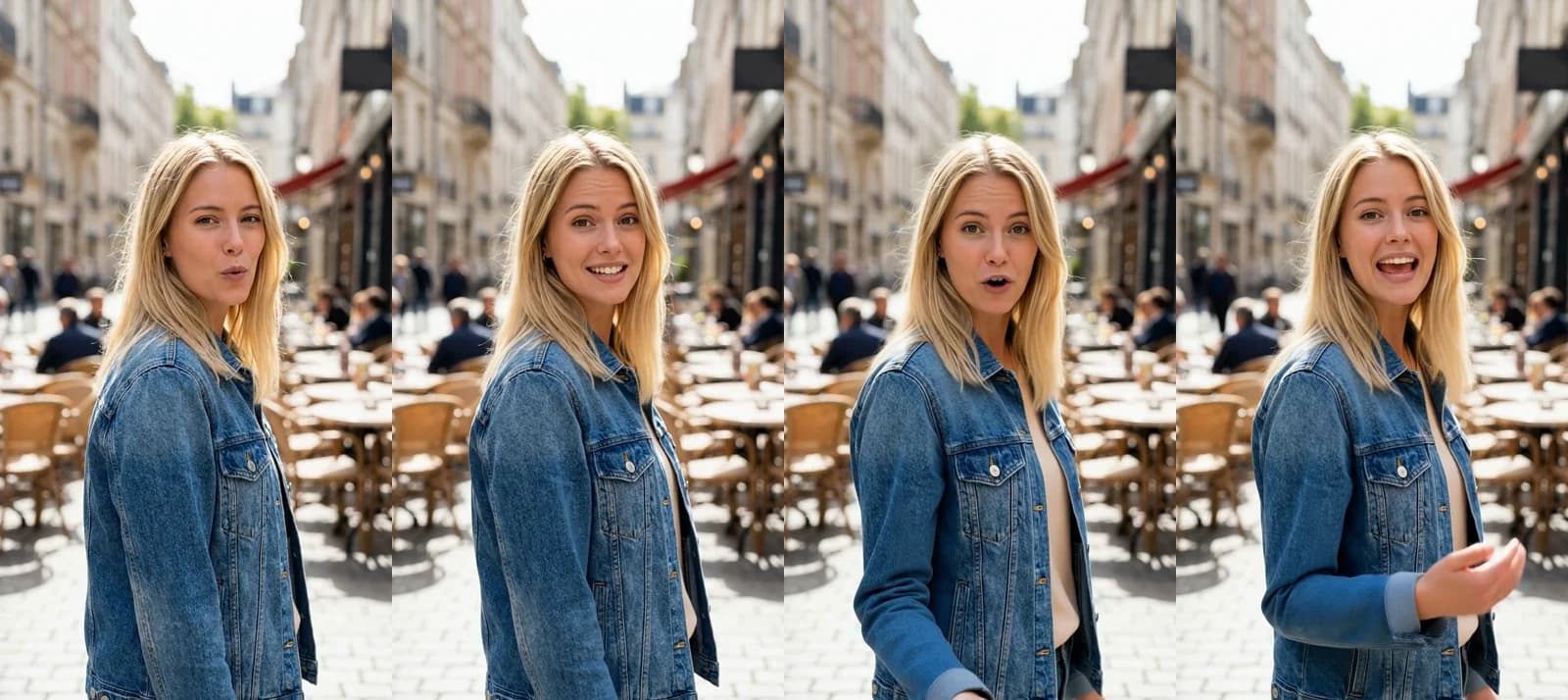 Made in Novoads with the Talking actor · the denim-jacket face with a library voice, reading a 5.8-second welcome line, made for our AI actors guide · 200 credits at 720p today · 2026-07-28
That's the denim-jacket face reading her welcome line, her mouth changing shape with the words across four frames. It's a line about Novoads, not a rate offer, so it shows what the tool makes and can't show how a mortgage script would come out.
Moving the partner's listing photo
- Open Video and pick Wan 3.0 from the model menu.
- Switch Reference to Start / End Frames and drop the listing photo in as the start frame. The editor then shows "The video starts on this picture."
- Describe only the camera move, such as a slow push toward the front door, with no people and nothing added to the house or the yard.
- Set 8 seconds at 720p (14 credits) and send it with the round up-arrow button.
Kling 3.0 is the other option for the same photo. You add the picture in a box that reads "Drop a start frame or click to upload", and a 5-second clip costs 10 credits. Our guide to product videos with AI goes deeper into turning one photo into a clip.
A banner from the Image tool
- Open Image, click Reference and upload the listing photo as a JPG, PNG or WebP file.
- Describe the banner in the prompt, with the photo as the scene, open space for your text, and no numbers or words drawn into the picture.
- Under Settings, pick GPT Image 2 (the tool opens on Nano Banana Pro) and switch the quality from High to Medium.
- Pick 16:9 or 1:1. A run makes three pictures for 3 credits at Medium.
We'd keep the rate, the APR and every other number out of the generated image and set them as text you control, so no model draws a figure nobody checked.
What a month of mortgage ads costs in credits
Prices as of November 18, 2026. The credits come from Novoads' own price tables. The dollars are our own math, using each plan's cost per credit (shown with the plan's name), and every plan is on our pricing page.
The credits behind each ad
| What you make | Credits | Starter, $0.075 a credit | Plus, $0.049 a credit | Ultra 3,000, $0.043 a credit |
|---|---|---|---|---|
| Rate video, up to 60 s, 480p | 100 | $7.50 | $4.90 | $4.30 |
| The same take at 720p | 200 | $15.00 | $9.80 | $8.60 |
| Captions, one look, a started minute | 3 | about 23 cents | about 15 cents | about 13 cents |
| Three new presenter faces | 6 | 45 cents | about 29 cents | about 26 cents |
| Listing clip, Wan 3.0, 8 s, 720p | 14 | $1.05 | about 69 cents | about 60 cents |
| Listing clip, Kling 3.0, 5 s | 10 | 75 cents | 49 cents | 43 cents |
| Banner, three GPT Image 2 pictures | 3 | about 23 cents | about 15 cents | about 13 cents |
A talking actor is billed by the started minute, so a take of a few seconds costs the same as a full minute. We'd write one script that covers the rate, the term and the APR at a natural pace, and we wouldn't cut anything for length.
One week's set, priced on each plan
The set we'd start with is one rate video at 480p and two 8-second listing clips from a partner's photo. That's 128 credits, about $6.27 at the Plus rate. Captions in one of the caption looks bring it to 131.
| Plan | Credits a month | Sets of 131 credits | Credits left over | One set at the plan's rate |
|---|---|---|---|---|
| Starter | 200 | 1 | 69 | about $9.83 |
| Plus | 1,000 | 7 | 83 | about $6.42 |
| Ultra 3,000 | 3,000 | 22 | 118 | about $5.63 |
Those totals leave out a second take when the first one misses, which you pay for again, and a voice-over or putting the clips together into one ad, which our price tables don't list. The ad spend is yours on top.
What a production company quotes for a filmed minute
Web Tonic's guide to mortgage video production companies is dated August 12, 2026, and it puts the "cost per finished minute" at "roughly one to three thousand dollars for talking-head or interview work". Web Tonic makes mortgage videos itself and lists itself in that guide, so we read the range as one vendor's figure for a different job (filming a real person). When your borrowers need to see you on camera, you'll want that filmed minute.
The Regulation Z rule the top results skip
Neither of the two articles we could open on that results page names the terms that trigger Regulation Z's extra disclosures in an ad, though Main Street's email advice is built on rates and monthly payments, and the rule speaks to both. The rule text here is from the January 1, 2026 edition of the Code of Federal Regulations on govinfo.gov. The CFPB's own copy was marked as the current regulation when we read it on November 18, 2026. What follows is our reading of the rule's words, and it isn't legal advice.
What a 30-year line brings with it
Section 1026.24(d) of Regulation Z lists terms that, once they appear in an ad, call for more terms. One of them is "The number of payments or period of repayment." The CFPB's official interpretation gives "30-year mortgage" as an example. An ad that states a triggering term "shall state the following terms, as applicable".
- "The amount or percentage of the downpayment."
- "The terms of repayment, which reflect the repayment obligations over the full term of the loan, including any balloon payment."
- The "annual percentage rate," using that term, and, if the rate may be increased after consummation, that fact.
The same list of triggers names "The amount of any payment." The CFPB's examples of one include "$500,000 loan for just $1,650 per month."
Who the rule binds, and which mortgage ads
- The CFPB's commentary on section 1026.2 says "All persons must comply with the advertising provisions in §§ 1026.16 and 1026.24, not just those that meet the definition of creditor". In our reading, that covers a loan officer's or a broker's own ad as well as the lender's.
- "Advertisement means a commercial message in any medium that promotes, directly or indirectly, a credit transaction." The CFPB's commentary lists "Electronic advertisements, such as on the Internet." among its examples. In our reading of the definition, "any medium" includes a social video, and an AI presenter reading your rate as well.
- Section 1026.3 exempts credit "primarily for a business, commercial or agricultural purpose", so a business-purpose loan's ad falls outside it.
- Section 1026.24 is in Regulation Z's part on closed-end credit. A home equity line of credit is open-end, and its ads follow section 1026.16, which has "Additional requirements for home-equity plans" of its own.
The down payment, the APR and the broadcast shortcut
"As applicable" carries weight in that list. The CFPB's interpretation says that, because of how Regulation Z defines a down payment, "this triggering term is limited to credit sale transactions". That definition describes an amount "paid to a seller to reduce the cash price of goods or services purchased in a credit sale transaction". So we wouldn't read the rule as putting a down payment in every mortgage ad.
The CFPB also says the advertised annual percentage rate "may be expressed using the abbreviation" APR, and if the rate may rise after consummation, the ad has to say so. And the rule lets an ad use "an example of one or more typical extensions of credit", which the CFPB says "must be labeled as such and must reflect representative credit terms made available by the creditor".
A rate stated by itself is covered too. Section 1026.24(c) says an ad that states a rate of finance charge "shall state the rate as an" annual percentage rate. In an ad for credit secured by a dwelling, the only other rate allowed is a simple annual rate on the unpaid balance, shown with the APR and no more conspicuously.
Television and radio get a shortcut. Section 1026.24(g) lets "An advertisement made through television or radio" give the APR, note that the rate may rise if it can, and list a toll-free number for more cost information instead of every term. It names only television and radio, so we wouldn't count on it for a social video. The section also has a paragraph on rates and payments in ads for credit secured by a dwelling, so read all of it on govinfo.gov before a rate ad runs.
What this means for a rate video read by an AI presenter
In our reading, none of this changes just because an AI reads the script. The presenter says what you wrote, so a script that says 30-year or names a monthly payment needs the APR (called an APR), the repayment terms, the down payment where it applies and, if the rate can rise, that fact. Put the same words in the captions, and have whoever reviews your ads read the script before you send it.
Where we'd start next week
Write next week's rate offer as the script you'd want read aloud, with the APR and repayment terms written into it, and make that one take before anything else. Then ask your agent partner for one listing photo and permission to use it.
Novoads turns your script into a take from a talking AI presenter and your partner's photo into a moving clip or a banner. It's all priced by the credit and paid from the first month. Novoads starts at $15 a month (Starter, 200 credits a month), with Plus and Ultra on the pricing page for more volume.
Price this week's rate video
See what one AI presenter take and two listing clips cost on each Novoads plan.
Compare the plansFrequently Asked Questions
Will mortgage brokers be replaced by AI?
We don't think so. In the ads this post makes with AI, the AI reads a script the broker wrote or turns a photo the broker was allowed to use into a banner or a moving clip. The offer, the rate sheet and the borrower all stay with the broker. And Regulation Z's advertising rules bind whoever advertises the credit, so a person still answers for what every ad says.
Does a mortgage ad that says 30-year need the APR?
Under 12 CFR 1026.24(d), the number of payments or period of repayment is a triggering term, and the CFPB's official interpretation gives "30-year mortgage" as an example. An ad for consumer closed-end mortgage credit that states one must also state, as applicable, the down payment, the terms of repayment and the annual percentage rate. If the rate can rise after consummation, the ad has to say so too. This isn't legal advice, so read the section on govinfo.gov before the ad runs.
Can a social video use the television and radio shortcut?
We wouldn't count on it for a social or online video. Section 1026.24(g) lets an ad made through television or radio meet the rule by stating the APR, noting that the rate may rise if it can, and listing a toll-free number consumers can call for more cost information. But the section names only television and radio.
What does a mortgage video ad cost to make with AI?
In Novoads, a talking AI presenter reading your script costs 100 credits at 480p, and that covers anything up to a minute. Two 8-second Wan 3.0 clips from a partner's listing photo add 28 credits. That brings the set to 128 credits, about $6.27 at the Plus rate.
Key Takeaways
- The four mortgage ads we'd make first are a rate offer read to camera, a banner or clip beside a partner's listing, a cash-out offer to past clients and a one-step explainer on pre-approval.
- In Novoads, a talking AI presenter reading your script costs 100 credits at 480p, which covers anything up to a minute. A Wan 3.0 clip that starts on a partner's listing photo costs 14 credits for 8 seconds.
- Under 12 CFR 1026.24(d), an ad for consumer closed-end mortgage credit that states a repayment period (the CFPB gives "30-year mortgage" as an example) must also state the down payment, the terms of repayment and the APR, as applicable.
- The CFPB says anyone who advertises the credit must comply, whether or not they're the lender. The shortcut of giving an APR plus a toll-free number is written for television and radio only.
- An AI presenter reads the loan officer's script and is never shown as the loan officer, a borrower or a client. No clip shows a rate, a closing or a house that isn't real.