Brand Video Examples: 7 Types Brands Use, and How to Make One With AI
The seven brand-video types that cover almost every need, with an example of each and how to produce them with AI in minutes instead of a production week.

Mauricio Valdivia
·11 min

Great Brand Videos No Longer Start With a Camera
A skincare brand shoots nothing this quarter. It still publishes nine brand videos: a founder telling the origin story, three product explainers, four customer testimonials, and a launch teaser for a new serum. Each one looks like it was filmed on a phone in someone's bathroom. None of them was.
That is the shift worth understanding before you brief another production. A brand video is any short video a company makes to sell a product, explain what it does, or build recognition, and it is the single most reused asset in modern marketing. It runs as an ad on Meta and TikTok, as a hero clip on a homepage, and as an autoplay loop on a product page. For most of its history it also required a camera, a crew, and a calendar. That last part is what changed.
The formats themselves did not. Brand video comes in a small, repeatable set of shapes, and the constraints around them are published, not guessed. Meta lists per-placement video specs in its Ads Guide, so the aspect ratio and length of every example below were decided by where the video runs, not by taste. This guide walks through the seven brand-video examples that cover almost every need, then shows how to produce them with AI in minutes instead of weeks.
What Counts as a Brand Video
"Brand video" is a loose phrase, so it helps to draw the edges before listing examples.
Brand video, product video, and performance ad
The three overlap, but they answer different questions. A brand video builds recognition and feeling. A product video explains what the thing does and how it works. A performance ad, the format behind most ecommerce video ads, exists to earn a click or a sale right now. In practice one script often does two jobs at once, which is why the categories blur.
| Goal | Where it runs | Feel | |
|---|---|---|---|
| Brand story | Build recognition | YouTube, site, socials | Emotional |
| Product video | Explain the product | Product page, ads | Practical |
| Performance ad | Earn a click or sale | Meta, TikTok feeds | Direct |
The useful part is not the taxonomy. It is that most "brand videos" people actually need are short, vertical, and built to run in a feed, which is exactly the kind AI produces well.
The format is set by the placement, not by taste
Where a video runs dictates its shape. Meta's Ads Guide specifies vertical 9:16 video for Reels and Stories and favors 4:5 in the Feed, with durations that stretch from a few seconds to minutes depending on placement. TikTok and YouTube Shorts want the same tall frame. This matters because a brand video built in the wrong ratio gets cropped, letterboxed, or rejected, and the fastest way to waste a shoot is to film horizontal footage for a vertical world. Our Facebook video ad examples breakdown shows what each placement looks like in practice.
Why the shape matters more than the budget
Here is the unhedged version. For most brands, the production value of a single video matters far less than having enough videos to find the one that works. A polished sixty-second film that nobody watches past second three is worth less than a plain phone-style clip with a hook that lands. Once you accept that, the economics of brand video flip, and the seven examples below stop being creative decisions and start being a checklist.
Brand Videos That Tell Your Story
The first group exists to make people feel something about the company, not to move a unit today.
The brand story or manifesto
This is the origin film: why the company exists, what it believes, who it is for. Think a founder explaining the problem that would not leave them alone, or a montage of the product in real lives set to a voiceover. It rarely converts on its own, but it anchors everything else and gives your other videos a reason to be trusted. Keep it under a minute for social and save the two-minute cut for the homepage.
The founder and behind-the-scenes
People buy from people, and a founder talking straight to camera is the cheapest trust you can manufacture. Behind-the-scenes footage (the workshop, the packing table, the lab) does the same job by showing the work is real. These read as branded content, not as ads, which is exactly why they slip past the reflex to scroll. The angle matters more than the polish: a plain clip of the founder answering the one question customers always ask beats a glossy sizzle reel.
Behind-the-scenes has more angles than most brands use:
- The making-of. How the product is actually built or sourced.
- The founder answer. The one objection they hear most, addressed on camera.
- The team. Real people who stand behind the thing, in their real setting.
None of these needs a script polished past a first draft, which is exactly the point.
Brand Videos That Show Your Product
The second group has one job: make someone understand, and want, the thing you sell.
The product explainer or demo
The workhorse. Show the product solving the exact problem it is sold against, in the first five seconds, with the result up front. A demo does not need narration-grade production; it needs to be legible on a muted phone screen. This is the format most brands underproduce, because filming ten variations of a demo used to mean ten setups. It no longer does.
A demo that earns the watch usually shows three things:
- The problem, in the first frame. The before state the viewer already recognizes.
- The product doing its single most convincing job. Not every feature, the one that sells.
- The result, held long enough to register. The after, on screen for more than a beat.
Miss any of the three and you have a product shot, not a demo.
The how-to or educational clip
A step-by-step that teaches something adjacent to your product ("three ways to layer this serum") earns attention by being useful before it sells. It positions the brand as the expert and gives the algorithm a reason to keep serving it. These stack well: one product supports a dozen how-tos, each a separate brand video.
The launch or announcement
Short, punchy, built around a single new thing: a product drop, a feature, a collaboration, a sale. The launch video's only job is to make the new thing feel like an event. Because it is time-bound, it is the format where testing several hooks fast pays off most, since you only get one launch window to find the message that travels.
A launch clip has to answer three questions fast:
- What is new? Named in the first line.
- Why now? The reason the viewer should care today.
- What next? One clear step, not three.
Get those into the first fifteen seconds and the rest is style.
Brand Videos That Borrow Other People's Trust
The third group works because the message appears to come from someone other than the brand.
The customer testimonial
A real-seeming person explaining what changed for them is the most persuasive thirty seconds in marketing, because a brand praising itself is discounted on arrival and a peer is not. Testimonials carry the trust signal that brand-authored copy cannot buy. The catch has always been supply: you cannot summon a filmed testimonial for every angle, region, and product on demand. That constraint is the one AI removes most cleanly.
One product can carry a whole shelf of testimonials, each aimed at a different buyer:
- The skeptic's version. "I did not think this would work, and then it did."
- The specific-result version. One measurable change, named plainly.
- The switcher's version. Why they left the thing they used before.
Same product, three reasons to believe, and none of them needs a separate casting call.
The UGC-style creator ad
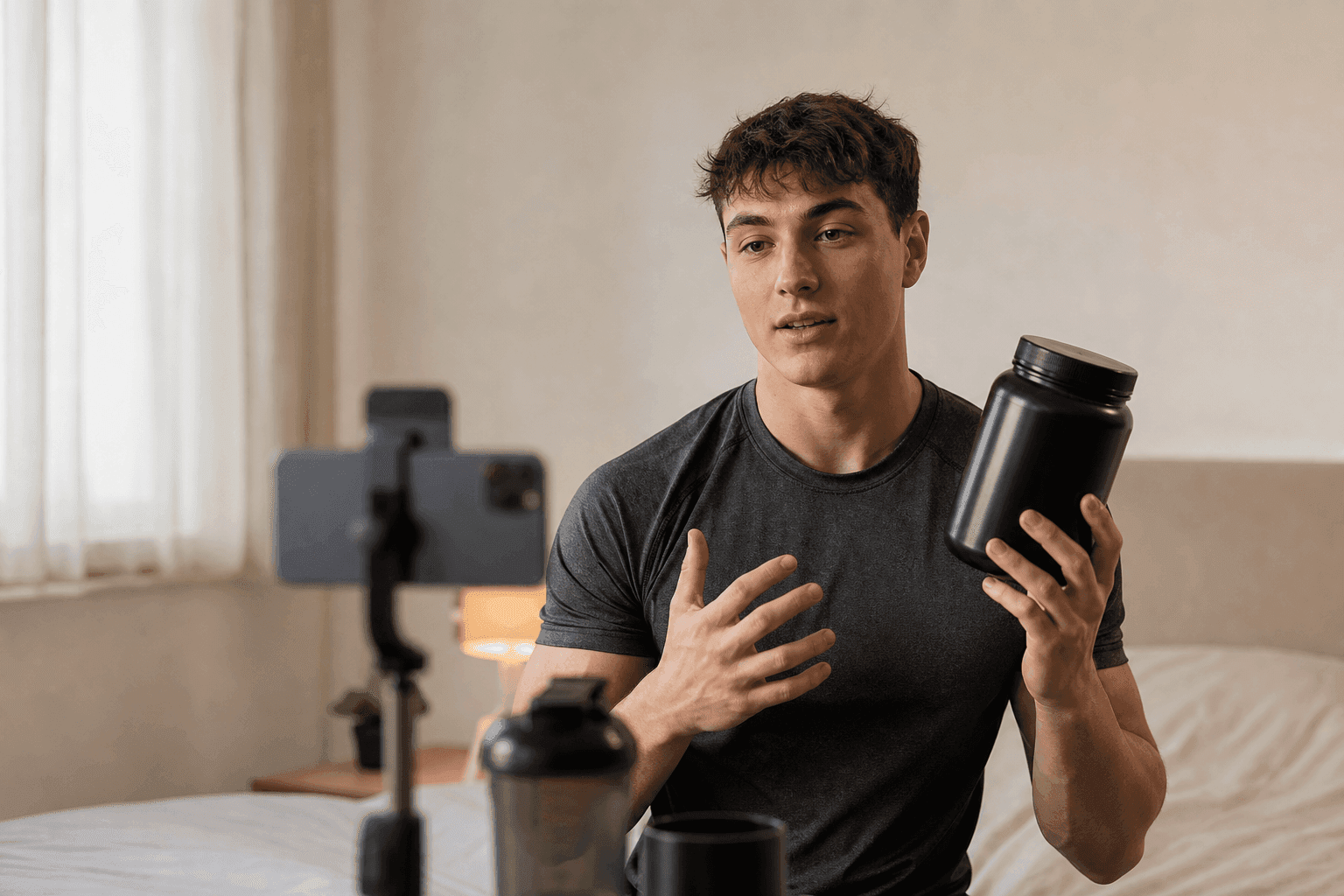
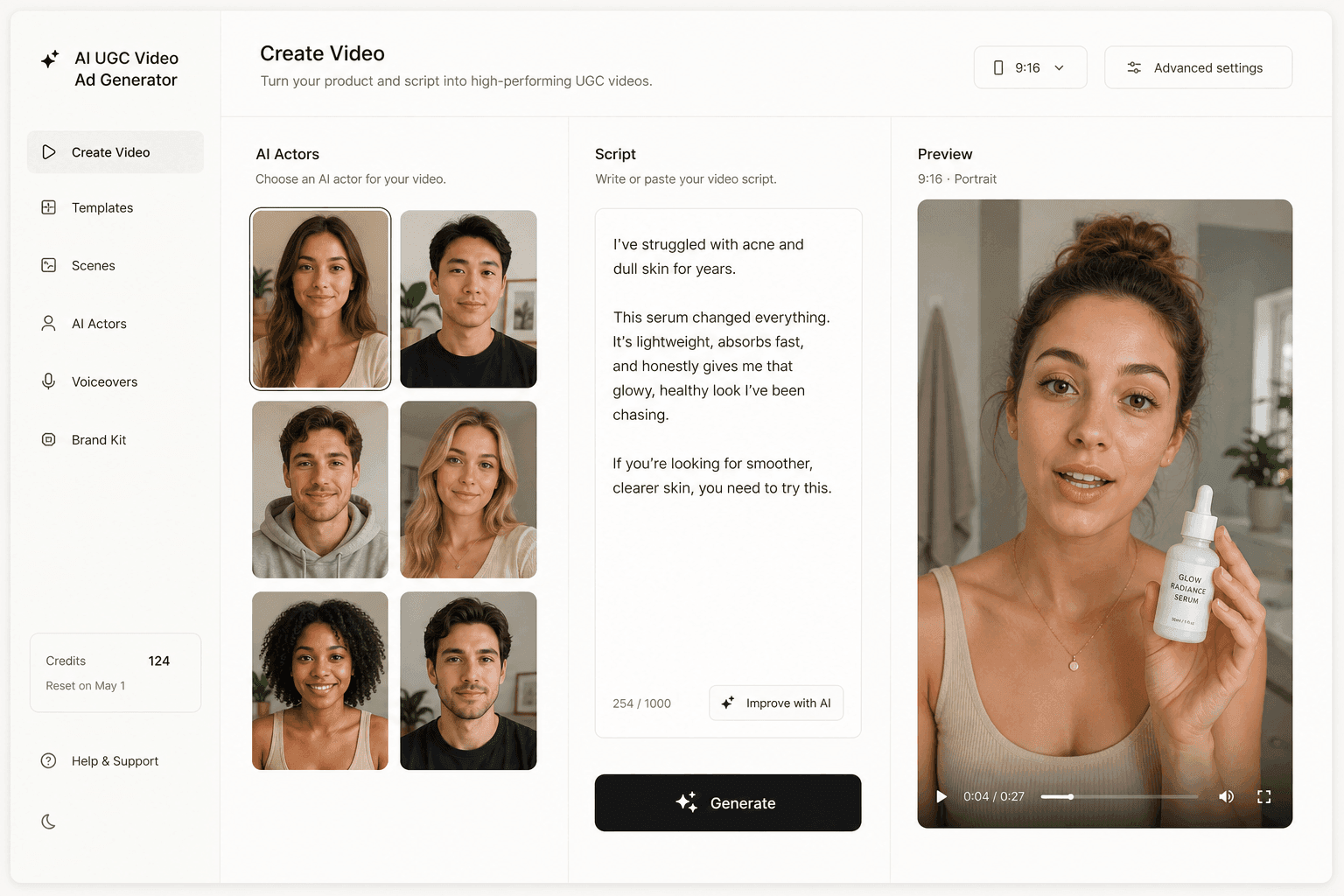
The dominant format on TikTok and Reels is a creator talking to camera, holding the product, sounding like a friend rather than a spokesperson. It is UGC-style advertising, and it wins because it does not look like advertising. This is also the example where volume is everything. The winning creator, hook, and accent are unpredictable, so you run many and let the data pick. Doing that with human creators means a brief and an invoice per clip; doing it with AI means a script and a few dollars.
Under the casual surface, a UGC-style ad is a small, learnable formula:
- A hook in the first line, before the product is even named.
- A real-sounding voice, casual and specific, not a script being read.
- The product in hand, used the way an actual customer would.
- A reason to act now, folded into the last two seconds.
Change one variable at a time across variations, and you learn which lever actually moves the result.
A Worked Example: One Product, Five Brand Videos
Take a single product, a vitamin-C serum, and see what "brand video at volume" actually means.
Instead of booking one shoot for one hero video, you produce five brand videos in an afternoon, each a different angle on the same product:
- Founder story. Thirty seconds on why you formulated it.
- Product demo. The dropper, the texture, the before and after.
- Testimonial. A customer persona describing the change in her skin.
- How-to. "Where vitamin C fits in a morning routine."
- UGC-style ad. A creator holding the bottle, first line a hook.
Each clip is a script plus an AI actor, generated at vertical 9:16 for the feed. A single short clip runs from about a dollar on the cheapest engine (a five-second Seedance 2.0 Mini clip) to about $8 for an eight-second Seedance 2.5 clip, so all five cost roughly $5 to $40 and take an afternoon, not a production week, which is what makes AI brand videos work on a small team's budget. Now compare: the same five as a shoot mean a crew, a location, five setups, and a turnaround measured in weeks. The point is not that the AI version is cheaper per video. It is that five angles for the price of a lunch lets you test, which is the whole game. Our guide to creating ads with AI runs the full comparison.
Reading the result is the easy part. You launch all five, let each gather enough impressions to matter, and keep the one that beats your cost-per-result benchmark. The other four were not waste; they were the price of finding the winner, and that price just fell by two orders of magnitude. Next month you take the winning angle and test five variations of it, which is how a testing program compounds instead of starting over.
How to Make a Brand Video With AI
The workflow is short, and it is the same regardless of which of the seven examples you are after.
Start from a product image or a script
There are two entry points. Upload a photo of your product and let the tool build the ad creative around it, or write (or auto-generate) a short script and skip straight to an actor. There is no product-URL import and no plugin to install; the inputs are an image and words. If you are turning a still catalog into motion, the product-video flow is the place to start.
Pick an actor and a format that matches the placement
Choose an AI actor whose age, gender, and accent match the audience you are targeting, then set the aspect ratio to the placement. Vertical 9:16 for Reels, Stories, TikTok, and Shorts; 1:1 or 4:5 for the Feed; 16:9 when it lives on YouTube or a landing page. Matching the ratio to Meta's published spec up front is what keeps the render out of the cropped-and-rejected pile. The actor speaks your script with voice, lip-sync, and captions, in any of dozens of languages.
Generate variations, not one hero
This is the step brands skip and the reason most of them underperform. Do not generate one perfect brand video. Generate the same angle with two actors, or two hooks, or two accents, launch them as a test, kill the losers, and put budget behind the winner. Because each variation costs a few dollars and lands in about four minutes, the AI commercial workflow makes the volume the format was always built for finally affordable. Realism is not the differentiator here: an AI clip is as believable as any tool renting the same frontier engines. Throughput is.
Know when it came out right
A brand video is working before you spend a cent on distribution if it clears a short bar:
- The first three seconds make sense with the sound off.
- A stranger can say what the product is after a single watch.
- The hook is a specific claim or moment, not a logo card.
- It is the right ratio for the placement, so nothing important sits in the cropped zone.
If a variation misses two of these, it is a redraft, not a media-budget problem. The advantage of generating is that a redraft is another four minutes, not another shoot day.
Where AI Brand Videos Fall Short, and Where They Win
An honest read, because pretending AI covers everything is how you ship the wrong thing.
Book a shoot when:
- A specific real person is the message: a named founder, a partner, a real customer whose face is the point.
- You need a flagship brand film where craft itself signals quality, like a luxury launch or a hero homepage film.
- The product must be handled in a way a generated actor cannot yet convincingly perform.
Generate with AI when:
- You need many variations of the same idea to find what works.
- You are producing the recurring feed content that never stops: demos, testimonials, how-tos, launches.
- Speed and cost per test matter more than a single perfect frame.
Most brands need far more of the second than they admit. One hero film does not make a content program; thirty cheap, on-brand variations do. If your brand-video budget is going to a handful of expensive clips a quarter, you are paying production prices for a job that is mostly about volume. That is the exact mismatch AI was built to close, and it is why social-video production is moving from the shoot to the screen.
How Novoads Turns One Product Into a Shelf of Brand Videos
Novoads produces UGC-style brand videos from a script or a product image. Pick an AI actor, generate a vertical clip with voice, lip-sync, and captions, and download it ready for Meta, TikTok, YouTube, or a product page. The same product supports the whole set (founder story, demo, testimonial, how-to, launch, and creator ad) because each is just a new script against the same catalog. You can test a brand video for $49/month. Cancel anytime.
Brand Video Is a Testing Problem, Not a Production Problem
For most of its history, the hard part of brand video was making it: the crew, the calendar, the invoice per clip. That is why brands shot one or two precious videos and hoped. The examples never changed. The story, the demo, the testimonial, and the creator ad have been the winning shapes for years. What stayed out of reach was producing enough of them to find the winner.
That is the constraint AI removes. When a brand video costs a few dollars and lands in minutes, the question stops being "what is our one video this quarter" and becomes "how many angles can we test this week." The brands that internalize that will not have better cameras. They will simply never run out of creative to try.
Frequently Asked Questions
What is a brand video?
A brand video is any short video a company makes to sell a product, explain what it does, or build recognition. It runs as an ad on Meta and TikTok, as a hero clip on a homepage, and as an autoplay loop on a product page. The point is not the production value; it is that the video carries the brand's message in the format people actually watch, which today is short and vertical.
What are the main types of brand videos?
Seven types cover almost every need: the brand story or manifesto, the founder or behind-the-scenes clip, the product explainer or demo, the how-to or educational clip, the launch or announcement, the customer testimonial, and the UGC-style creator ad. Most brands need a steady supply of the last five and only occasional versions of the first two.
What is the difference between a brand video and a product video?
A brand video builds recognition and feeling for the company; a product video explains what a specific product does and how it works. They overlap constantly, and one script often does both jobs, but the intent differs: brand video is about who you are, product video is about what the thing does. A performance ad is a third cousin whose only job is to earn a click or a sale right now.
Can you make a brand video with AI?
Yes, for most of the common types. AI video tools let you upload a product image or write a short script, pick an AI actor that matches your audience, and produce a vertical brand video with voice, lip-sync, and captions in minutes. It is best suited to the recurring feed content (demos, testimonials, how-tos, launches, creator-style ads) where you need many variations, and less suited to a flagship film where a specific real person is the whole message.
How much does it cost to make a brand video with AI?
A single AI-generated clip runs from about a dollar for a five-second Seedance 2.0 Mini clip to about $8 for an eight-second Seedance 2.5 clip, and about $26 for a full 30-second Seedance 2.5 take, so producing five short variations of one product costs about $5 to $40 total and takes an afternoon. Compare that to a traditional shoot, which means a crew, a location, and a turnaround measured in weeks. The saving is real, but the bigger change is that testing many angles finally becomes affordable.
What length and format should a brand video be?
It depends on where it runs. Meta's Ads Guide specifies per-placement video specs: vertical 9:16 for Reels and Stories, 4:5 in the Feed, and durations that range from a few seconds to minutes. TikTok and YouTube Shorts want the same tall frame; a homepage or YouTube upload can use 16:9. Matching the aspect ratio to the placement up front is what keeps a video from being cropped, letterboxed, or rejected.
Key Takeaways
- A brand video is any short video a company makes to sell, explain, or build recognition, and it comes in a small set of recognizable shapes rather than one custom production every time.
- Seven types cover almost every need: the brand story, the founder or behind-the-scenes clip, the product explainer, the how-to, the launch, the customer testimonial, and the UGC-style creator ad.
- The format is set by the placement, not by taste: Meta's Ads Guide specifies per-placement video specs, favoring vertical 9:16 for Reels and Stories and 4:5 in the Feed.
- AI now produces most of these from a script or a product image in minutes for a few dollars, which turns brand video from a production problem into a testing problem.
- Book a shoot for the one flagship where a specific real face is the message; generate the rest so you can run many variations cheaply and let the data pick the winner.